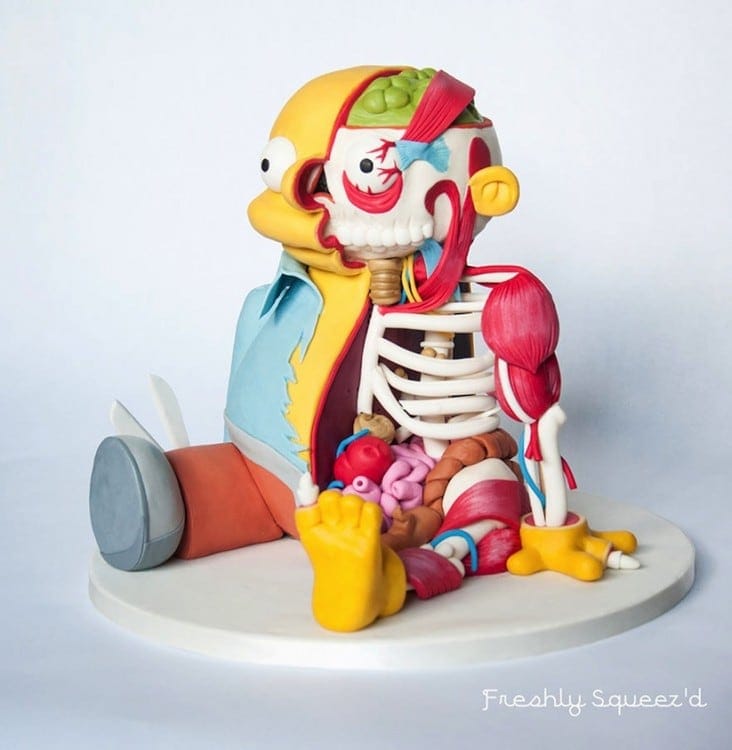
Kylie Mangles is a New Zealand artist and cake maker known for sculptural cakes that blur the line between confection and prop, often using fondant, piping, food colouring, and carved sponge to build unsettlingly literal forms. The work gained attention through Cutout Ralph, a cake based on Ralph Wiggum from The Simpsons that turned a cartoon figure into something oddly creepy and materially convincing.
| Field | Detail |
|---|---|
| Occupation | Artist, cake maker |
| Known for | Sculptural novelty cakes with a strong visual concept |
| Materials | Sponge, buttercream, fondant, icing, food colouring |
| Notable work | Cutout Ralph |
| Public profile | Shared through visual culture and design coverage rather than a large commercial studio brand |
What kind of maker is Kylie Mangles?
Kylie Mangles works at the meeting point of cake decorating, sculpture, and character design. The cakes associated with her name are not conventional celebration cakes with neat borders and sugar flowers. They are built to carry a concept first, using edible materials to mimic cartoon bodies, faces, and textures with an emphasis on shape and mood.
That approach places her closer to a visual artist who happens to work in cake than to a standard bakery decorator. The result depends on construction as much as finish: carved cake layers create the bulk, then icing, fondant, and painted details sharpen the illusion.
Why did Cutout Ralph get attention?
Cutout Ralph worked because it took a familiar animated character and translated him into a physical object with awkward presence. Ralph Wiggum is usually soft, flat, and comic in the context of television. As a cake, the figure becomes heavier, stranger, and more vulnerable, which changes how the image reads.
The creepiness comes from that shift in material. Food normally signals pleasure, celebration, and softness; a cake that looks like a cutout cartoon body pushes against those expectations. The joke is visual, but the effect depends on technique: careful carving, colour matching, and a finish that preserves the slightly wrong, handmade look.
How are sculptural cakes like this made?
Work of this kind usually starts with structure. Bakers carve sponge into blocks or silhouettes, then stabilize the shape with buttercream, ganache, or internal supports. Once the form holds, fondant can wrap the surface like skin, while modelling paste, piping, and paint supply features that read from a distance.
The success of the piece depends on control over proportion and surface. Too much polish can flatten the concept; too little and the reference disappears. In a work like Cutout Ralph, the point is not realism in the strict sense, but a deliberate, edible imitation that keeps the cartoon logic visible while making it physically present.
Why do these cakes matter in visual culture?
Kylie Mangles sits within a broader shift in how people view cake decoration: not as a supplementary craft, but as a medium for image-making. Social platforms have made unusual cakes highly visible, and audiences now read them as design objects, not just desserts. That visibility rewards risk, wit, and technical bravado.
Her work matters because it shows how food can carry character, narrative, and unease at once. It also reflects the appeal of handmade image objects that are temporary by nature. A cake like this exists to be photographed, cut, and consumed, which makes its craft both performative and fleeting.
Frequently Asked Questions
Is Kylie Mangles a baker or an artist?
She is best understood as both. The work uses the tools of baking, but the results are composed like visual art: concept-driven, image-led, and highly attentive to form. That overlap is part of what makes the cakes memorable.
What materials are used in her cakes?
Typical sculptural cake materials include sponge cake, buttercream or ganache for structure, fondant for a smooth outer layer, and food colouring or edible paint for detail. Depending on the design, internal supports may also be needed to hold unusual shapes. The visible finish often matters as much as flavour.
Why does a creepy cake feel different from an ordinary novelty cake?
An ordinary novelty cake usually aims for charm or humour. A creepy cake uses the same edible materials but introduces visual friction: odd proportions, flattened expressions, or lifelike details that feel out of place on a dessert. That tension gives the piece its power and makes it linger in memory.
Articles mentioning Kylie Mangles