
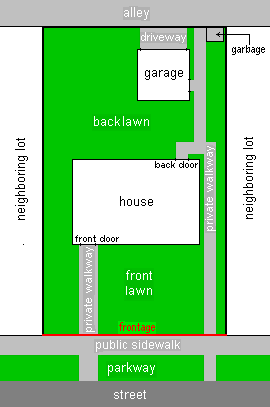
A land lot is a defined parcel of land treated as a unit for ownership, sale, taxation, planning, or development. It can be a small urban plot for a house, a vacant site held for future construction, or a larger tract divided into lots by survey and legal description. The term matters because land rarely changes hands as an abstract area; it moves through records, boundaries, and rights attached to a specific piece of ground.
- A land lot is a legally defined portion of land, not just a visual patch on the ground.
- It may be owned by a person, a company, a trust, a government body, or several owners together.
- Surveying and cadastral mapping establish its boundaries and official description.
- The lot can carry different rights and restrictions, including zoning, easements, and title conditions.
- In many places, fee simple is the most complete form of private ownership attached to a lot.
What makes a land lot a lot?
A land lot exists because law and surveying draw a boundary around part of the earth and treat it as a discrete property. That boundary may be shown on a plat, deed, cadastral map, or title register. The physical ground may look continuous, but the lot turns it into a unit that can be transferred, inherited, mortgaged, or regulated.
This is why lot size alone does not define it. Two plots of equal area can differ greatly in value and use depending on access to roads, water, utilities, and planning rules. The lot is both a piece of land and a bundle of rights attached to that land.
How do lots get created?
Lots usually come from subdivision, when a larger tract is broken into smaller parcels for sale or development. Surveyors measure the land and mark boundaries, while planners and local authorities may approve the layout. Older lots can also survive from historic property divisions, especially in cities where boundaries have shifted many times over centuries.
Once created, a lot becomes part of a public and private record system. Deeds describe it, tax authorities assess it, and title searches trace who has owned it and what claims or restrictions affect it. In practice, the paperwork often matters as much as the soil, because a lot is only as clear as the records that define it.
Why lots matter in property and design
Lots shape what can be built, where buildings sit, how streets line up, and how dense a neighbourhood becomes. A narrow urban lot encourages one kind of architecture; a wide suburban lot encourages another. For designers, builders, and planners, the lot is the starting frame that sets limits on footprint, setback, access, and light.
They also shape economics. The price of a lot can reflect not only land value but also development potential, zoning, subdivision history, and the cost of preparing the site. Vacant lots can wait for years before being built on, while occupied lots can be redeveloped, assembled into larger sites, or split into smaller ones if regulations allow.
Common legal terms linked to a lot
Several legal ideas often travel with a land lot. Fee simple means the owner holds broad rights to the land, subject to law and restrictions. An easement gives someone else limited use, such as access across the lot for a utility line or driveway. Zoning governs what may be built there, from housing to commercial use to industrial work.
In some systems, the word lot is interchangeable with parcel or plot; in others, the terms differ slightly in administrative or surveying use. A lot may be owned outright, jointly, or through a legal entity such as a corporation or trust. However it is held, the core idea remains the same: a fixed piece of land recognized by law as a property unit.
Frequently Asked Questions
Is a lot the same as a parcel of land?
Often, yes. In everyday and legal use, a lot and a parcel both mean a defined piece of land that can be owned and recorded. Some jurisdictions prefer one term over the other, or use them with subtle administrative differences.
Can a land lot have more than one owner?
Yes. A lot can be owned jointly by two or more people, or by a legal entity such as a company, government body, or trust. The ownership structure affects how the property can be sold, inherited, or managed.
Why do surveys matter so much for lots?
Because the survey fixes the boundaries. Without a reliable survey, disputes can arise over where one lot ends and another begins, or over whether a structure crosses a property line. Survey records give the lot its measurable legal identity.