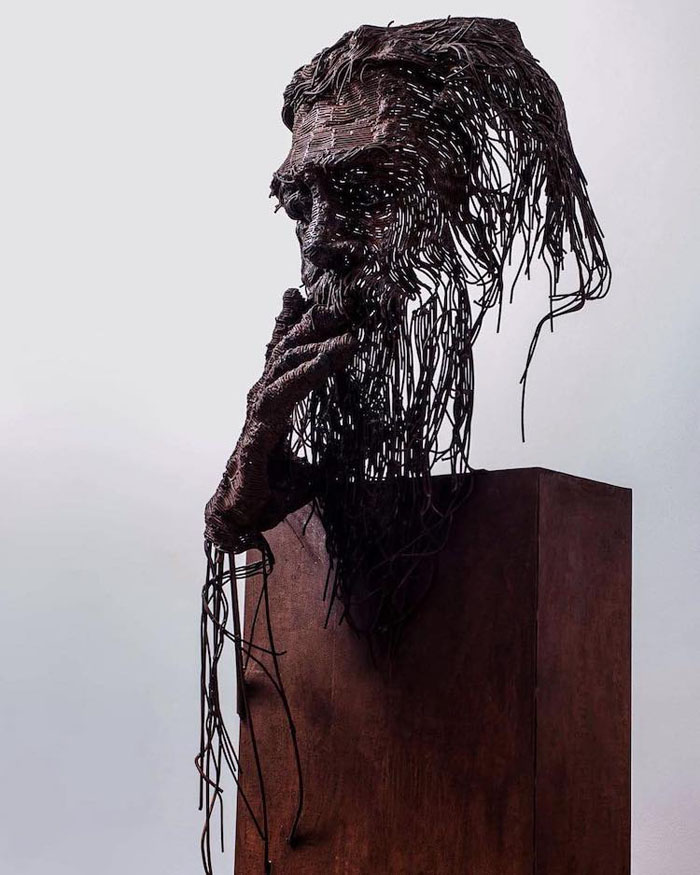
Leonardo da Vinci was an Italian Renaissance artist, engineer, scientist, and writer whose paintings, drawings, and notebooks shaped how later centuries think about creative intelligence. Born in Vinci in 1452 and active in Florence, Milan, Rome, and France, he worked across oil painting, metalpoint drawing, anatomy, mechanics, hydraulics, cartography, and stage design. He became famous not just for a small number of surviving artworks, but for a way of working that joined observation, experiment, and image-making.
- Best known as the painter of Mona Lisa and The Last Supper.
- His notebooks record studies of anatomy, water, machines, flight, optics, and proportion.
- He worked for court patrons, especially Ludovico Sforza in Milan and later Francis I of France.
- He helped define the Renaissance ideal of the maker-scholar who moves between art and science.
- His legacy rests as much on drawings and unfinished projects as on completed paintings.
Why does Leonardo da Vinci matter?
Leonardo matters because he treated looking as a form of knowledge. He dissected bodies to understand muscle and bone, watched water move through channels and eddies, measured the fall of light across faces, and translated all of it into drawings dense with notes and diagrams. That habit made his studio practice unusually broad: painting sat beside anatomy, engineering, and natural history rather than standing apart from them.
His surviving work also set a standard for technical control. In painting, he refined sfumato, a soft transition between tones that removes hard outlines and gives figures a breathing, almost atmospheric presence. In drawing, he used chalk, pen, and ink to test form, shade, and motion. Those methods influenced artists, designers, and illustrators long after the Renaissance ended.
What did Leonardo make?
Only a small number of paintings are securely attributed to Leonardo, which makes each one unusually important. The Last Supper in Milan shows his interest in gesture and narrative structure, while Mona Lisa is famous for its layered landscape, subtle modeling, and ambiguous expression. Works such as Virgin of the Rocks and Saint John the Baptist show his attention to anatomy, rocks, plants, and light.
His drawings and notebooks are even more revealing than the finished paintings. They include flying machines, war devices, water studies, horses, botanical sketches, and anatomical plates. Many of these ideas never became working objects, but they matter because they show a designer thinking through form by drawing it. Leonardo’s process often began with close looking and ended in pages that combine image, measurement, and speculation.
How did he work?
Leonardo worked slowly and revised constantly. He kept searching for better compositions, better anatomy, and better ways to render movement, which is one reason so many projects remained unfinished. That slowness was not a lack of discipline; it was part of a method that valued testing over speed. He examined surfaces, shadow, and proportion until the image felt convincing to the eye.
His workshop practice was collaborative, like that of many Renaissance artists, but the surviving evidence suggests that he pushed it toward research. He made studies from life, copied earlier works, and wrote in mirror script across the page. For FreeYork readers, the material detail matters: Leonardo’s legacy is inseparable from paper, chalk, ink, panel, wall paint, and the labor of drafting ideas before they became images.
What is Leonardo’s legacy in design and visual culture?
Leonardo became the model of the “Renaissance man,” though that phrase can flatten the real complexity of his work. More precisely, he showed how drawing can function as an instrument for thinking across disciplines. That idea survives in architecture, product design, illustration, motion graphics, and scientific visualization, where diagrams and sketches still do the work of discovery.
He also became an icon of authorship. Museums, publishers, advertisers, and governments repeatedly use his name and face because they signal intelligence, invention, and authority. That popularity can obscure the practical side of his practice, but it also proves his cultural reach: Leonardo remains one of the few historical figures whose drawings still shape how modern audiences imagine creativity itself.
Frequently Asked Questions
Was Leonardo da Vinci only a painter?
No. Painting made him famous, but it was only one part of his activity. He also studied anatomy, built mechanical designs, mapped terrain, designed stage effects, and filled notebooks with investigations of water, flight, and optics.
Why are Leonardo’s notebooks so important?
The notebooks show how he thought, not just what he finished. They combine sketches, measurements, lists, and observations, making them central to understanding his method. For historians of design, they are among the clearest records of drawing as research.
Why is Leonardo linked with the idea of the “Renaissance Man”?
He worked across art, science, and engineering with unusual range and ambition. Later writers turned that breadth into a cultural ideal of universal ability and curiosity. The label fits imperfectly, but it captures the extraordinary span of his practice.
Articles mentioning Leonardo da Vinci