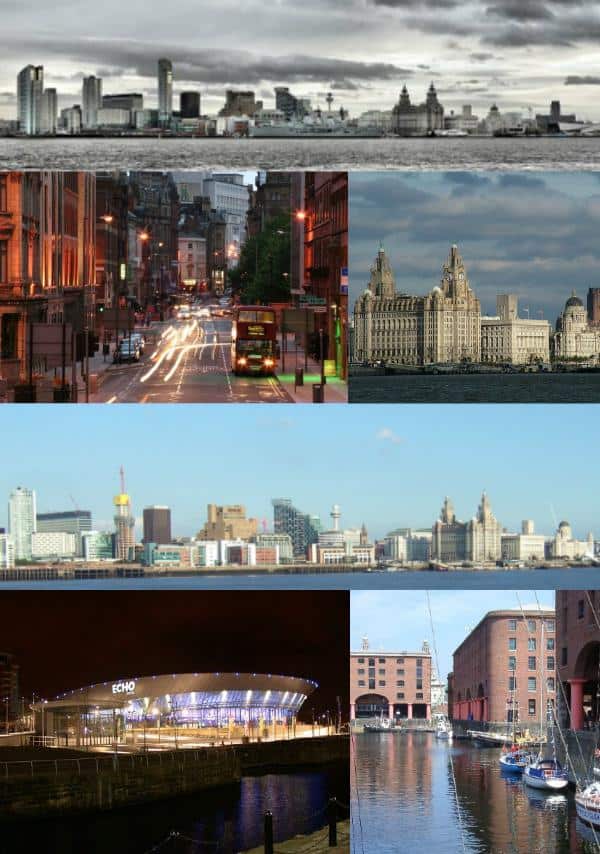
Liverpool is a port city on the eastern side of the Mersey Estuary in north-west England. Founded as a borough in 1207 and granted city status in 1880, it grew into one of Britain’s major Atlantic ports and today sits at the centre of the Liverpool City Region. Its docks, warehouses, civic buildings and riverfront have shaped both the city’s economy and its visual identity, making it a frequent setting for photography, illustration and architectural study.
- A historic port city shaped by maritime trade, migration and industry.
- Known for a strong Victorian and Edwardian civic core, from cathedrals to public buildings.
- Its docklands and river edge remain important visual reference points in art and photography.
- Part of the wider Liverpool City Region, which extends beyond the city proper.
- Often read through contrasts: working waterfront, dense urban streets, and monumental civic architecture.
Why Liverpool matters
Liverpool matters because it is a city where trade left a visible built record. Wealth from shipping and commerce funded docks, bonded warehouses, museums, churches and transport infrastructure. That physical legacy gives the city a layered look: narrow streets and commercial blocks in the centre, large-scale waterfront structures along the river, and later civic landmarks rising above them.
For visual culture, Liverpool offers more than a skyline. It is a place where brick, stone, iron and glass tell the story of industrial Britain. Photographers often frame its river light, long facades and weathered textures; illustrators often use its compact streets and recognisable landmarks to anchor character and place. The city’s visual character comes from use as much as from design: loading, unloading, moving, worshipping, shopping and commuting have all left marks on its surfaces.
What does Liverpool look like?
Liverpool combines waterfront infrastructure with a dense urban centre. The Albert Dock and related dock complexes show the engineering scale of the city’s mercantile past, with heavy masonry, repetitive openings and enclosed basins built for cargo handling. Nearby, civic buildings and commercial streets present a different register: sandstone facades, towers, domes and terraces that signal civic ambition and nineteenth-century urban growth.
The city is also defined by landmarks that break the horizontal line of the port. Liverpool Cathedral and Liverpool Metropolitan Cathedral sit high in the visual field, each with a distinct silhouette and material language. Beyond the centre, districts of terraced housing, post-war development and regenerated docklands show how the city has been rebuilt and reinterpreted over time. That mix of old and new gives Liverpool a layered, sometimes abrupt visual rhythm.
How has Liverpool been represented in art and photography?
Liverpool often appears in work that depends on place as a cue for atmosphere and identity. In photography, its waterfront can stand in for industrial heritage, urban renewal or the endurance of working port architecture. Natural light plays well on the city’s stone and brick, especially around the cathedrals and civic buildings, where long surfaces and strong massing reward careful framing.
Illustrators and image-makers use Liverpool differently but with similar goals. The city’s outlines are clear enough to read quickly, yet varied enough to support different moods: monumental, commercial, gritty or reflective. For that reason it appears in editorial imagery, advertising compositions and character illustration as a convincing urban backdrop rather than a generic city. Its recognisable profile helps ground a scene in a specific British setting.
Frequently Asked Questions
Is Liverpool only important because of its docks?
No. The docks are central to Liverpool’s history, but the city’s importance also comes from its civic architecture, religious buildings, universities, cultural institutions and dense residential districts. The port explains much of the city’s growth, but not all of its meaning or appearance.
Why do photographers use Liverpool so often?
Liverpool offers strong visual contrasts in a relatively compact area. Water, masonry, ironwork, church towers and dockside infrastructure create scenes with clear structure and texture. The city also carries enough historical weight that a photograph of a street or facade often reads as more than a simple urban view.
Is Liverpool part of London or the wider England south-east?
No. Liverpool is in north-west England, on the River Mersey estuary, far from London. It is the principal city of its own metropolitan area and part of the Liverpool City Region, which extends beyond the city boundary into surrounding towns and districts.
At a glance
- Address
- Liverpool, United Kingdom
- Coordinates
- 53.4, -2.983333
Articles mentioning Liverpool