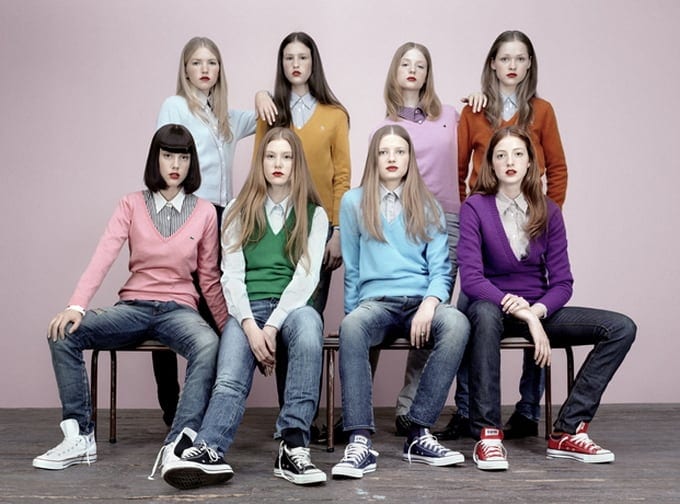
Louis Décamps is a French photographer known for staged, surreal images that mix fashion, advertising, and editorial portraiture. Born in 1972, he built his practice around image-making that treats photography less as witness and more as construction: he arranges people, props, and settings into scenes that feel wry, theatrical, and slightly off-balance.
- French photographer born in 1972.
- Works across editorial, advertising, and exhibition photography.
- Known for surreal, playful compositions and controlled direction of subjects.
- Has shown work in Paris galleries and published in fashion magazines.
- Has shot campaigns for major brands and magazines in France and abroad.
What kind of photographer is Louis Décamps?
Décamps belongs to a strain of contemporary photography that borrows from art direction, cinema, and performance. Rather than waiting for an accidental moment, he builds images deliberately, using pose, gesture, and set design to create scenes with a comic or uncanny edge. His pictures often depend on the tension between polished surfaces and absurd situations.
This approach makes him useful to both editorial clients and brands. Magazines can use his eye for narrative and character, while advertisers can use his ability to make a product or campaign feel memorable without relying on straightforward realism.
Where did his work come from?
Décamps began in design before moving more fully into photography, and that background matters. Design training tends to sharpen attention to composition, materials, typography, and the overall logic of an image, and those habits show in his work. He also traveled widely and photographed what he saw, which likely strengthened his interest in the constructed look of cultures, costumes, and interiors.
After arriving in Paris, he gained recognition in the commercial image world and then moved into exhibition contexts. In 1998, the Prix Picto helped bring his work into public view, leading to gallery presentations such as My Reality Things, Japan or Still, and Heads on Tables in Paris.
What does his photography look like in practice?
His images often stage people as if they are actors in a scene that has one foot in reality and one foot in a joke. Faces may be held in deliberately strange expressions, bodies arranged with artificial precision, and objects placed to create a sense of visual surprise. The result is not raw spontaneity but controlled oddity.
That control is central to the work. Décamps directs subjects closely, shaping the final picture through framing, lighting, styling, and pose. The humor in his photographs comes from restraint as much as from excess: the scene is orderly enough to read immediately, but strange enough to linger.
Why does Louis Décamps matter?
Décamps represents a form of commercial photography that does more than illustrate a brief. His pictures bring a recognisable authorial style to assignments, which is one reason editors and advertisers commission him. In a field where many images flatten into generic polish, his work keeps a sense of personality and risk.
He has worked for publications including Citizen K, Elle editions in several countries, WWD, and Milk Magazine, and for brands such as Air France, Absolut Vodka, Cacharel, Canal+, Danone, Galeries Lafayette, and Diesel. That range shows how surreal, carefully directed photography can move between fashion pages, children’s features, and brand campaigns without losing its visual identity.
Frequently Asked Questions
Is Louis Décamps mainly a fashion photographer?
Fashion is a major part of his output, but not the whole of it. He also works in advertising and editorial portraiture, and his images often behave more like constructed scenes than traditional fashion spreads. His practice sits at the overlap of fashion image-making and art-directed conceptual photography.
What makes his images feel surreal?
The surreal effect comes from the way he combines ordinary subjects with unusual placement, expression, or context. He does not need heavy manipulation to create that feeling; careful staging and an eye for visual incongruity are enough. The result often looks playful, but with a controlled, slightly unsettling edge.
Has he shown work in galleries as well as in magazines?
Yes. His work has appeared in gallery settings in Paris, including exhibitions tied to the Prix Picto and later shows such as one at the Alain Blondel gallery in 2009. That gallery presence matters because it places his photography in a more reflective context, apart from the fast turnover of magazines and campaigns.
Articles mentioning Louis Decamps