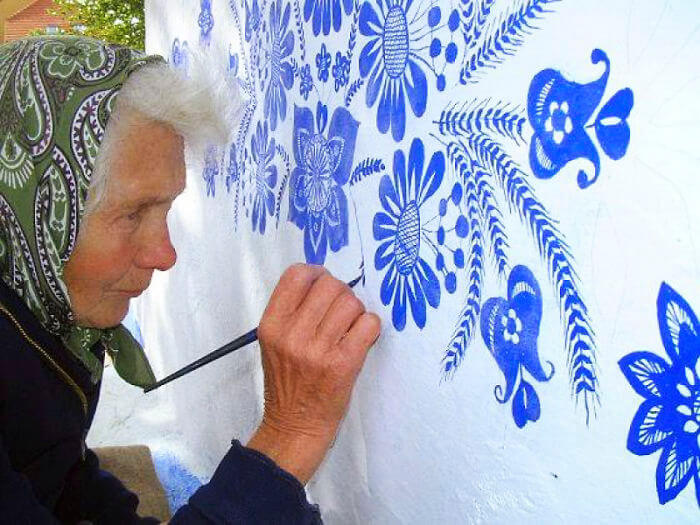
Louka is a village and municipality in Hodonín District in the South Moravian Region of the Czech Republic. It sits in the ethnographic region of Horňácko, a cultural area in the southeast of Moravia known for folk costume, music, ornament, and a strong rural building tradition.
| Country | Czech Republic |
|---|---|
| Region | South Moravian Region |
| District | Hodonín District |
| Area | 9.54 km² |
| Population | About 1,015 |
| Regional context | Horňácko |
Where is Louka?
Louka lies about 28 kilometres east of Hodonín, 71 kilometres south-east of Brno, and 257 kilometres south-east of Prague. Its setting places it near the Slovak border and within a landscape shaped by small-scale agriculture, village streets, and detached houses rather than dense urban blocks.
That location matters because Horňácko villages often preserve local forms of domestic architecture and decoration longer than larger towns do. Painted façades, ornamental borders, and garden fronts remain part of everyday visual culture, not just heritage displays.
What kind of place is it?
Louka is both a settlement and a local administrative unit. In Czech municipal life, that means the village functions as its own municipality, with a local government and a clearly defined territory. With just over 9 square kilometres of land, it is compact, and its character comes from the scale of a small Moravian village rather than from monumental buildings or formal civic planning.
Places like Louka are often read through their ordinary surfaces: plaster walls, rooflines, boundary fences, roads, yards, and church or chapel fronts. These elements become especially visible in regions such as Horňácko, where decorative painting and hand-maintained exteriors carry local identity.
Why does Louka matter in visual culture?
Louka matters because it provides the setting in which vernacular decoration survives. The village is associated with the kind of house painting, floral ornament, and domestic upkeep that FreeYork often documents: work done by local makers, homeowners, and craft traditions rather than by large firms or formal design schools.
In practice, that means Louka is not significant only as a point on a map. It is part of a living regional system in which houses, yards, textiles, and festive objects share motifs and methods. A hand-painted wall in Louka belongs to the same cultural field as embroidery, painted furniture, and other Horňácko forms of making.
What does Louka look like in practice?
Like many villages in South Moravia, Louka is likely to present a mix of older masonry houses, newer repairs, and small private gardens. The visual rhythm is domestic and low-rise. Ornament appears on individual façades, around windows, at entrances, and in the detailing of fence posts, outbuildings, and garden walls.
The village also gains its character from repetition. When one house carries painted flowers or a particular border pattern, nearby houses, sheds, and gates help establish whether that pattern feels local, improvised, or inherited. In a place such as Louka, the built environment becomes a record of maintenance, taste, and continuity.
Frequently Asked Questions
Is Louka a town or a village?
Louka is a village and municipality, not a town. In Czech administrative terms, the municipality is the local governing unit, while the village is the settlement itself. Its small population and area fit a rural rather than urban profile.
What is Horňácko?
Horňácko is a traditional ethnographic region in southeastern Moravia. It is known for folk music, costume, dialect, ornament, and distinctive village culture. Louka belongs to this region, which helps explain why local decoration and house painting are culturally important there.
Why is Louka mentioned in articles about painted houses?
Louka appears in that context because it belongs to a region where hand-painted domestic exteriors remain part of local tradition. A village like this provides the physical setting for folk decoration to continue in everyday life. The houses are not museum objects; they are lived-in surfaces that carry regional style.
At a glance
- Coordinates
- 48.918335, 17.488611
Articles mentioning Louka (Hodonín District)