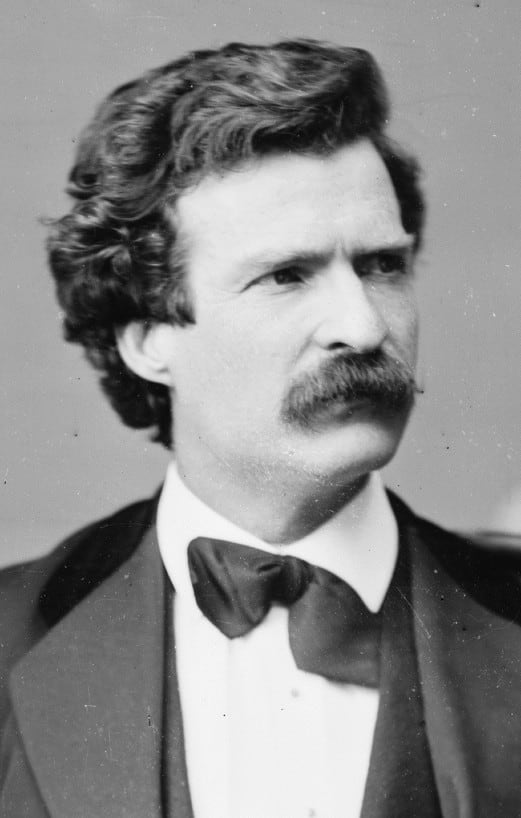
Mark Twain was the pen name of Samuel Langhorne Clemens, an American writer, journalist, lecturer, and humorist whose sharp vernacular prose helped define U.S. literature in the late nineteenth century. He became famous for The Adventures of Tom Sawyer and Adventures of Huckleberry Finn, books that turned regional speech, river life, and boyhood mischief into lasting literary forms.
- Born Samuel Clemens in 1835; took the name Mark Twain from river-boat language.
- Learned print culture early through work as a printer’s apprentice and journalist.
- Built fiction out of Missouri childhood, the Mississippi River, and spoken American English.
- His best-known books remain central to debates about realism, race, satire, and national identity.
How did Mark Twain become Mark Twain?
Clemens grew up in Hannibal, Missouri, a river town that gave him both the setting and the language for much of his fiction. As a young man he worked in printing, a trade that taught him how newspapers, cheap books, and serial publication shaped public taste. He later became a steamboat pilot on the Mississippi, and the river term “mark twain” — meaning a safe depth of two fathoms — supplied the pen name that stuck.
That background matters because Twain never wrote as a distant observer. He wrote from inside the slang, labor, and print systems of his time. His voice sounds casual and funny, but it is carefully built from oral storytelling, local speech, and the rhythms of mass-market publishing.
What made his writing stand out?
Twain helped move American fiction away from polished imitation of British models and toward spoken vernacular. His sentences often sound as if they are being told aloud, with deadpan irony, slang, and comic timing carrying the meaning. He could make a joke land in a single line, then turn the same line into social criticism.
Huckleberry Finn is the clearest example of that method. The book follows a boy and an escaped enslaved man down the Mississippi, using regional speech and episodic structure to expose hypocrisy, cruelty, and false morality. Its language is admired for its force and accuracy, but the book is also widely discussed for its racism and its use of racial slurs, which remain part of any serious reading of Twain.
Why does Mark Twain matter in visual culture?
Twain matters to visual culture because his books have been illustrated, adapted, staged, and filmed for more than a century. The Mississippi river town, the raft, the straw hat, the barefoot boy, and the wry white-haired author became instantly recognizable images. Artists and designers have repeatedly returned to those motifs because they carry a version of “Americanness” that is easy to picture and hard to exhaust.
His work also influenced the look of publishing itself. First editions, magazine serialization, chapter illustrations, and later mass-market covers all helped fix Twain in the public imagination. The visual identity of Tom Sawyer and Huckleberry Finn often leans on rustic typography, river scenes, and nostalgic childhood imagery, even when the books themselves are far more uneasy than that packaging suggests.
What did Twain write beyond the famous novels?
Twain wrote travel books, essays, speeches, short fiction, and satire across a long career. The Innocents Abroad mocked the conventions of travel writing; A Connecticut Yankee in King Arthur’s Court mixed fantasy with social critique; Life on the Mississippi turned memory and reportage into literature. He also became a public lecturer, using performance as part of his literary persona.
That range matters because Twain was not only a novelist but a media figure who understood how to use print, stage presence, and public controversy. He worked with publishers, illustrators, and editors, and he built a recognizable brand before that word became standard. His career shows how authorship in the nineteenth century depended on style, commerce, and performance as much as on writing alone.
Frequently Asked Questions
Was Mark Twain a realist or a humorist?
He was both, and the combination is what makes him durable. Twain used humor to expose fraud, vanity, violence, and social pretension, while his attention to speech and setting gave his work a strong realist base. The comedy often sharpens the realism instead of softening it.
Why is Huckleberry Finn still taught?
It remains one of the most influential American novels because of its narrative voice, its vernacular style, and its forceful treatment of freedom and conscience. It also remains controversial because it reflects and repeats the racial language of its time. Teaching the book usually means teaching both its literary power and its historical harm.
What is Mark Twain’s place in publishing history?
Twain arrived at the moment when newspapers, magazines, and cheap books were expanding quickly, and he used those systems well. He understood serialization, publicity, and the sale of persona as parts of authorship. That makes him an important figure not just in literature, but in the rise of modern literary celebrity.
Articles mentioning Mark Twain