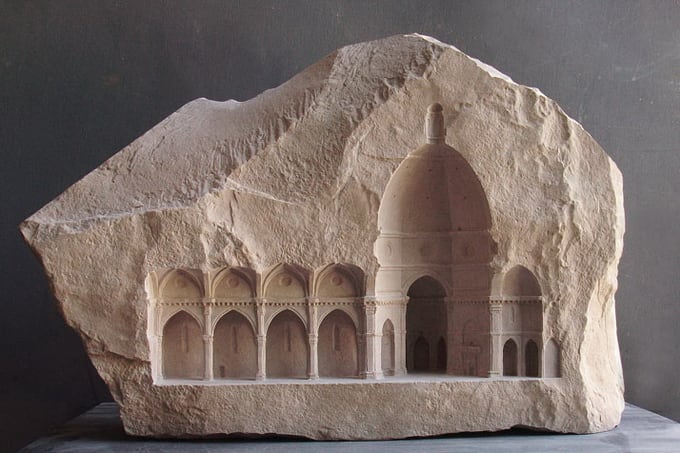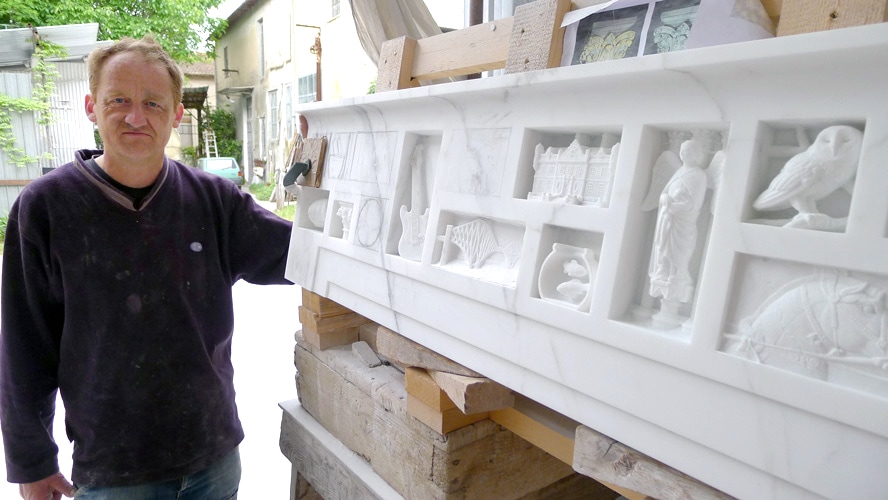
Matthew Simmonds is a British sculptor known for carving miniature architectural interiors and facades into blocks of stone. His work turns solid marble, limestone, and other stones into small-scale spaces that seem hollowed, lit, and inhabited, often echoing churches, cloisters, ruins, and other sacred architecture.
- He works with stone as both structure and subject, using carving to create the illusion of enclosed architectural space.
- His practice grew out of architectural stone carving and a long study of historic buildings.
- Light, shadow, and changing viewpoint are central to how the sculptures are read.
- The work explores positive and negative form, as well as the tension between nature and human construction.
From stone carver to sculptor
Simmonds’ approach comes from the discipline of architectural stone carving, where surface, profile, and detail have to work within the logic of a building. He brings that training into sculpture, but shifts the purpose: instead of supporting an edifice, the carving becomes the edifice. The result is a small object that suggests a much larger interior world.
His subject matter is closely tied to architecture he has studied for years, especially sacred buildings. Gothic vaults, arches, tracery, nave-like spaces, and fragments of ecclesiastical ornament recur because they offer a rich formal vocabulary and a strong emotional charge.
How are his sculptures made?
Simmonds carves into blocks of solid stone rather than assembling separate parts. That matters because the work depends on the contrast between what remains and what is removed: walls become voids, solid mass becomes chamber, and the surface becomes an opening. The stone often carries fine detail at a miniature scale, so the carving has to be precise enough to hold up under close inspection.
He uses the inherent qualities of the material rather than disguising them. Veining, texture, and color variations in marble or limestone can read like weathered masonry, worn ornament, or a change in light across an interior. The material is not just a support for an image of architecture; it is part of the illusion.
Why does scale matter?
Scale is the main device that makes Simmonds’ work unsettling and memorable. A viewer sees a recognisable architectural space, but compressed into something hand-sized or cabinet-sized. That shift changes the relationship between body and building: the sculpture can be held, circled, and studied from close range, while still evoking places meant to dwarf the person standing inside them.
Because the works are small, moving around them changes the image. Openings appear and disappear, recesses deepen or flatten, and interior forms are defined by shadow as much as by carving. The sculptures depend on that movement, which makes them feel less like static models and more like activated spaces.
What themes run through the work?
Simmonds’ sculptures explore the boundary between presence and absence. Carving away stone creates an interior, so the work is built from subtraction as much as addition. That makes positive and negative form a visible subject rather than a technical detail, and it gives the pieces a strong conceptual clarity.
Light and darkness are equally important. In sacred architecture, light often carries symbolic meaning, and Simmonds uses that association without reducing the work to illustration. His interiors can feel devotional, ruin-like, or meditative, but they also keep one foot in material fact: they are blocks of stone altered by hand, with all the labour and resistance that implies.
Frequently Asked Questions
What is Matthew Simmonds best known for?
He is best known for carving miniature architectural spaces into stone blocks. These works often resemble fragments of medieval or sacred interiors, with arches, vaults, and niches rendered in fine detail. The carvings are notable for making solid stone look open, hollow, and inhabited.
What materials does he use?
His sculptures are typically carved from stone such as marble and limestone. Those materials suit the work because they can hold crisp detail while also carrying natural variation in tone and texture. The stone’s own surface qualities help create the illusion of old architecture.
Why are his sculptures associated with architecture?
The work is rooted in architectural stone carving and in a sustained interest in historic buildings. Simmonds borrows the grammar of architecture — arches, columns, chambers, and ornament — and translates it into sculpture. The result sits between model, ruin, and imagined interior.
Articles mentioning Matthew Simmonds