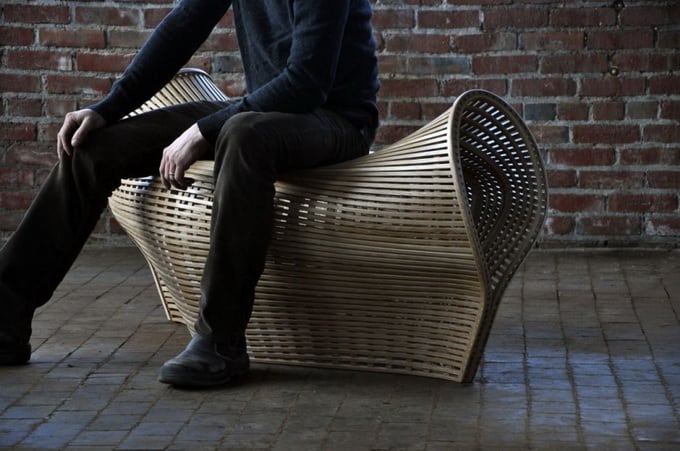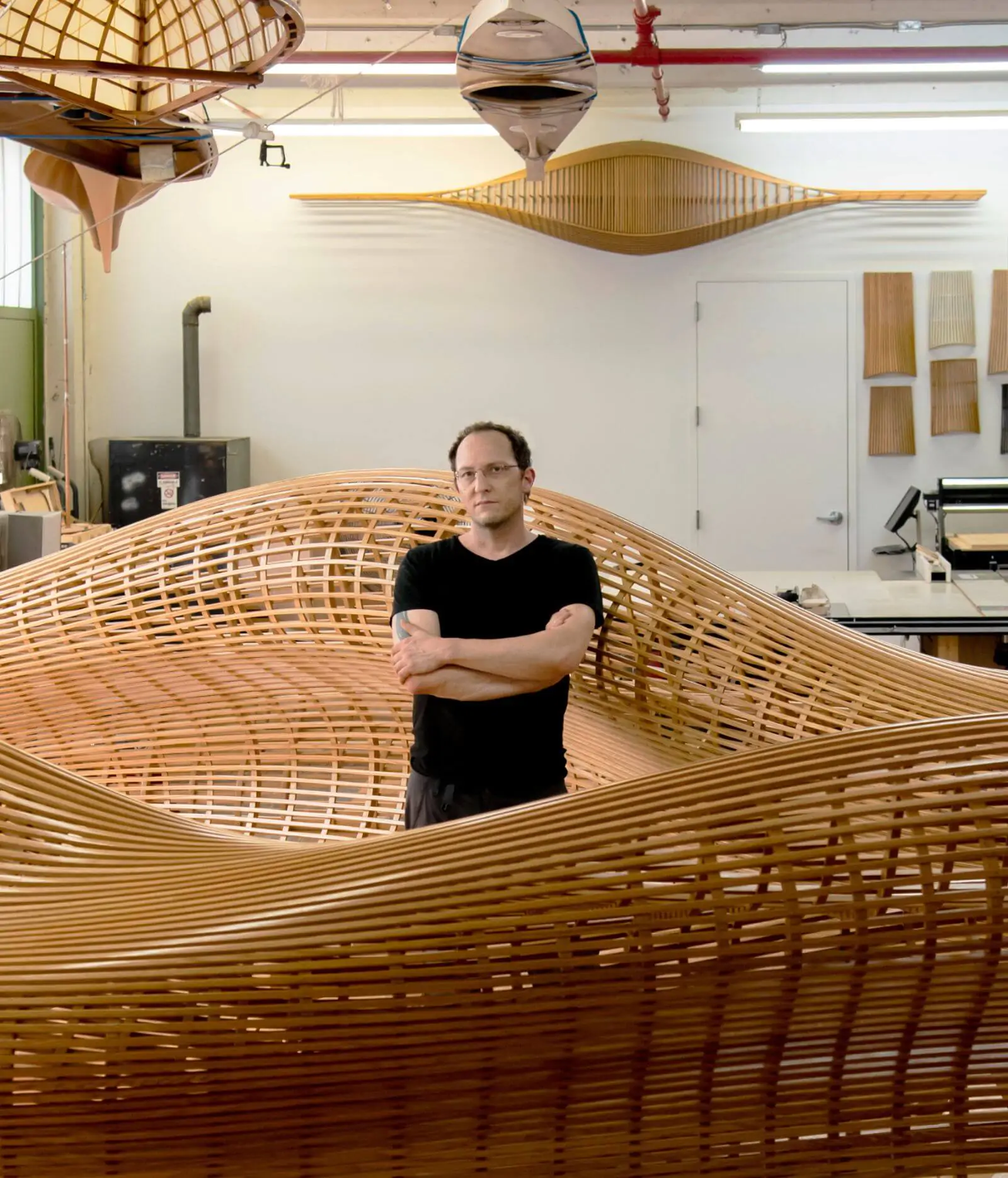
Matthias Pliessnig is an American furniture designer known for sculptural chairs and benches built from bent wood. His work combines handcraft and digital design, especially computer-aided curves and laminated or steam-bent timber, to produce forms that look fluid, taut, and in motion.
- He works primarily in furniture, not mass-market products.
- His pieces usually begin as digital curves and engineering studies before becoming wood objects.
- He is associated with a kinetic, contemporary style that emphasizes line, tension, and movement.
- His practice bridges traditional woodworking and modern fabrication methods.
What kind of designer is Matthias Pliessnig?
Pliessnig designs furniture as a sculptural discipline. Chairs and benches are his main field, and he treats them as structural forms rather than decorative objects. The result is furniture that often reads like an architectural sketch made solid: thin members, sweeping arcs, and visible grain all work together to show how the object is built.
He is based in Philadelphia and trained at the Rhode Island School of Design and the University of Wisconsin–Madison. That background helps explain his approach: a strong design education, plus a close attention to craft, joinery, and material behavior.
How does he make his furniture?
Pliessnig is known for using computer-aided curves to shape forms that would be difficult to invent or refine by hand alone. Those digital drawings are not the finished work; they are part of a process that leads into traditional woodworking. The final pieces often rely on bent wood, laminated components, and careful assembly so that the curves remain precise while still carrying the warmth of the material.
This method matters because the furniture has to do two jobs at once. It must hold a person’s weight, and it must preserve the visual lightness of the original curve. His practice shows how contemporary design can use software without losing the touch, tool marks, and grain patterns that come from making by hand.
Why does his work stand out?
Pliessnig’s furniture stands out because it makes structure visible. Many of his chairs and benches expose ribs, slats, and continuous sweeping members instead of hiding them under upholstery or ornament. That approach gives the work a sense of motion, as if the wood has been bent just enough to capture a gesture and then frozen in place.
He has also helped define a recognizable lane in contemporary furniture design: one where technology supports craft rather than replacing it. The phrase “kinetically contemporary” suits this work because the objects feel active even when they are still. They show how modern fabrication can deepen, rather than flatten, the character of wood.
What should be looked for in a Pliessnig piece?
Look first at the line. His benches and chairs often use long curves that seem to rise, dip, and twist in a single continuous movement. Then look at the surfaces and edges, where the grain and laminated layers reveal how the shape was formed. The material does not disappear; it becomes part of the drawing.
Also look for tension between delicacy and strength. The forms can seem airy, but they are engineered to carry load and support the body. That balance is central to his work and helps explain why his pieces are discussed both as furniture and as design objects.
Frequently Asked Questions
Is Matthias Pliessnig mainly a furniture designer or an artist?
He is primarily a furniture designer, though his work is often discussed in artistic terms because of its sculptural appearance. The objects still have to function as chairs and benches, so design and utility remain central. That practical requirement shapes the forms as much as any aesthetic goal.
What materials does he use?
Wood is the core material in his practice, especially in forms that can be bent, laminated, or carefully joined. The exact species and construction methods vary by piece, but the emphasis stays on expressing grain, curvature, and structural clarity. Metal or other materials may appear in supports or fittings, but wood defines the work.
Why is computer design important in his process?
Computer design lets him calculate curves and refine complex shapes before fabrication begins. That matters because bent wood furniture depends on precision: small changes affect both appearance and strength. The software supports the handwork rather than replacing it, which is a large part of why the finished pieces feel both exact and handmade.
Articles mentioning Matthias Pliessnig