
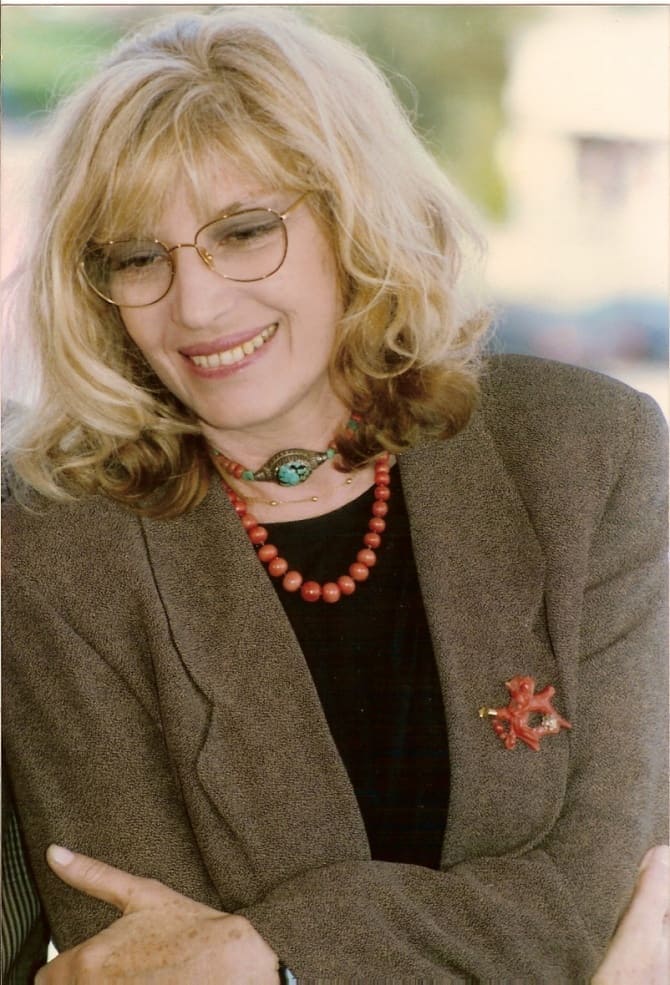
Monica Vitti was an Italian actor whose cool, angular screen presence helped define European art cinema in the 1960s. She became best known through her collaborations with Michelangelo Antonioni, then shifted into comedy and proved she could carry lighter, faster, more bodily performances without losing the precision that made her famous.
| Born | 3 November 1931, Rome, Italy |
|---|---|
| Known for | Film acting, especially modernist dramas and comic roles |
| Key collaborators | Michelangelo Antonioni, Mario Monicelli |
| Notable co-stars | Marcello Mastroianni, Richard Harris, Dirk Bogarde |
| Active period | 1950s through the 1980s, with major work in the 1960s and 1970s |
Why Monica Vitti mattered
Vitti mattered because she brought a particular kind of modern femininity to the screen: guarded, ironic, restless, and difficult to pin down. In Antonioni’s films, that quality became a visual language. Her face, posture, and timing carried uncertainty and emotional distance, which suited stories about alienation, desire, and the failure of communication in postwar Italy.
She was not only an art-house symbol. Vitti also had strong comic instinct, sharp rhythm, and a willingness to make herself look awkward or absurd for a joke. That range made her unusual among international stars of her era. She could play mystery and satire, cool elegance and physical farce, often in the same decade.
How did she become famous?
Vitti first came to wide attention through her work with Antonioni in the early 1960s, especially L’Avventura, La Notte, L’Eclisse, and Red Desert. These films made her one of the defining faces of modernist cinema. Antonioni framed her in architecture, empty landscapes, glass, concrete, and industrial surfaces, turning her into part of the composition rather than a conventional star surrounded by action.
That collaboration also changed how audiences understood acting. Vitti often worked with minimal gesture, controlled speech, and long pauses. The tension came from what remained unsaid, not from plot mechanics. Her performances fit films that cared about surfaces, space, and mood as much as dialogue.
What did her comedy look like?
After Antonioni, Vitti moved into comedies, especially with Mario Monicelli. Here the same intelligence that had served her in austere dramas became a tool for timing, exaggeration, and disruption. She could play ambitious, self-possessed, or socially awkward women without flattening them into types.
Her comic roles often mixed glamour with embarrassment. That contrast mattered: she was not simply “serious” in art films and “light” in comedies. Instead, she used precision, vocal control, and expressive shifts in face and body to make characters feel unstable, clever, and alive. In practice, that meant performances that could pivot from poise to panic in a single scene.
How is Monica Vitti remembered today?
Vitti is remembered as both a star and a stylistic reference point. Film historians associate her with the look and mood of European modernism: stark locations, muted palettes, isolated figures, and emotional ambiguity. Designers, illustrators, and photographers still borrow from that atmosphere when they want coolness with unease, or elegance with a sense of distance.
She also remains important because she crossed categories without losing identity. Many actors are remembered for one mode only; Vitti linked art cinema, popular comedy, and fashion-conscious screen presence into a single career. That breadth explains why her image still travels well beyond film studies.
Frequently Asked Questions
Was Monica Vitti only an Antonioni actress?
No. Antonioni made her internationally famous, but he did not define her entire career. After that period she worked extensively in comedy, especially in Italian films directed by Mario Monicelli, and showed a strong command of lighter material. Her range is part of what makes her significant.
What made her screen presence distinctive?
Vitti combined restraint with sharp expressiveness. She could hold a face almost still and still suggest doubt, irony, or irritation, which made her effective in films built on atmosphere and ambiguity. In comedy, the same control let her land shifts in tone without losing credibility.
Why does she matter to visual culture?
Her image helped establish a vocabulary of modern elegance: detached, architectural, and slightly uneasy. That look still informs film, illustration, and fashion when makers want sophistication without softness. Vitti’s performances also show how acting can shape the visual design of a work, not just its story.