
A muscle car is an American-made two-door coupe or hardtop built around a large, powerful V8 engine and sold with street performance in mind. The classic formula puts a high-output engine into a relatively ordinary mid-size or full-size body, usually with rear-wheel drive, four seats, and a price that stays below true sports-car territory. Muscle cars matter because they turned straight-line speed into a mainstream style, especially in the 1960s and early 1970s, when Detroit factories sold performance as an accessible option rather than an exotic specialty.
Stories from Muscle car
2 stories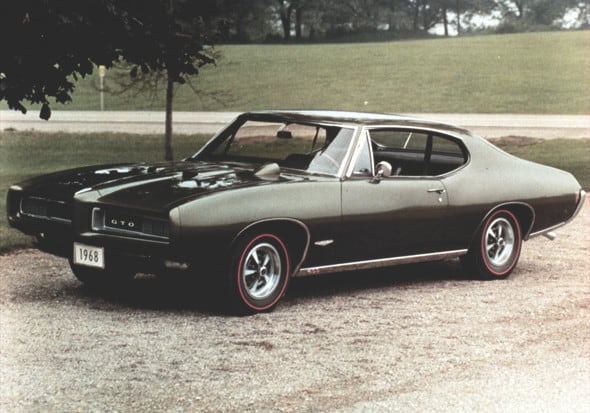

About Muscle car
- Built for acceleration, not delicate handling
- Usually based on mass-market American coupes or sedans
- Typically use large-displacement V8 engines
- Often associated with drag racing and street cruising
- Defined as much by image and sound as by technical output
Read the full overviewWhere did muscle cars come from?, What makes a muscle car different from a sports car?, What do muscle cars look and sound like in practice?, Why did muscle cars become such a lasting design type?
Where did muscle cars come from?
Muscle cars emerged in the United States after World War II, when the domestic auto industry could combine inexpensive platforms with increasingly powerful engines. The early 1960s gave the term its shape: manufacturers learned that buyers wanted speed without the expense of a dedicated sports car, and they could package that speed in familiar, widely available models. Pontiac’s GTO, introduced in 1964, is often treated as a landmark because it made the performance upgrade explicit and marketable.
The formula spread quickly. Ford, Chevrolet, Plymouth, Dodge, AMC, and others responded with models that paired aggressive styling, heavy-duty suspensions, and big engines. The cars were tied to youth culture, suburban parking lots, drive-ins, and sanctioned drag strips, where quarter-mile acceleration became a public measure of status.
What makes a muscle car different from a sports car?
A muscle car is not simply any fast car. Sports cars usually prioritize lighter weight, tighter steering, and chassis balance, often with two seats or a compact cabin. A muscle car takes the opposite route: it starts with a practical body shell and adds horsepower, producing a car that feels blunt, loud, and forceful rather than precise.
This difference shows up in the driving experience. Muscle cars often use large-capacity V8 engines with deep torque, so they launch hard in a straight line and respond with a heavy, audible surge. Their suspensions and brakes were sometimes less advanced than their engines, which made them exciting in a drag race but less composed in corners.
What do muscle cars look and sound like in practice?
Muscle cars usually wear long hoods, short decks, pronounced grille openings, and proportions that hint at the size of the engine bay. Many had modest interiors and shared components with ordinary family cars, which kept costs down. The bodywork often carried stripes, scoops, hood bulges, and badges that advertised performance as loudly as the exhaust did.
The sound is part of the identity. A muscle car’s engine note tends to be low, uneven, and forceful, with a visible shudder at idle and a hard bark under throttle. In practice, the appeal comes from contrast: an everyday-looking coupe that suddenly becomes rude, rapid, and mechanically expressive when the accelerator opens.
Why did muscle cars become such a lasting design type?
Muscle cars became important because they translated engineering into a clear cultural package. They were easy to understand, easy to modify, and easy to photograph, which made them ideal symbols of speed, rebellion, and American manufacturing confidence. They also supported a strong aftermarket of carburetors, exhaust systems, camshafts, and suspension parts, so owners could keep changing the car after purchase.
The classic era was cut short by insurance costs, emissions rules, fuel prices, and the oil crisis of the 1970s. Later cars revived some of the same language, but the original muscle car remains distinct because it came from a specific manufacturing moment: a period when Detroit could sell a lot of engine for not much money and call that everyday transportation.
Frequently Asked Questions
Are all high-performance American cars muscle cars?
No. Corvettes, modern super-sedans, and many import performance cars do not fit the traditional definition because they are not based on the classic mid-size or full-size two-door American coupe formula. The term usually depends on body style, era, and market position as much as on horsepower.
What engines are most associated with muscle cars?
Large V8 engines are the core of the classic muscle car idea. Common examples include Chevrolet small-blocks and big-blocks, Ford V8s, and Chrysler’s performance V8s, especially the 426 Hemi in high-profile applications. The key feature is not a specific engine family but a large-displacement, torque-rich layout.
Can modern cars be called muscle cars?
Yes, but the term is used more loosely now. Modern models such as the Ford Mustang, Chevrolet Camaro, and Dodge Challenger carry the muscle car label because they echo the old formula of powerful American coupes with rear-wheel drive. They are descendants of the classic type, even when their engines, electronics, and handling are far more advanced.