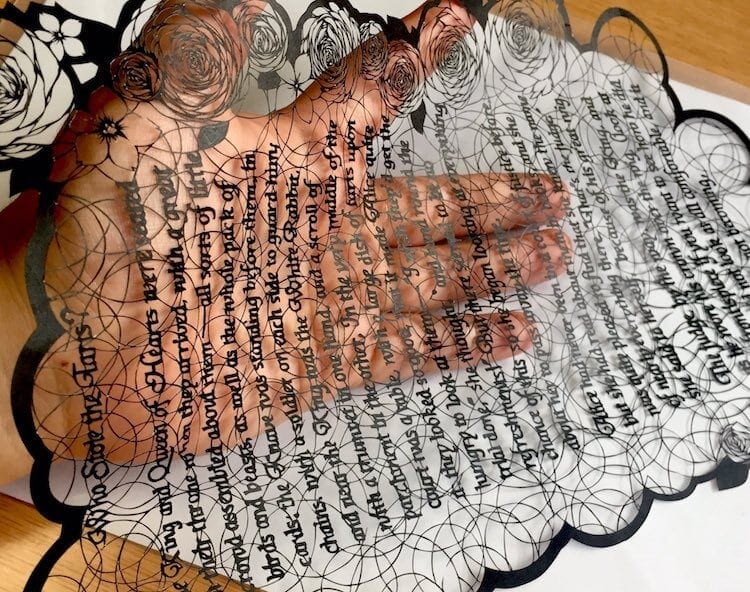
Nami Sakashita is a Japanese paper-cut artist known for intricate, hand-cut works that translate literary subjects into delicate, graphic compositions. Her practice sits at the meeting point of illustration, craft, and book culture, using a single sheet of paper and a cutting tool to build images through negative space as much as line.
| Field | Paper cutting, illustration, literary art |
|---|---|
| Nationality | Japanese |
| Known for | Fine paper-cut compositions inspired by literature |
| Mediums | Paper, craft knife, layered cut forms |
| Working method | Careful hand cutting, often with a high level of detail and precision |
What does Nami Sakashita make?
Sakashita makes cut-paper images that read like illustrations, but the material drives the effect. Instead of drawing with ink, she removes paper to form figures, textural details, and delicate voids. The result is often light, lace-like, and structurally exact, with each cut contributing to the composition.
Her work is especially associated with literary homage. That means the subject matter may come from a novel, poem, or other written source, but the final object is not a direct reproduction of text. It is a visual interpretation, turning reading into an object that can be held, framed, and studied as an image.
How does paper cutting shape her work?
Paper cutting demands planning because every removal is permanent. An artist has to think in reverse, deciding where the white of the page will become light, where a cut will open space, and where a bridge of uncut paper will keep a form intact. Sakashita’s practice depends on that discipline, which gives the work its tension: the image looks airy, but it survives through a network of tiny structural decisions.
This technique also changes how the viewer reads detail. In paper cutting, a hairline curve, a cluster of holes, or a dense passage of filigree can suggest fabric, foliage, architecture, or a character’s silhouette without using paint or shading. Sakashita uses that economy well, letting the material carry both the image and the mood.
Why literature matters in her art
Literature gives Sakashita’s work narrative depth. A paper-cut piece can distill a scene, a character, or a symbolic motif from a book into a single visual statement. That makes her work appealing to readers as well as to people interested in contemporary craft, because the image often depends on recognition, memory, and interpretation.
Homage to literature also places her in a wider tradition of artists who respond to texts with handmade forms. In her case, the choice of paper is especially apt: books are made of paper, and so are the images she creates. That material link reinforces the connection between reading and making.
How is her work seen in practice?
Sakashita’s pieces are usually presented as refined, finished artworks rather than raw craft demonstrations. Their impact comes from precision: crisp edges, controlled density, and a careful balance between ornament and legibility. Depending on the subject, the work may feel intimate and quiet or densely dramatic, but it remains anchored in the same exacting process.
Paper cutting of this kind sits between print culture and fine art. It can be reproduced in photographs and articles, but the original object matters because the quality of the cut, the thickness of the paper, and the shadows cast by the surface all affect the experience. That physical presence is part of what makes Sakashita’s work memorable.
Frequently Asked Questions
Is Nami Sakashita a papercut illustrator or a fine artist?
She can be understood as both. Her work uses the techniques and materials of craft, but the results are presented as art objects with strong conceptual and visual control. The boundary between illustration and fine art is part of what gives her practice its interest.
What materials does she use?
Her core medium is paper, cut by hand with precision tools such as a craft knife or scalpel. The final image depends on the weight, color, and surface of the paper as much as on the design itself. In paper cutting, the material is not neutral; it determines how sharp or fragile the image feels.
Why is her work linked to literature?
Because she often uses literary subjects as the starting point for a piece. Rather than illustrating a book in a straightforward way, she translates its atmosphere, characters, or symbols into cut paper. That approach gives the work a strong sense of interpretation instead of literal storytelling.
Articles mentioning Nami Sakashita