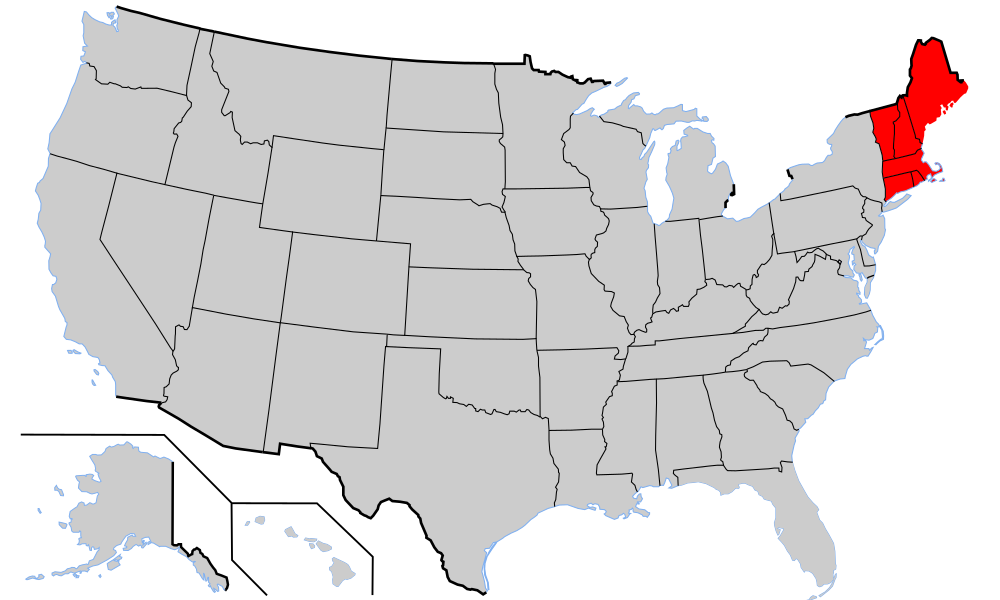
New England is a region in the northeastern United States made up of Maine, New Hampshire, Vermont, Massachusetts, Rhode Island, and Connecticut. It sits between New York state, Quebec, the Atlantic Ocean, and the Canadian Maritimes, and it entered English colonial history with the Plymouth settlement in 1620. The region matters because its towns, ports, universities, printing trades, and political institutions shaped early American life and still strongly influence its visual identity.
- New England is a six-state region, not a single state or city.
- Its colonial history began with English settlements at Plymouth and elsewhere in the 17th century.
- It is known for dense historic towns, working waterfronts, forests, stone walls, and seasonal light.
- Its visual culture draws from Puritan architecture, maritime commerce, industrial mills, and later tourism.
- Artists, designers, and photographers often use New England as shorthand for weathered surfaces, autumn color, and a strong sense of place.
How New England took shape
The region took shape through English colonisation in the early 1600s, when settlers established Plymouth Colony and later a string of towns and ports along the coast. Those settlements developed around fishing, shipbuilding, farming, and trade, with each state taking on its own political character while sharing a common colonial framework. The name stuck because the area functioned as a distinct English-speaking corner of North America long before the United States existed.
New England’s early settlements left a durable built environment. Meetinghouses, clapboard houses, narrow village greens, dry stone walls, lighthouses, and mill complexes became part of the region’s visual language. Even where cities later expanded, older forms of settlement remained legible in street grids, town centers, harbors, and the spacing of civic buildings.
What does New England look like?
New England’s look changes with terrain, but its most recognizable features are practical ones: shingled coastal houses, white church steeples, brick mill buildings, fishing piers, granite curbs, and weathered wood. Inland, the same region can shift to maple forests, farm fields, old railroad corridors, and mountain roads. The landscape is often represented in fall foliage, but that is only one seasonal expression of a broader design culture built around rough materials and changing weather.
That mixture of refinement and wear appears in print, photography, signage, and architecture. New England cities such as Boston and Providence combine colonial-era plans with industrial and university districts, while smaller towns preserve compact centers built for walking and local trade. In visual work, the region often reads as orderly but battered: painted trim peeling in salt air, brick darkened by age, and interiors lit by low winter sun.
Why New England matters in visual culture
New England matters because it helped establish some of the earliest American civic and domestic forms, and those forms remain culturally useful. The region’s town meeting tradition, Protestant meetinghouse architecture, and merchant-built ports created a visual code for restraint, durability, and public life. Later industrialisation added textile mills, factories, and worker housing, giving designers and historians a second layer of material culture to study.
Modern artists and publications return to New England because it offers a dense field of textures and symbols without needing heavy interpretation. A winter shoreline, a cathedral-like campus quad, a weathered lobster trap, or a highway cutting through maple forest can all carry regional meaning quickly. That shorthand can become nostalgic, but it is also grounded in real materials and economic histories: timber, granite, brick, rope, sailcloth, paper, and the built remnants of trade and manufacture.
How is New England used in design and storytelling?
In branding and editorial design, New England often stands for heritage, craftsmanship, academia, coastal weather, and independent local business. State identities, tourism campaigns, and museum graphics frequently borrow from colonial lettering, nautical imagery, map fragments, and natural palettes drawn from rock, fog, pine, and rust. Vermont’s recent visual language, for example, often leans on landscape and civic simplicity rather than spectacle.
Photographers and illustrators use the region for its strong light and legible surfaces. A harbor in Maine, a stone church in Connecticut, a Rhode Island shoreline, or an abandoned mill in Massachusetts can each anchor a broader story about labor, memory, and place. New England is not just picturesque; it is highly coded, and that code comes from centuries of settlement, commerce, migration, and rebuilding.
Frequently Asked Questions
Is New England a cultural region or a political one?
It is both, but not in the same way. New England is a political grouping of six states, yet it also functions as a cultural region with shared histories, accents, architecture, and civic habits. The cultural meaning is older than the modern administrative use.
Why do so many images of New England focus on autumn?
Autumn produces the region’s most vivid colour contrast: red maple leaves, gray stone, white-painted houses, and dark water or roads. Tourism and publishing have reinforced that association because it reads instantly and sells well. The fixation can obscure the region’s other visual identities, especially winter, coastal work, and industrial landscapes.
What materials are most associated with New England’s built environment?
Wood, brick, granite, slate, and painted clapboard appear most often. Those materials reflect local climate, available stone, maritime trade, and colonial building habits. In older towns, they create a durable palette that still shapes how the region is photographed and designed.
At a glance
- Address
- United States
- Coordinates
- 44.205556, -70.306425
Articles mentioning New England