
New Guinea is the world’s second-largest island, lying north of Australia in the southwest Pacific Ocean and shared by two sovereign states: Papua New Guinea in the east and Indonesia in the west. It sits on the edge of the Australian tectonic plate, which has shaped its geology, climate, and long biological isolation. That isolation has also made the island one of the most diverse places on earth, both ecologically and culturally.
Stories from New Guinea
7 stories




About New Guinea
- It is split politically between Papua New Guinea and Indonesia.
- Its land area is about 786,000 square kilometres.
- It belongs geologically to the same broader plate system as Australia.
- Its separation from nearby landmasses has produced exceptional linguistic, ecological, and cultural diversity.
- It is often discussed as part of the wider Indo-Australian Archipelago.
Read the full overviewWhere is New Guinea?, Why does New Guinea matter?, What does New Guinea look like in practice?, How has its history been shaped?
Where is New Guinea?
New Guinea stretches east to west just below the equator, between the Arafura and Coral seas. The island forms the northern fringe of Australia’s near region and sits east of the Malay Archipelago. Its western half makes up Papua, which is part of Indonesia; its eastern half forms the independent state of Papua New Guinea.
The island’s position matters because it has long been a meeting point and barrier at once. Ocean routes brought trade, migration, and later colonial contact, but the difficult interior and dense forests limited movement inland. As a result, many communities developed in relative isolation, especially in the central mountain ranges.
Why does New Guinea matter?
New Guinea matters because it combines unusual environmental richness with extraordinary human diversity. The island contains lowland rainforest, mangroves, alpine grasslands, and active volcanic zones, all within a single landmass. That range of habitats supports a huge number of species found nowhere else, including birds-of-paradise, cassowaries, tree kangaroos, and thousands of endemic plants and insects.
It is equally important as a cultural region. New Guinea is one of the most linguistically complex places on earth, with hundreds of languages spoken across its mountains, coastlines, and river valleys. That diversity reflects long histories of settlement, exchange, and local adaptation rather than a single unified culture.
What does New Guinea look like in practice?
Geography on New Guinea is often dramatic at a small scale. Steep ridges rise quickly from coastal plains into a rugged spine of mountains, including peaks high enough to carry glaciers in the past. Rivers drain large wet lowlands, while the coasts support fishing settlements, sago processing, and gardens planted in cleared forest or volcanic soil.
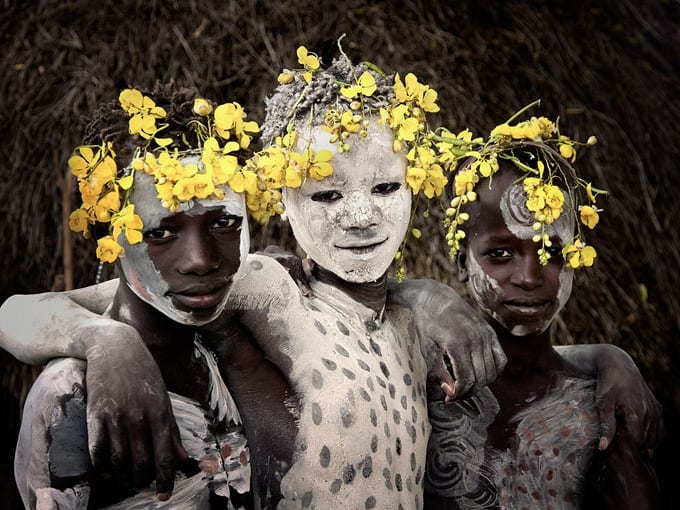
In visual and material terms, the island is known for highly specific local traditions rather than one dominant style. Bark cloth, shell ornament, featherwork, carved masks, ceremonial shields, body paint, and fibre assemblies appear in different forms across different communities. Materials are usually local and direct: wood, pig tusk, clay, fibre, lime, ochre, shell, feathers, and plant dyes, shaped by hand for use in exchange, ritual, status display, and performance.
How has its history been shaped?
New Guinea’s modern history was shaped by European colonial division, missionary activity, plantation economies, and later decolonisation and state formation. The eastern half moved toward independence as Papua New Guinea, while the western half remained under Indonesian administration after a different colonial path. These political boundaries cut across older regional and linguistic continuities.
That history still affects the island’s cultural life and visual record. Photography, ethnography, and museum collections from the colonial period often framed New Guinea through a foreign gaze, emphasising “exotic” artefacts or remote landscapes. More recent work tends to focus on local authorship, land rights, and the continuity of making practices under changing political conditions.
Frequently Asked Questions
Is New Guinea a country?
No. New Guinea is an island, not a single country. Its eastern half is the independent state of Papua New Guinea, while its western half is part of Indonesia. The island name refers to the landmass itself, not to one political unit.
Why is New Guinea so biologically diverse?
Its size, tropical climate, mountain ranges, and long geographic isolation all contribute to that diversity. Different elevations create sharply different habitats over short distances, from coral coasts to cloud forest to alpine zones. Those conditions have allowed many species to evolve separately.
Why do artists, photographers, and writers mention New Guinea so often?
It offers both striking landscapes and a dense record of human making. The island’s objects, ceremonies, architecture, and body arts have drawn attention from anthropologists, museums, and image-makers for more than a century. At the same time, those representations need care, because the island has often been portrayed through outsider fantasies rather than local realities.