
A nightmare is a disturbing dream that wakes a sleeping person with fear, panic, grief, or dread. It usually feels vivid and immediate while it is happening, and the distress can continue after waking, sometimes making it hard to fall asleep again.
Stories from Nightmare
2 stories
About Nightmare
- Nightmares are a type of dream with a strong negative emotional charge.
- They often involve danger, pursuit, injury, loss, or other forms of psychological threat.
- They can happen to anyone, though stress, illness, trauma, and irregular sleep can make them more common.
- Unlike a bad dream that fades quickly, a nightmare often leaves a lingering bodily response: racing heart, tension, or tears on waking.
- Nightmares matter in art and storytelling because they turn private fear into a form that can be pictured, staged, and shared.
Read the full overviewWhat happens in a nightmare?, Where does the idea of the nightmare come from?, Why do nightmares matter in art and design?, How are nightmares shown in practice?
What happens in a nightmare?
Nightmares are built from dream logic, but they are usually organized around a threat. The dream may place the sleeper in pursuit, confinement, falling, injury, public embarrassment, the loss of a loved one, or some other situation that triggers intense alarm. The content does not need to be supernatural or grotesque to qualify; ordinary settings can become terrifying when the emotional pressure is high.
Physically, a nightmare often ends with a sudden awakening. The body may respond as if danger were real: shallow breathing, sweating, shaking, or a pounding pulse. The dream itself can be fragmentary or extremely detailed, and people often remember the feeling more clearly than the exact sequence of events.
Where does the idea of the nightmare come from?
The word has a long history in English and other European languages, where it was once associated not just with bad dreams but with a night-dwelling creature that oppressed sleepers. That older meaning helps explain why nightmares have so often been imagined as attacks from outside the self, rather than as events generated by the dreaming mind.
Modern sleep science treats nightmares as a parasomnia, meaning an unwanted event tied to sleep. They are studied in relation to REM sleep, stress, trauma, medications, fever, and disrupted sleep schedules. Not every frightening dream points to a deeper problem, but recurring nightmares can be part of post-traumatic stress disorder, anxiety, depression, or sleep disorders.
Why do nightmares matter in art and design?
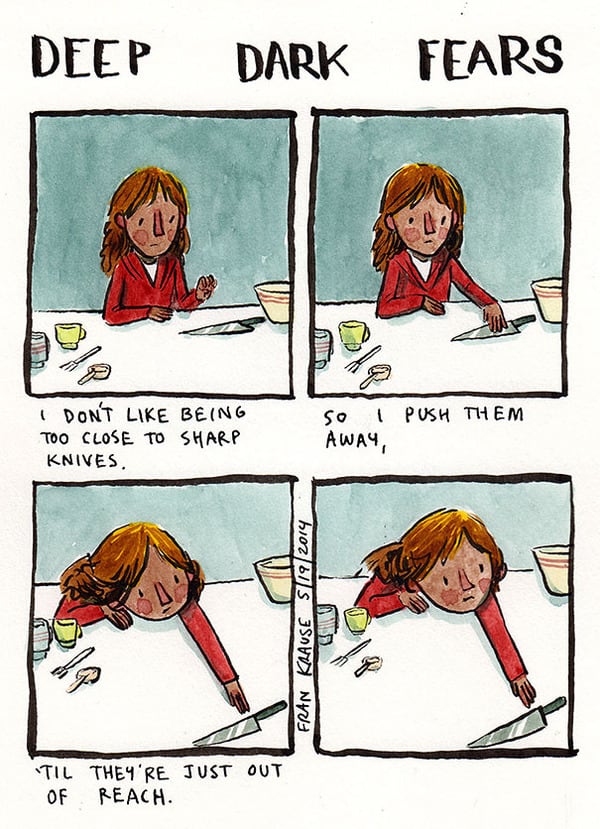
Nightmares are one of the clearest bridges between inner experience and visual form. Comics, illustration, film, and stage design use them because they supply ready-made structures: unstable perspective, distorted scale, repetition, darkness, and sudden contrast. A nightmare scene rarely needs explanation; its visual language is often enough to communicate fear.
For artists, the challenge is not only to show something scary, but to show how fear feels. That is why nightmare imagery often relies on awkward cropping, warped bodies, impossible architecture, and claustrophobic pacing. In graphic storytelling, the page can mimic the dream state by breaking chronology, overlapping scenes, or letting symbols stand in for explicit action.
How are nightmares shown in practice?
Common nightmare imagery includes teeth, masks, eyes, confinement, corruption, falling, drowning, and distorted domestic spaces. These motifs work because they combine recognition with threat: a bedroom becomes unsafe, a face becomes unreadable, a hallway becomes endless. The most effective nightmare imagery often keeps one foot in reality, which makes the distortion feel more unsettling.
In comics and illustration, nightmare sequences are often marked by dense blacks, abrupt transitions, heavy shadow, and figures that seem either trapped or dissolving. In motion pictures, sound design does part of the work: silence, low rumbles, muffled voices, and sudden noise can make a simple image feel oppressive. The medium matters, but the core effect stays the same: a familiar world made unstable.
Frequently Asked Questions
Is a nightmare the same as a bad dream?
Not exactly. A bad dream may be unpleasant, but a nightmare typically wakes the sleeper and leaves a stronger emotional and physical reaction. The waking distress is part of what makes it a nightmare rather than just a difficult dream.
What causes nightmares?
There is no single cause. Stress, trauma, fever, certain medications, irregular sleep, and sleep deprivation can all increase the chance of nightmares. Recurring nightmares may also be linked to mental health conditions or sleep disorders, especially when they become frequent or severely disruptive.
Why do nightmares appear so often in horror art?
Nightmares already contain a visual grammar of fear, so artists can borrow it directly. They compress panic, uncertainty, and bodily vulnerability into images that are easy to recognize and hard to forget. That makes them useful for comics, painting, cinema, and any medium that wants to make private dread visible.