
Nik Wallenda is an American high-wire artist and daredevil known for walking tightropes without a safety net, often across major public landmarks. Born Nikolas Wallenda in 1979, he comes from the seventh-generation Flying Wallendas circus family and built a career around long-distance wire walks, usually performed in front of live crowds and television cameras. His most famous feat was the 2012 tightrope crossing over Niagara Falls, which made him one of the best-known names in contemporary aerial performance.
Stories from Nik Wallenda
1 story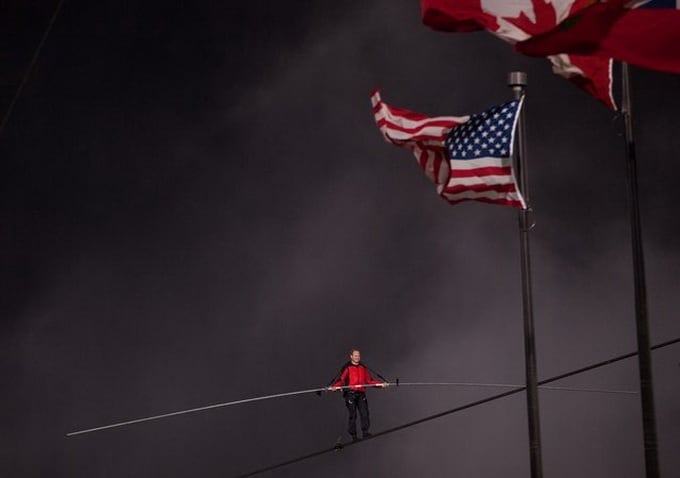
About Nik Wallenda
- He works in high-wire performance, usually on a wire suspended above water, buildings, stadiums, or canyons.
- Wallenda is part of the long-running Flying Wallendas family, whose circus acts shaped his training and public identity.
- His acts depend on precise rigging, balancing equipment, wind management, and detailed safety planning, even when the performance appears minimal.
- He became widely known after crossing Niagara Falls in 2012, the first person to complete that walk on a tightrope.
- Wallenda’s performances sit between circus craft, live spectacle, and media event, which is why they attract both technical and popular interest.
Read the full overviewWhere does Nik Wallenda come from?, What makes his performances distinctive?, Why did the Niagara Falls walk matter?, How does a Wallenda-style wire walk work?
Where does Nik Wallenda come from?
Wallenda was born in Sarasota, Florida, into a circus family whose name is tied to wire walking for more than a century. The Flying Wallendas became famous for pyramid formations on the high wire, and several family members died in wire-related accidents, which shaped the family’s reputation as both skilled and risk-tolerant. That background matters: Wallenda’s work is not a solo stunt tradition so much as an inherited performance practice built on rigging knowledge, balance training, and public risk.
He began performing as a child and later expanded the family act into his own brand of long-distance and high-altitude walks. His public image combines old circus lineage with modern broadcast spectacle. That mix has helped him remain visible well beyond the circus circuit.
What makes his performances distinctive?
Wallenda’s signature is the untethered high-wire walk, often done without a net. The wire itself is usually a steel cable stretched tightly between two points and stabilized by rigging teams, anchors, and tension systems. In some performances he uses a balancing pole to shift weight and correct small movements, but the central visual is simplicity: one person, one wire, large open space below.
What distinguishes his work from a standard circus wire act is scale and setting. He has crossed canyons, stadium spans, and urban gaps, often in conditions that add wind, height, humidity, and public visibility to the difficulty. The performance therefore depends not only on bodily control, but on engineering, meteorology, and choreography of the entire site.
Why did the Niagara Falls walk matter?
The 2012 Niagara Falls crossing made Wallenda a global figure because it joined technical difficulty with a place already loaded with spectacle and danger. He became the first person to walk a tightrope directly over the falls themselves, completing a route that had been considered a major publicity and safety challenge for decades. The event was broadcast live and framed as both a sports-like feat and a heritage circus performance.
The walk mattered because it showed how a classic circus skill could still produce a mass-media event in the 21st century. It also reinforced the idea that high-wire work is not merely about thrill-seeking. It is a carefully prepared craft that depends on rigging teams, rehearsals, permits, broadcast planning, and strict timing.
How does a Wallenda-style wire walk work?
A walk of this kind starts long before the performer steps onto the wire. Teams measure span length, calculate sag, set anchor points, and factor in weather and load. The wire must be tensioned to a specific profile, and even small changes in wind or humidity can affect how the cable behaves. The performer then practices with harnesses or lower setups before the public walk itself.
During the walk, the body works as a counterweight system. The balancing pole lowers the center of mass and slows rotation, while tiny foot adjustments keep the performer centered over the cable. What looks like pure nerve is actually a disciplined control of physics, muscle memory, and attention.
Frequently Asked Questions
Is Nik Wallenda a circus performer or a stunt performer?
He is both, but his roots are in circus performance rather than film or action stunts. His family history comes from the Flying Wallendas, and his craft belongs to the high-wire tradition. The modern media framing around his work makes it look like a stunt, but the underlying practice is a trained performance discipline.
Did he really cross Niagara Falls without a safety net?
Yes, he completed the 2012 crossing without a safety net beneath the wire. That does not mean the event lacked planning or support, because the rigging, route design, and broadcast setup were extensive. The absence of a net was part of the public meaning of the act, not evidence that the event was improvised.
Why do people still pay attention to high-wire acts like his?
High-wire acts condense skill, danger, and visible craft into a single image that is easy to understand and hard to ignore. Wallenda’s performances also carry historical weight because they connect to circus traditions that predate modern entertainment media. The result is a rare blend of old technique and contemporary spectacle.