
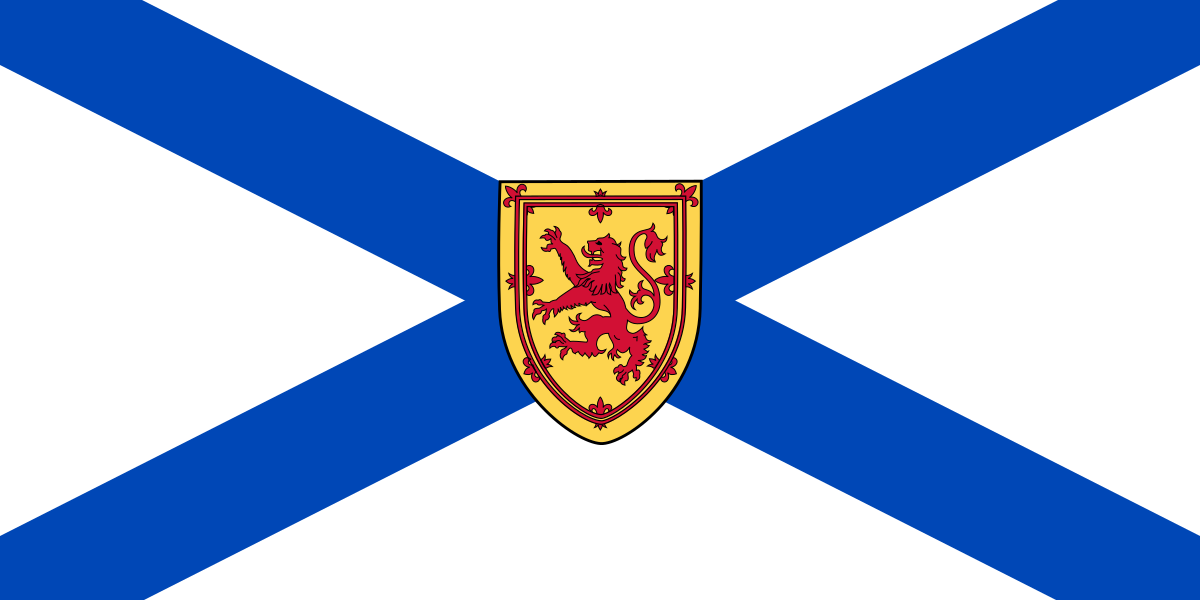
Nova Scotia is a Canadian province on the Atlantic coast, known for its long shoreline, working harbours, island-dotted waters, and Halifax as its capital. It is one of the Maritime provinces and includes mainland Nova Scotia, Cape Breton Island, and thousands of smaller coastal islands. Its shape, climate, and seafaring economy have made it a place where shipbuilding, fishing, and coastal settlement have strongly shaped local architecture and visual culture.
- Province on Canada’s Atlantic coast, with Halifax as the capital
- Part of the Maritimes and Atlantic Canada
- Second-smallest Canadian province by area, but one of the most densely settled in the region
- Includes Cape Breton Island and about 3,800 coastal islands
- Known for lighthouses, fishing villages, harbours, and weathered coastal building materials
Why Nova Scotia looks the way it does
Nova Scotia’s geography has had a direct effect on how people build and live there. The province is wrapped in bays, inlets, headlands, and offshore islands, which encouraged small port settlements rather than one inland centre. Buildings near the coast have had to handle salt air, wind, fog, wet winters, and severe storms, so durable materials and simple forms have often mattered more than ornament.
This setting helped produce a practical vernacular architecture: wood-frame houses, clapboard siding, steep roofs, small porches, and outbuildings suited to storage, nets, and tools. In many older communities, the harbour still shapes the street plan. Roads follow the shore, and buildings face the water because the water was the route of trade, work, and daily life.
What makes Nova Scotia distinctive?
Nova Scotia’s identity comes from the mix of its landscapes and its layered settlement history. Mi’kmaq presence predates European colonisation, and later French, British, Scottish, Irish, African Nova Scotian, and other communities all contributed to the province’s culture. That history appears in place names, churches, cemeteries, fishing stations, folk music, and building traditions.
For visual culture, the province is especially associated with a particular coastal atmosphere: painted wooden houses, salt-stained shingles, working wharves, lobster traps, boats on moorings, and roads cutting through spruce forest or over open rock. Cape Breton adds a different register, with rugged uplands, a strong musical and craft tradition, and a landscape that feels more exposed and dramatic than the sheltered bays of the mainland.
Why does Nova Scotia matter in design and photography?
Nova Scotia has long appealed to artists, photographers, and designers because it offers a strong relationship between built form and environment. The province’s towns often show how modest buildings can become visually memorable when repeated along a harbour edge or set against fog, cliff, or tidal water. Even common materials such as painted timber, corrugated metal, and concrete take on character in this context.
In contemporary practice, Nova Scotia appears in projects that use coastal light, vernacular references, and restraint rather than heavy decoration. A modern house may borrow the compact massing of a fisherman’s cottage, use board-and-batten cladding or shingles, and frame the sea with large openings. In photography, the province is often used as a subject for weather, texture, and seasonal change: ice, mist, bare trees, red soil, granite, and weathered paint.
What does it look like in practice?
In everyday life, Nova Scotia often presents as a working coastal place rather than a polished resort. Fishing harbours still contain wharves, sheds, lobster gear, and boats; small towns may centre on a main street, a church, a school, and a dock; and domestic architecture frequently balances comfort with toughness. Even newer buildings often echo the scale and material logic of older ones because the climate rewards continuity.
That same logic influences interiors and objects as well. Local design often favours natural wood, durable finishes, and a direct relationship to light and view. The province’s visual language is therefore not just scenic; it is structural. Its best-known images come from what has been built to withstand its conditions and support its industries.
Frequently Asked Questions
Is Nova Scotia an island?
No. Nova Scotia is a peninsula connected to mainland Canada, though it also includes Cape Breton Island and thousands of smaller offshore islands. The peninsula form is part of why the province has such an extensive coastline and so many sheltered harbours.
Why is Halifax so important?
Halifax is the provincial capital and the largest urban centre in Nova Scotia. Its harbour made it a major port, naval base, and administrative centre, so the city became the province’s main economic and cultural hub. Many of the province’s institutions, universities, and design firms are concentrated there.
What materials are most associated with Nova Scotia architecture?
Wood is the most characteristic material, especially in frame houses, shingle siding, and painted clapboards. In coastal settings, builders also use metal roofing, stone foundations, and other durable finishes that cope better with salt, moisture, and wind. Modern projects often keep those material cues even when the form is contemporary.
At a glance
- Address
- Canada
- Coordinates
- 45, -63
Articles mentioning Nova Scotia

