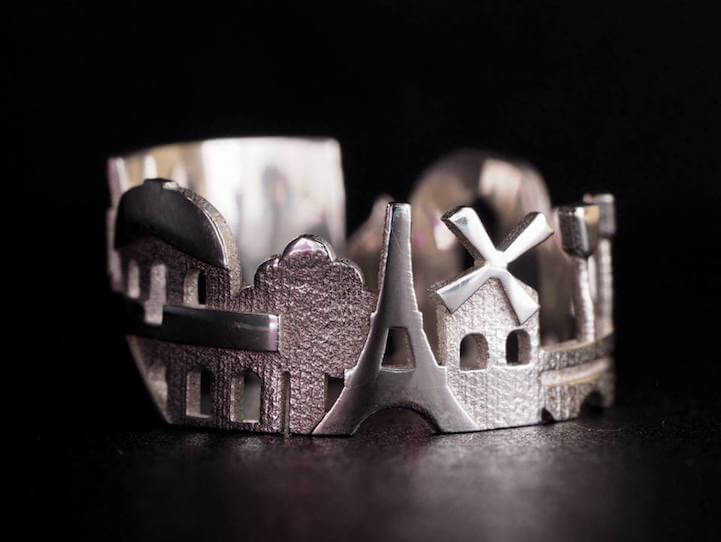
Ola Shekhtman is a jewellery designer whose work turns city landmarks and architecture into wearable objects, most visibly in rings shaped around famous skylines and buildings. Her pieces sit between adornment and miniature sculpture, using metalworking and careful silhouette design to compress recognisable places into compact forms.
| Field | Jewellery design |
|---|---|
| Known for | Architecture-inspired rings and other wearable cityscapes |
| Materials | Typically precious metals and finished jewellery components, often chosen to hold crisp architectural outlines |
| Style | Graphic, figurative, and place-specific |
| Why it matters | Shows how contemporary jewellery can act as a form of memory, identity, and urban portraiture |
What Shekhtman makes
Shekhtman’s work treats buildings as forms with emotional and visual weight, not just as backdrops for everyday life. In her rings, façades, towers, domes, and skylines become raised profiles that wrap around the finger. The effect is immediately legible: the object reads as jewellery first, but as a named place a second later.
This approach depends on translation. A landmark has to be simplified until its outline survives at a small scale, while still carrying enough detail to feel specific. That means balancing proportion, depth, and negative space so the ring remains wearable and the architecture remains recognisable.
How are architecture rings made?
Architecture-inspired jewellery usually begins with drawing. The designer studies the skyline, façade, or building profile, then reduces it to a contour that can work in metal. At ring scale, the challenge is structural as much as visual: thin projections can bend, and heavy forms can make the piece uncomfortable or unstable.
That is why these pieces often rely on precise fabrication methods such as casting, laser cutting, soldering, or detailed hand-finishing. The surface may be polished to emphasize the silhouette, or textured to suggest stone, brick, or the density of a city. Even when the result looks playful, the making requires a strong understanding of scale, balance, and wearability.
Why does this kind of jewellery matter?
Shekhtman’s work belongs to a wider interest in jewellery as storytelling. A ring can mark a place lived in, loved, visited, or imagined. By turning architecture into adornment, the designer gives city imagery a more intimate function: it moves from public space to the body.
This matters because jewellery often carries personal meaning through form alone. A skyline ring can work as souvenir, identity token, or design object, depending on who wears it. It also bridges disciplines that are usually kept apart: graphic design, urban imagery, and craft-based metalwork.
How to read the work on the finger
Seen in practice, an architecture ring is partly about recognition. The viewer may notice the outline of a famous building, a city block, or a whole skyline before identifying the maker. That first glance matters, because the piece depends on visual shorthand: enough information to signal a place, not so much that the form becomes cluttered.
The strongest examples make scale feel strange in a productive way. A cathedral, tower, or cluster of buildings becomes a small wearable horizon. That compression is the core of the idea, and it is what gives Shekhtman’s jewellery its impact: a city reduced to a gesture, then carried on the hand.
Frequently Asked Questions
Is Ola Shekhtman a sculptor or a jewellery designer?
She is best understood as a jewellery designer, because the work is made to be worn and to function as adornment. The pieces have sculptural qualities, but their success depends on comfort, scale, and the practical demands of jewellery making. That combination places the work firmly in the field of contemporary jewellery.
What makes her rings different from ordinary souvenir jewellery?
Souvenir jewellery often uses a place name or a generic symbol. Shekhtman’s work builds the place into the form itself, using the architecture as the structure of the ring. The result feels more considered and more visual, closer to a small design object than a stamped keepsake.
Why do architecture and jewellery work so well together?
Both depend on proportion, outline, and attention to detail. Architecture already uses silhouette to communicate identity, and jewellery uses the body to give objects scale and intimacy. When the two are combined, the piece can carry both personal meaning and recognisable place-based imagery.
Articles mentioning Ola Shekhtman