
Old Tjikko is a Norway spruce in Sweden that has survived for about 9,550 years by repeatedly regenerating from the same root system. It stands on Fulufjället Mountain in Dalarna and is known as the world’s oldest identified living individual clonal tree. Its age was established by radiocarbon dating of material from the root system, not by counting rings in the visible trunk.
Stories from Old Tjikko
1 story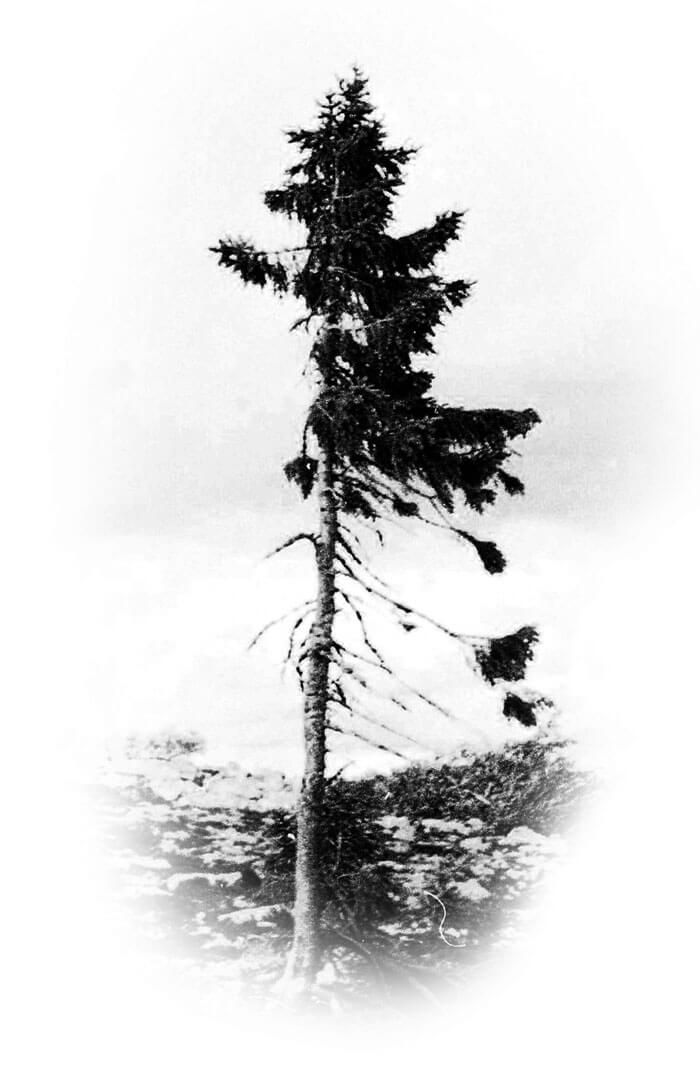
About Old Tjikko
- Species: Norway spruce (Picea abies)
- Location: Fulufjället Mountain, Dalarna, Sweden
- Claim to fame: Oldest known living individual clonal tree
- How its age was dated: Radiocarbon dating of roots and associated organic remains
- Why it matters: It shows how a tree can persist far longer than any single trunk can live
Read the full overviewWhat makes Old Tjikko unusual?, How was it dated?, Why does Old Tjikko matter?, What does it look like in practice?
What makes Old Tjikko unusual?
Old Tjikko is not old in the way a broad-trunked oak or pine is old. The above-ground stem visible today is comparatively young, because Norway spruce can clone itself by sending up new trunks from an ancient root system. When the stem dies back or is damaged, the organism can survive below ground and produce another stem later.
That makes Old Tjikko a single living organism with a very long biological history, even though the trunk in view is only one recent expression of it. This distinction matters because a tree’s visible wood can be replaced many times while the root system continues to live. Old Tjikko became famous precisely because it forced a clearer separation between an individual tree and a clonal lineage.
How was it dated?
The age of Old Tjikko was determined through carbon dating of material from the root system and nearby remains, which pointed to a lineage that began at the end of the last Ice Age. Dendrochronology, the counting of annual growth rings, could not provide the answer because the present trunk is too young and the oldest surviving parts are underground. The number attached to Old Tjikko therefore refers to the age of the clone, not the age of any single stem.
This method is important because it reflects how difficult it can be to date long-lived clonal plants. A single tree ring sequence only tells part of the story. In clonal species, the living organism can outlast its visible parts by thousands of years, which means the oldest living plant may look ordinary if judged only by its current stem.
Why does Old Tjikko matter?
Old Tjikko became a reference point in discussions of longevity, climate history, and plant reproduction. It shows how some forest species persist through cycles of fire, cold, and regrowth without needing an uninterrupted above-ground trunk. In that sense, it is less a monument of timber than a record of ecological endurance.
Its fame also sharpened public attention on the difference between the oldest tree and the oldest living organism. Clonal colonies such as Pando in the United States may be much older overall, but they are made up of many connected stems. Old Tjikko is valuable because it represents a single genetic individual whose lineage reaches deep into post-glacial Europe.
What does it look like in practice?
Visitors expecting a giant ancient trunk often find something more modest. The present stem is small and slender, because it is only the latest growth from an old root system. The real age of the plant is hidden underground, where roots and dormant tissues have persisted across millennia.
That contrast between visible youth and hidden antiquity is what makes Old Tjikko so compelling. It is not a ruin and not a relic in the usual sense. It is a living process, with old biology continuing through repeated renewal.
Frequently Asked Questions
Is Old Tjikko the oldest tree in the world?
It is often described as the oldest known living individual clonal tree. That is not the same as the oldest organism overall, because some clonal colonies are older if all their connected stems are counted together. The exact title depends on how “tree” and “individual” are defined.
Why not count the rings?
The visible trunk is too young to represent the full age of the organism, and much of the oldest material is underground. Tree rings only date the current stem, not the ancient root system that keeps producing new growth. Radiocarbon dating was the better tool for this case.
Can a tree really live for thousands of years?
A single upright trunk usually cannot, but some species can survive by cloning themselves from the same root system. In Old Tjikko’s case, the organism renews its above-ground body while the lineage persists. That makes extreme longevity possible without an unbroken trunk.