
Paul Octavious is a Chicago-based photographer and designer whose work moves between editorial image-making, commercial campaigns, and personal projects. He is known for photographs that feel carefully staged but still lively, with a strong sense of color, arrangement, and object-like clarity. His pictures have appeared in major magazines and newspapers, and his client list includes Nike, Wired, The New York Times, Mercedes, and Hermès.
Paul Octavious on FreeYork

About Paul Octavious
| Essential fact | Detail |
|---|---|
| Based in | Chicago, Illinois |
| Primary work | Photography and design |
| Common output | Editorial photography, commercial imagery, visual concepts |
| Clients | Nike, Wired, Printing, The Wall Street Journal, Mercedes, Hermès, The New York Times |
| Representation | tinker street* |
What kind of photographer is Paul Octavious?
Octavious works as both a photographer and a designer, and that combination shapes how his images read. The design background shows in the way he handles composition, spacing, and visual rhythm. His photographs often look built rather than merely captured, which gives them a polished but not sterile character.
That approach suits editorial and commercial assignments, where an image has to communicate quickly and with precision. It also leaves room for eccentricity. In the work associated with his name, ordinary subjects can become graphic, playful, or quietly surreal through careful framing and controlled color.
Where did his work appear?
Octavious has worked for a wide spread of clients and publications. On the commercial side, brands and titles such as Nike, Mercedes, Hermès, Wired, Printing, and The Wall Street Journal point to a practice that can adapt to different audiences without losing its visual fingerprint. His photographs have also been featured in the New Yorker, the New York Times, swissmiss, Huffington Post, the Paris Review, and The Fox Is Black.
That range matters because it places him in the overlapping space between independent image-makers and commissioned professionals. The same sensibility can travel from a magazine feature to a brand campaign, which usually means a strong command of lighting, prop use, and color structure. It also suggests an image-making process that is collaborative but still authorial.
What does his work look like in practice?
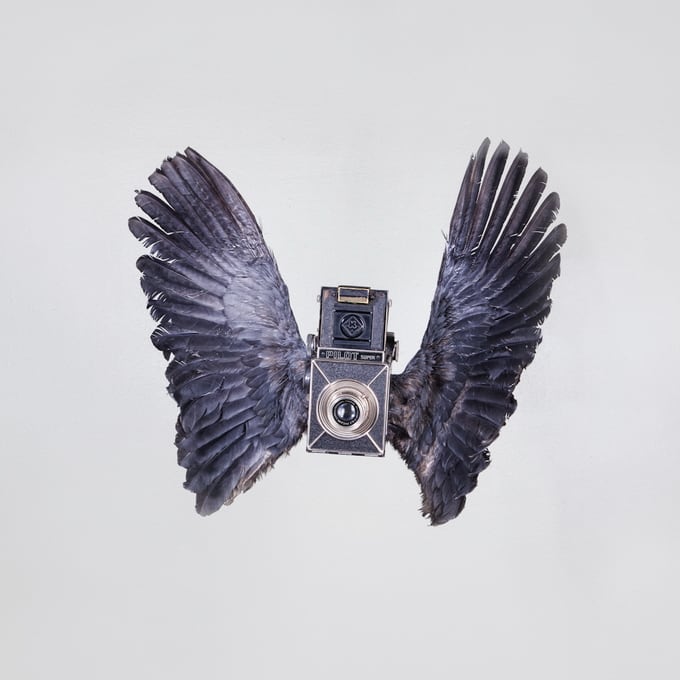
Two tagged projects help show the range of his practice. Vivid Portraits of Adoptable Dogs suggests a portrait approach that uses staging and clear visual tone to make subjects memorable without overcomplicating them. Birds Of Aperture points to a more concept-driven project, where the camera, the frame, or the idea of aperture itself becomes part of the subject. Both titles imply that Octavious treats photography as a constructed visual language, not just documentation.
In practical terms, that usually means attention to set-up, background, and object placement. The work tends to rely on crisp surfaces, straightforward legibility, and a designer’s sense of balance. Rather than burying the subject in atmosphere, it isolates and organizes it so that the image lands quickly.
Why does Paul Octavious matter?
Octavious matters because he represents a contemporary kind of image-maker who moves comfortably between editorial culture, advertising, and personal experimentation. That flexibility is increasingly important in visual media, where photographers are often expected to think like art directors, producers, and designers at once. His practice shows how those roles can overlap without flattening the work.
He is also part of a broader Chicago design and photography scene that values smart composition and visual wit over heavy-handed spectacle. The work associated with him demonstrates how a photograph can be both accessible and carefully authored. It is made to be seen quickly, but it rewards close looking because the structure has been thought through.
Questions
Is Paul Octavious mainly a photographer or a designer?
He is both. The available descriptions consistently place him in photography and design, and that combination is visible in the way his images are composed. His work reads as photographic, but it often carries the logic of layout and art direction.
What kinds of clients does he work with?
His client list includes fashion, technology, publishing, and general-interest media. Names such as Nike, Wired, The Wall Street Journal, Mercedes, Hermès, and The New York Times show that his practice spans both commercial and editorial contexts. That range suggests versatility rather than a single niche.
What is distinctive about his visual style?
His images tend to be clean, deliberate, and carefully arranged. Color, shape, and subject placement seem to matter as much as the subject itself. The result is work that feels controlled but not dull, with enough visual personality to stand apart in busy publication and advertising settings.