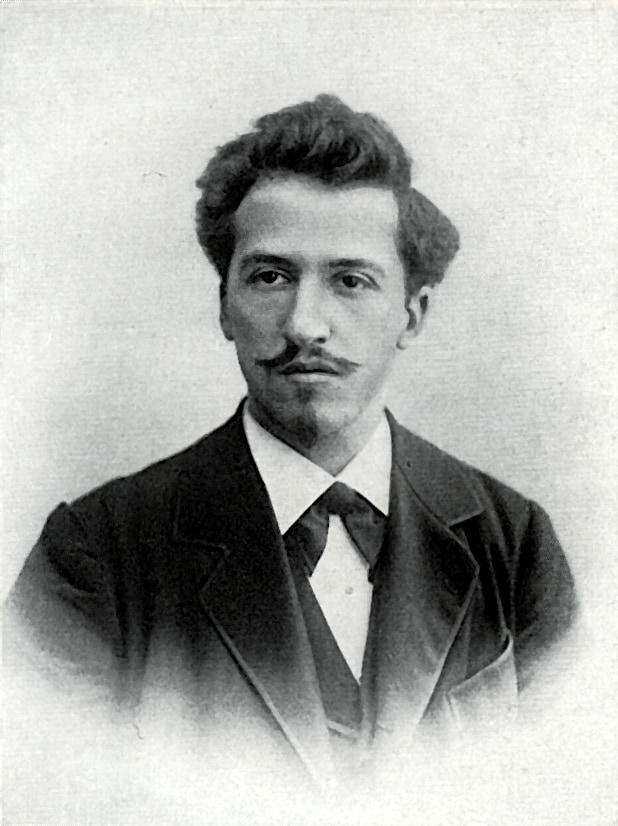
Piet Mondrian was a Dutch painter whose strict grids of black lines, white ground, and primary colors became one of the clearest visual languages of modern art. Starting from landscape painting, he moved toward abstraction and helped shape De Stijl, the Dutch avant-garde movement associated with Theo van Doesburg. His work gave geometric reduction a moral and aesthetic force that still shows up in fashion, graphics, interiors, and furniture.
- Born Pieter Cornelis Mondriaan in 1872 in Amersfoort, the Netherlands; later shortened his name to Mondrian.
- Early paintings showed trees, farms, mills, and rivers before he turned to abstraction.
- Developed Neo-Plasticism, a theory of art based on straight lines, right angles, and limited color.
- Used a small palette: black, white, gray, and the primary colors red, blue, and yellow.
- His visual system became a lasting reference for designers, architects, and fashion makers.
How did Mondrian get from landscapes to grids?
Mondrian began as a conventional Dutch painter, trained in a period when landscape and naturalism still dominated serious art. His early canvases show the influence of rural Holland: trees, windmills, church facades, and water rendered with careful observation. Over time, he simplified these subjects into flatter shapes and stronger verticals and horizontals, especially in his tree studies, where branches begin to break into a lattice of lines.
That process accelerated after he encountered Cubism in Paris and absorbed the wider push toward abstraction in the 1910s. Instead of painting the visible world, he tried to identify its underlying order. By the time he joined the circle around De Stijl, he had arrived at a spare vocabulary of orthogonal lines, asymmetrical balance, and carefully placed blocks of color.
What is Neo-Plasticism?
Mondrian called his mature theory Neo-Plasticism, or “new plastic art.” The term sounds technical, but the idea is direct: painting should avoid imitation and rely on the most elementary visual relations. He believed that straight vertical and horizontal lines, together with primary colors and non-color fields, could express universal harmony more clearly than representational images.
In practice, this meant eliminating curves, diagonals, illusionistic depth, and descriptive detail. The finished paintings often look simple, but their structure is exacting. Line thickness, color placement, and the size of each rectangle matter to the whole composition; a small change can upset the balance. Mondrian treated the canvas almost like a field of tensions that had to be held in equilibrium.
What does a Mondrian painting look like in practice?
The best-known Mondrian works use a white or off-white ground divided by black lines into unequal rectangular compartments. Some of those compartments remain empty, while others receive blocks of red, yellow, or blue. The effect is not mechanical repetition but controlled variation: no two compositions are identical, and many rely on asymmetry to stay alive.
Later paintings became more dynamic. In works such as Broadway Boogie Woogie, painted after Mondrian moved to New York, the black grid loosens into a network of colored dashes that suggest the rhythm of the city and jazz music. Even there, the same principles remain visible: order, interval, and the tension between stability and movement.
Why does Mondrian matter outside painting?
Mondrian matters because his work crossed quickly from fine art into design culture. His compositions offered a ready-made visual system for twentieth-century modernism: clear, modular, and easy to adapt to printed matter, interiors, product design, and clothing. Designers did not just borrow the look; they borrowed the idea that form could be reduced to a disciplined set of rules.
That is why Mondrian still appears in fashion and branding. Garments and objects inspired by him usually echo the black grid and primary-color blocks, translating a painted surface into seams, panels, and fabric pieces. The appeal comes from the same source as the original paintings: a sense of order made visible through materials and construction.
What role did he play in De Stijl?
De Stijl began in the Netherlands in 1917 as a broad movement for radical simplification in art, architecture, and design. Mondrian was one of its key figures, though he was not always easy to align with the group’s other members. His writing and painting gave the movement a rigorous theoretical core, especially its commitment to abstraction and reduction.
He differed from some collaborators because he pursued a very pure form of non-representation. Theo van Doesburg, the movement’s founder, later introduced diagonals and a looser approach, which Mondrian resisted. That disagreement shows how central Mondrian’s own standards were: he was not just producing a style, but defending a method.
Frequently Asked Questions
Is Mondrian’s style just a simple grid?
No. The grid is only the most visible part of a larger system of proportion, tension, and placement. Mondrian carefully adjusted the size of each rectangle, the thickness of each line, and the balance of color and empty space. The paintings look austere because the structure is so tightly controlled.
Did Mondrian always paint abstract work?
No. He started with landscapes and other natural subjects, and those early works mattered to his later development. Abstraction did not appear all at once; it emerged through gradual simplification and repeated study of trees, buildings, and scenery. The mature style grew out of observation rather than rejecting it from the start.
Why is Mondrian so common in design and fashion?
His work translates well into cut-and-sew construction, print layouts, and modular design systems. The black lines resemble seams or panel edges, and the primary colors create strong contrast on simple surfaces. That makes his visual language easy to adapt without losing its identity.