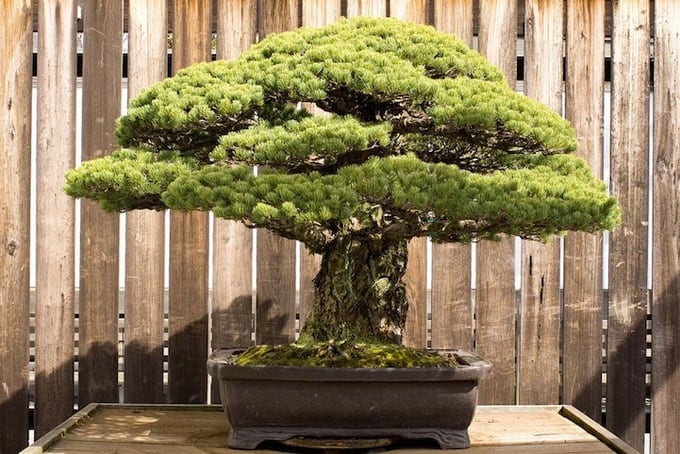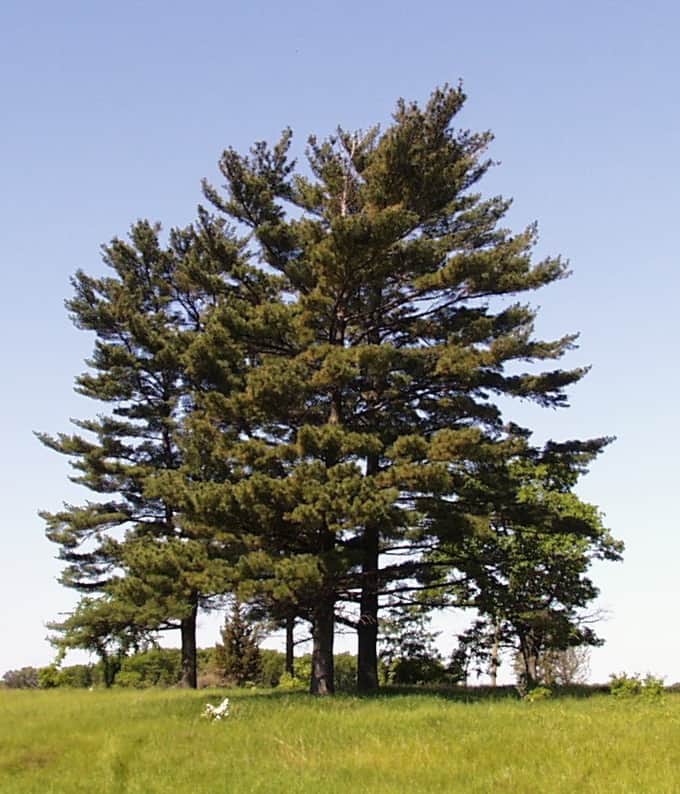
Pinus strobus, the eastern white pine, is a large North American pine valued for its straight trunk, soft pale wood, and fast growth. It is native to eastern North America, from Newfoundland and the Great Lakes region south through the Appalachian Mountains and parts of the Mississippi basin. The tree has long carried cultural meaning for the Haudenosaunee, who know it as the Tree of Peace, and it also matters in woodworking, log building, and historic timber trade.
- A tall, straight conifer with long, flexible needles grouped in fives.
- Known for light, workable wood with relatively low density and fine grain.
- Native to eastern North America and widely planted beyond its original range.
- Used in cabins, trim, paneling, furniture, and carved objects.
- Holds cultural significance in Haudenosaunee tradition as the Tree of Peace.
What makes eastern white pine distinctive?
Eastern white pine is easy to recognize once its form is familiar. It grows with a tall central leader, layered branches, and soft blue-green needles that hang in bundles of five. Mature trees can become very large, with trunks that stay relatively straight and clear of knots for long sections. That growth habit made the species valuable wherever builders needed long, even timber.
The wood itself is pale, lightweight, and easy to cut, plane, and carve. It does not have the hardness of oak or maple, but that softness is often an advantage in making. Cabinetmakers, joiners, and cabin builders use it when they want a material that moves cleanly under saws and chisels and takes finish without much resistance.
Why does white pine matter in making?
Pinus strobus became one of the defining construction woods of colonial and early industrial North America. Its boards and beams were used in framing, ship masts, interiors, doors, and millwork. Because it grew in abundance in the Northeast and around the Great Lakes, it shaped regional building practice as much as local stone or clay did elsewhere.
In contemporary work, white pine still appears in log cabins, panelled rooms, rustic furniture, turned objects, and carved boxes. It is especially common where a maker wants a warm, natural look without the heavy visual weight of darker species. In the articles tagged with this tree, it appears as a building material in cabins and as a carved block of wood turned into a money box, showing how a single species can serve both structural and decorative ends.
How is it used in cabins and woodcraft?
In log and post-and-beam construction, white pine offers a combination of length, workability, and visual calm. Logs can be peeled and shaped without excessive tool wear, and the finished surfaces read as pale, even, and relatively clean. That suits cabin interiors, where broad boards and exposed timber create a plain, open atmosphere rather than a dark, heavily grained one.
For small-scale woodworking, the species carves predictably. A maker can block it out, hollow it, and refine it with hand tools without fighting the grain. That makes it useful for boxes, toy forms, architectural models, and other pieces where the wood itself should stay present but not dominate the design.
What is its cultural and historical significance?
For the Haudenosaunee, the white pine is the Tree of Peace, a powerful symbol tied to the formation of the Great Law of Peace. In that tradition, the tree is associated with agreement, shelter, and the joining of nations under a shared political order. Its cultural meaning is not decorative or metaphorical in a loose sense; it belongs to a specific living history and protocol.
Elsewhere, the tree became entangled with extraction. Eastern white pine forests were heavily logged over centuries because the species produced long, usable timber at scale. That history matters when the tree appears today in buildings or craft objects: it is not just a pleasant softwood, but part of a long story of ecological change, trade, and land use.
Frequently Asked Questions
Is eastern white pine the same as white pine?
Yes. White pine is one of the common names for Pinus strobus, along with eastern white pine and northern white pine. In everyday use, “white pine” usually refers to this species unless a local context suggests another pine group.
What does white pine wood look and feel like?
It is pale, often creamy white to light yellow, with a fairly straight grain and a subdued figure. The wood feels soft under a blade or plane and tends to dent more easily than dense hardwoods. That softness is part of why it is so easy to shape.
Why is Pinus strobus important to designers and builders?
It offers a practical balance of availability, length, weight, and workability. Designers and builders use it when they want a natural material that can be cut efficiently and read as calm and bright in finished interiors. Its historical role in North American building also gives it a strong place in vernacular architecture.
Articles mentioning Pinus strobus