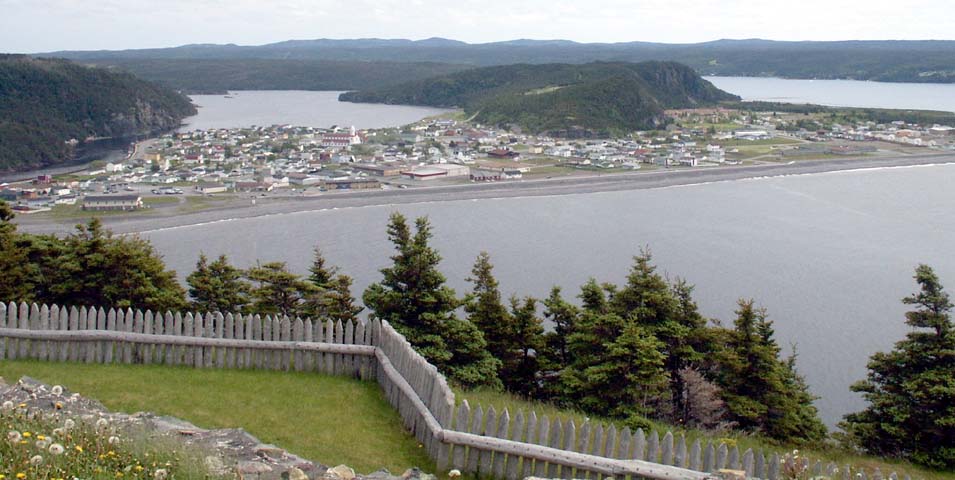
Placentia is a town on the southwest Avalon Peninsula in Newfoundland and Labrador, formed from the amalgamated communities of Jerseyside, Townside, Freshwater, Dunville, and Argentia. It sits on Placentia Bay and combines a long fishing and settlement history with a later military and industrial footprint, especially around Argentia. The town matters as a working coastal place where domestic life, port activity, and layered colonial history meet.
| Fact | Detail |
|---|---|
| Province | Newfoundland and Labrador |
| Region | Avalon Peninsula |
| Municipal form | Amalgamated town |
| Component communities | Jerseyside, Townside, Freshwater, Dunville, Argentia |
| Setting | Coastal settlement on Placentia Bay |
| Known for | Fishing heritage, harbour landscape, and the former strategic site at Argentia |
Where is Placentia?
Placentia lies on the southern side of the Avalon Peninsula, facing Placentia Bay. Its geography has shaped every part of its development: sheltered water for boats, nearby shoreline for settlement, and a scattered pattern of neighbourhoods that grew around roads, coves, and harbour edges rather than a single compact centre.
The modern town is an administrative merger of several communities that still retain their own names in local use. That structure matters because Placentia is less a uniform town than a cluster of places joined by municipal government, each with its own history, vernacular, and relationship to the harbour.
Why does Placentia matter?
Placentia is important as a place where Newfoundland’s older coastal economy remains visible. Fishing, boat work, domestic craft, parish life, and small-scale trade all left traces in the built environment and in family networks. The town also carries a strong sense of continuity: surnames, kinship ties, and local memory often span generations and neighbourhoods.
At the same time, Placentia’s history includes larger geopolitical forces. Argentia, now part of the town, became a major military site in the 20th century, bringing wartime infrastructure and outside investment into a place that had long depended on local maritime life. That contrast between intimate settlement and strategic importance gives Placentia a layered identity unusual for a town of its size.
What does Placentia look like in practice?
Placentia presents as a working coastal town rather than a picturesque heritage site preserved in one period. Homes, churches, docks, roads, and open water form the basic visual grammar. The landscape is shaped by weathered shorelines, modest domestic architecture, and the practical buildings that support fishing, transport, and community services.
In practice, the town’s form reflects adaptation. Settlements such as Freshwater or Jerseyside developed around local access to the bay and to overland routes, while Argentia reflects a different register of building and land use, tied to military and industrial history. The result is a place where multiple layers of Newfoundland life remain legible at once.
How has Placentia been represented?
Placentia often appears in writing, photography, and illustration as shorthand for Newfoundland coastal life: weathered surfaces, working boats, family names, and a sense of inherited place. Those representations can flatten the town into nostalgia, but the actual place is more mixed, with signs of migration, consolidation, decline, and reinvention alongside older traditions.
For artists and designers, Placentia can function as a source of visual detail rather than a fixed symbol. Harbour edges, house silhouettes, church forms, road patterns, and the relation between settlement and water offer material for observing how place is built over time. The town’s identity is not only scenic; it is structural, social, and economic.
Frequently Asked Questions
Is Placentia a single historic settlement?
No. The modern town was created from several communities that were brought under one municipal structure, including Jerseyside, Townside, Freshwater, Dunville, and Argentia. Those names still matter locally and help explain why Placentia feels distributed rather than centred on one main street.
What is Argentia’s role in the town?
Argentia is the part of Placentia most associated with large-scale strategic development in the 20th century. Its military and industrial past distinguishes it from the older fishing-based neighbourhoods and gives the town a second historical layer beyond everyday coastal settlement.
What makes Placentia relevant to visual culture?
Placentia offers a dense example of how place is shaped by labour, migration, and shoreline geography. Its buildings and landscape reflect functional decisions as much as aesthetic ones, which makes it useful for anyone studying vernacular architecture, regional identity, or the visual language of Atlantic Canada.
At a glance
- Address
- Newfoundland and Labrador, Canada
- Coordinates
- 47.245834, -53.961113
Articles mentioning Placentia, Newfoundland and Labrador