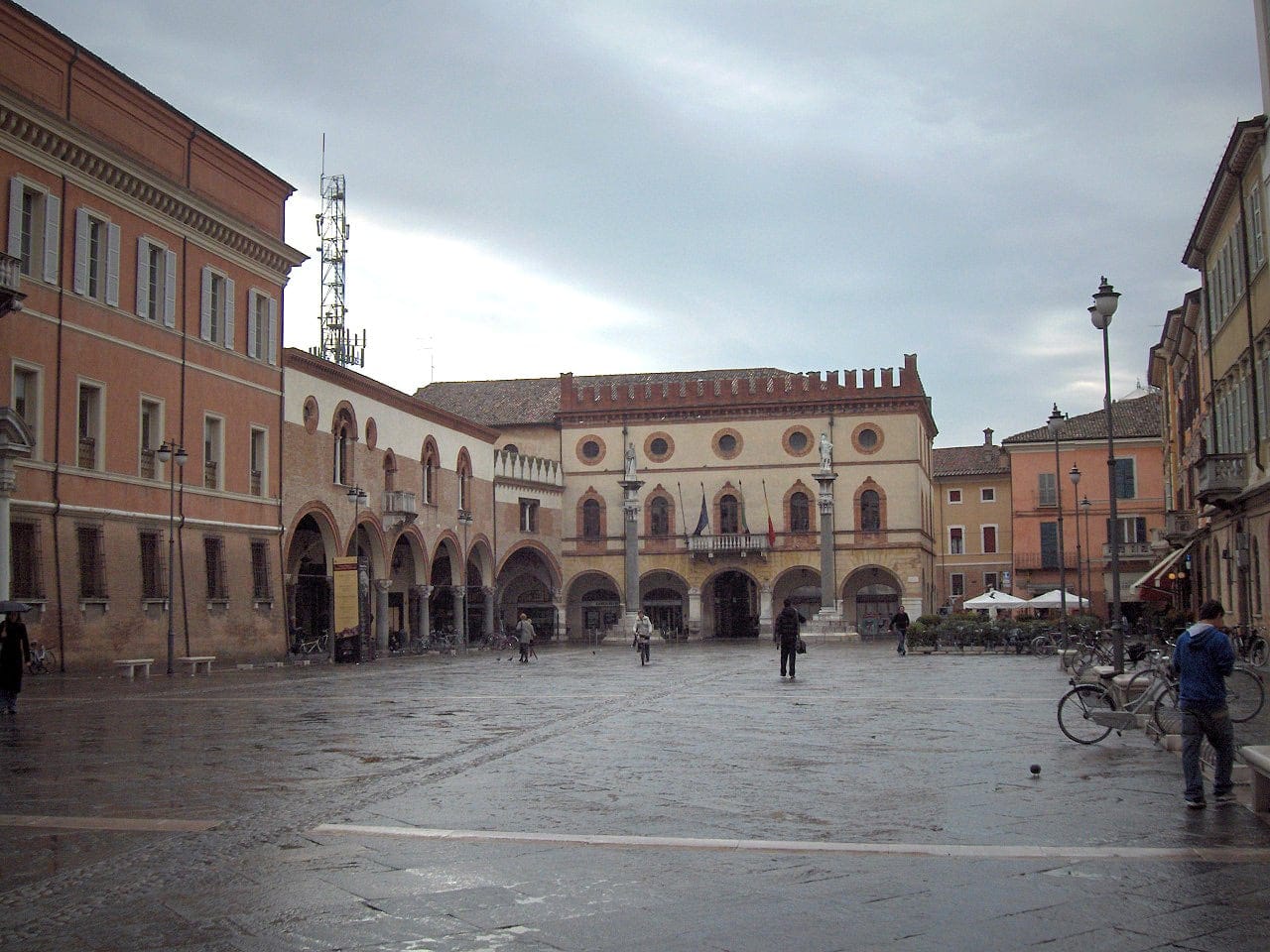
Ravenna is a city in Emilia-Romagna, Italy, known for its early Christian mosaics, late antique monuments, and long history as a seat of imperial power. It served as the capital of the Western Roman Empire from 402 to 476, then of the Ostrogothic kingdom, and later of the Byzantine Exarchate of Ravenna. That layered past left the city with a dense concentration of churches, mausoleums, and baptisteries whose interiors are lined with glass-and-stone mosaic surfaces.
- Ravenna’s fame rests on its mosaics, especially in churches such as San Vitale and Sant’Apollinare Nuovo.
- The city was a political capital for Romans, Ostrogoths, and Byzantines, which shaped its architecture and urban identity.
- Its monuments preserve a rare mix of Roman building forms and Byzantine decorative techniques.
- Ravenna remains important to artists and designers as a place where light, colour, and surface have been worked with exceptional precision.
Why Ravenna matters
Ravenna matters because it preserves some of the most accomplished mosaic programmes in Europe. The technique combines small cubes of coloured glass, stone, and gold leaf-backed tesserae to create images that shift with light rather than sit flat like painted panels. In Ravenna, the effect is atmospheric and architectural at once: walls, apses, and domes become luminous surfaces that frame figures, ornaments, and symbolic scenes.
That material richness gives the city a strong visual identity. Its churches do not rely on sculpture or grand façades to make an impression. Instead, they use interior surface, colour saturation, and repeated pattern to produce a controlled sense of splendour. For anyone interested in how materials shape experience, Ravenna offers a clear example of decoration as structure, not just ornament.
What does Ravenna look like in practice?
The most recognisable works in Ravenna use tesserae set into wet plaster, often at slight angles so they catch light unevenly. Gold backgrounds, blue fields, green vegetation, and stylised figures give the interiors a flattened but radiant appearance. This is not naturalism in the modern sense; it is a visual language built to suggest authority, devotion, and permanence.
That language appears across monuments from different periods, including the Mausoleum of Galla Placidia, the Basilica of San Vitale, and the Basilica of Sant’Apollinare Nuovo. Each uses mosaic differently, but all depend on the same basic craft: careful cutting of materials, precise setting by hand, and a design that treats walls as active visual planes. Ravenna’s importance lies in that continuity of technique across political change.
How did the city become so important?
Ravenna became strategically important because of its geography. Built near the Adriatic coast and surrounded historically by marshy terrain, it was easier to defend than many inland cities. When imperial power shifted in late antiquity, that defensibility made it an attractive capital. Its role under Roman, Gothic, and Byzantine rule brought wealth, administration, and ambitious building projects.
Those regimes did not leave Ravenna as a blank slate. They reused forms such as basilicas, baptisteries, and mausoleums, then filled them with new imagery that reflected changing religious and political claims. The city’s architecture therefore reads as a record of succession: one power after another using stone and mosaic to state continuity, legitimacy, and control.
Why designers and photographers still look to Ravenna
Ravenna remains relevant to contemporary visual culture because it shows how surface can carry meaning. Mosaic works by fragmentation and assembly; it turns tiny pieces into a coherent image while preserving the grain of the material. That logic appeals to artists working with pattern, texture, reflection, and ornate composition, including photographers who study historical costume, theatrical light, and rich interior settings.
In practice, Ravenna offers a model of image-making that is built from material decisions: the size of tesserae, the reflectivity of glass, the placement of gold, and the rhythm of repetition across a wall. Its monuments feel both highly crafted and strangely modern because they depend on close attention to surface effects. That is part of why the city continues to matter far beyond art history.
Frequently Asked Questions
Is Ravenna known mainly for mosaics?
Yes. Ravenna is most famous for its late antique and Byzantine mosaics, which survive in an unusually complete group of monuments. These works are central to the city’s identity and to its place in art history.
Why did emperors choose Ravenna as a capital?
Its defensive position made it easier to hold than many other Italian cities. Marshes and coastal access provided protection and practical links to the eastern Mediterranean. That combination helped Ravenna become a political centre for successive rulers.
What makes Ravenna different from other historic Italian cities?
Many Italian cities preserve Roman ruins, medieval churches, or Renaissance palaces, but Ravenna is especially strong in late antique interiors. Its monuments are valued less for monumental façades than for what happens inside: gold, glass, and stone arranged into luminous fields. That gives the city a quieter exterior and a far richer visual interior.
At a glance
- Coordinates
- 44.416668, 12.2
Articles mentioning Ravenna