
Richard Misrach is an American photographer known for large-scale colour images of landscapes marked by human intervention. His work documents deserts, coasts, industrial sites, military zones, and other places where natural surfaces carry the trace of use, damage, or neglect. He became one of the central figures in the move toward colour photography as a serious fine-art form, and his pictures helped make the large chromogenic print an accepted museum object.
Richard Misrach on FreeYork

About Richard Misrach
- Works primarily in large-format colour photography.
- Focuses on landscapes altered by human activity rather than untouched nature.
- Uses scale, distance, and colour to make environmental change visible.
- Has been widely collected by museums and influential on later photographers.
What kind of photographer is Richard Misrach?
Misrach is best known for turning landscape photography into a record of human impact. Rather than treating landscape as a pristine view, he photographs the residue of activity: oil slicks, burn scars, fences, military debris, waste, and built structures at the edge of wilderness. The result is not documentary in a narrow news sense, but observational and formal, with careful attention to light, horizon lines, and the way colour shapes meaning.
His pictures often feel calm at first glance, then unsettling. That tension is central to his work. A vivid sky or a reflective surface can sit beside evidence of contamination or abandonment, making the image read both as a beautiful picture and as a report on environmental stress.
How did his style develop?
Misrach emerged during the period when American photographers were reassessing colour. For a long time, serious art photography had been associated with black and white, while colour was linked to advertising and amateur pictures. Misrach helped show that large colour prints could carry conceptual weight, formal complexity, and critical force. His work belongs to the same broad shift that made colour central to late twentieth-century photography.
Technically, his pictures rely on large-format cameras and patient composition. That method slows down the act of photographing and produces detail rich enough to reward close looking. It also gives his prints a physical presence that matters in exhibition: the image does not read like a snapshot, but like an object sized to meet the body in a gallery.
Why does his work matter?
Misrach matters because he changed how many artists and viewers understand landscape. He showed that a landscape photograph can be about power, ecology, economics, and history without abandoning visual beauty. In his best-known series, the land is never neutral. It carries the mark of ownership, war, recreation, extraction, or neglect, and the photograph becomes a way to register that mark clearly.
His influence is visible in contemporary photography that treats colour, scale, and environmental damage as linked problems. Many later photographers adopted a similar patience and a similarly expansive print size. Museums collected his work early and often, which helped establish large colour landscape photography as a major field rather than a side note.
What does a Misrach photograph look like in practice?
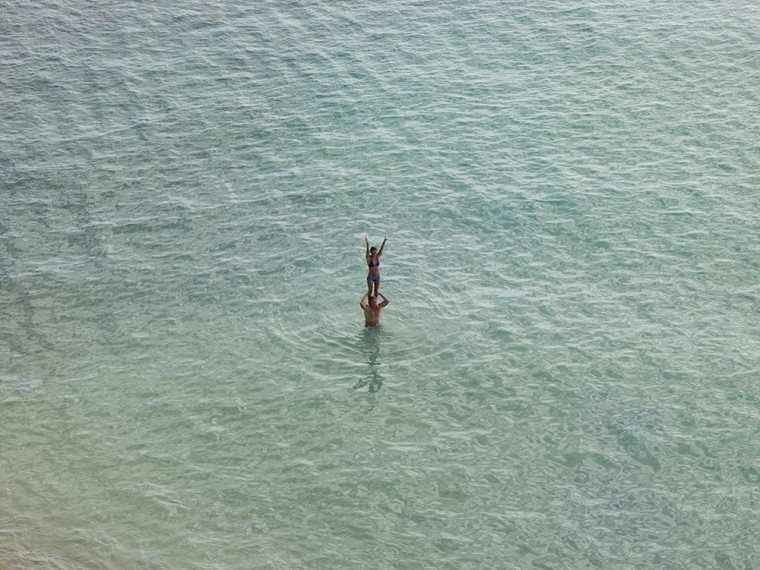
A Misrach image often uses a distant viewpoint and a broad frame. That distance can make a scene appear almost abstract until the viewer notices a fence line, a plume of smoke, a pier, a vehicle track, or debris in the water. He uses colour as description and mood at once: pale sand, rust, sodium light, haze, or sunset can all intensify the sense that the place is both ordinary and altered.
His beach photographs are a good example. Beaches usually carry a promise of leisure and openness, but in his hands they can also show erosion, crowding, pollution, or the awkward meeting of public recreation and private development. The image may hold a clean horizon and a damaged foreground at the same time, which is part of what gives the work its force.
Questions
Is Richard Misrach a landscape photographer?
Yes, but his landscapes are not picturesque views in the traditional sense. He photographs places where the human presence is visible in the terrain itself, whether through industry, military use, recreation, or environmental damage. That makes his work a form of landscape photography with a strong environmental and social dimension.
Why is his work associated with large-scale colour photography?
Misrach used colour at a time when many serious photographers still favoured black and white, and he printed on a large scale. That combination gave his work gallery presence and made colour feel deliberate rather than decorative. It also helped establish colour photography as a medium capable of sustained, serious artistic argument.
What makes his beach photographs distinct?
They treat the beach as a contested space rather than a simple scene of leisure. His beaches can show weather, commerce, waste, infrastructure, or the pressure of development, all while maintaining a composed, expansive image. The result is a photograph that looks open and serene but carries evidence of use and disruption.