
Roman De Giuli is a German photographer and filmmaker known for practical effects built from fluids, powders, pigments, and paper. He makes close-up images and films that turn tiny handmade surfaces into large, cinematic scenes, often with the help of macro optics, 8K capture, and sound design.
Roman De Giuli on FreeYork
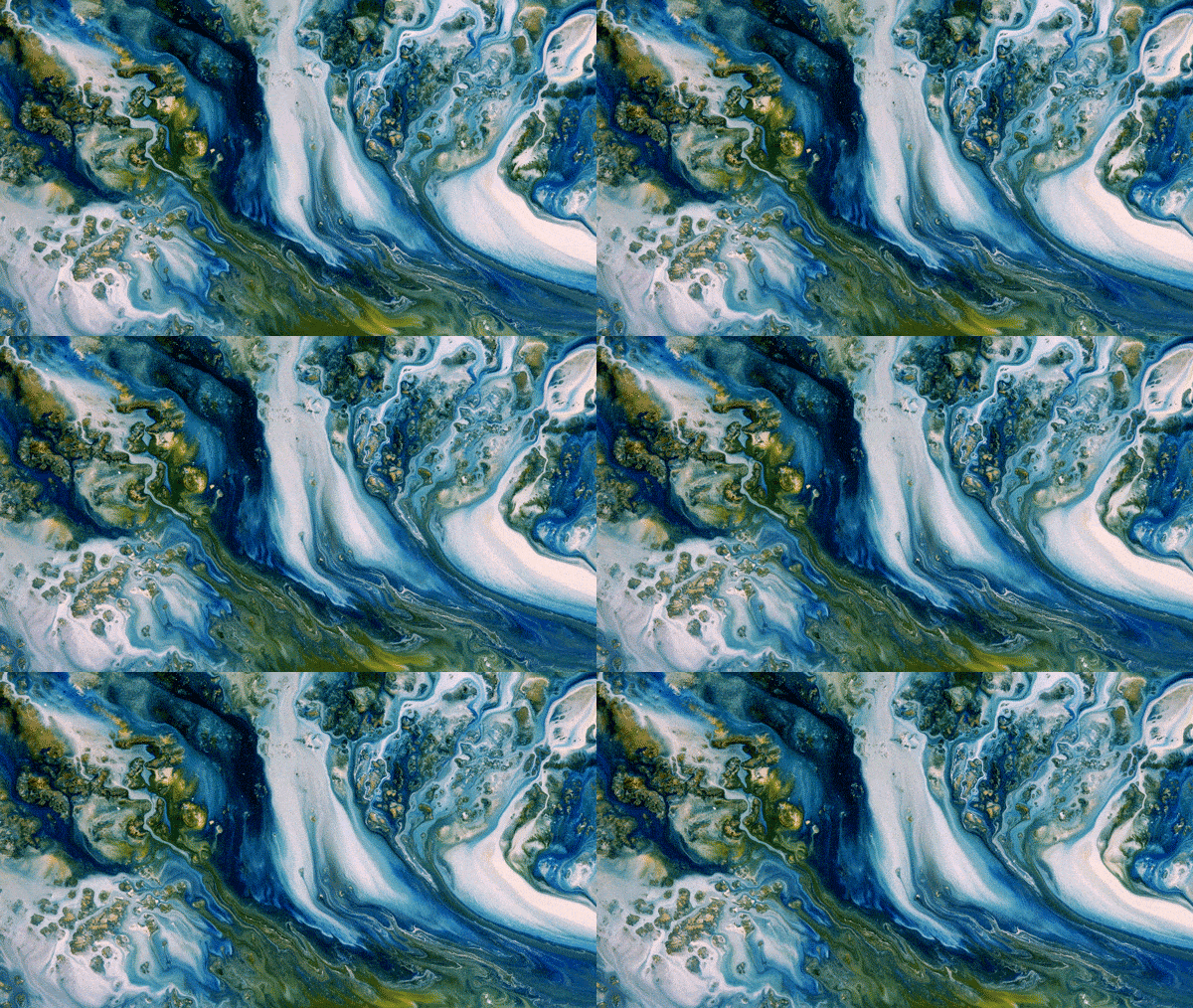
About Roman De Giuli
- He works at the point where photography, filmmaking, and material experimentation meet.
- His images are built physically, not digitally, using liquid movement, colour, and texture.
- He specialises in tiny sets that only reveal their detail through magnification.
- Since 2015 he has run Terracollage Studio in Nürnberg, Germany.
- His work appears in installations, advertising, television, and cinema.
What kind of work does Roman De Giuli make?
De Giuli creates visual scenes from real materials placed on paper and other small surfaces. Fluids spread, pool, and collide with powders and pigments; he then photographs or films the results at very high resolution. The final image often reads like an abstract landscape, a microscopic environment, or a special-effect plate, even though it began as a tabletop experiment.
That practical method matters. Rather than simulating flow and texture entirely in software, he uses actual physical behaviour as the source of the image. The result carries the unpredictability of wet material: edges feather, colours mingle, and forms appear to move even when they are static.
How does his process work?
De Giuli’s process depends on scale. He works on very small surfaces, then enlarges the material through macro lenses and high-resolution cinema cameras. This approach lets the surface behave like a terrain: drops become boulders, ripples become ridges, and stains become atmospheric fields.
His work also relies on observation. He studies organic patterns and how they change under pressure, motion, and contact. Music and sound design are part of the edit, shaping the rhythm of the final montage and giving the images a cinematic pace rather than leaving them as isolated still compositions.
Why does this matter?
De Giuli belongs to a line of image makers who treat materials as collaborators. His work shows that practical effects can still produce strange, convincing, and emotionally suggestive worlds without relying on conventional set-building or digital compositing. That makes his practice relevant to experimental film, commercial motion design, and contemporary visual culture more broadly.
It also highlights the craft side of image production. In his work, the decisive moment happens in the handling of matter: how the liquid is placed, what powder is introduced, how colour spreads, and when the camera records the change. The visual style comes directly from material behaviour.
Where is his work seen?
Since 2015, De Giuli has operated Terracollage Studio in Nürnberg, Germany. From there he produces visuals for media installations in public space as well as for advertising, television, and cinema. That mix of contexts suggests a practice that can move between gallery-like presentation and commercial briefs without giving up its experimental core.
His short-film and installation work tends to retain the same look: dense colour, visible texture, and a sense that the image is in motion even when the frame is still. The style is recognisable because it comes from method, not just from surface effect.
Questions
Is Roman De Giuli primarily a photographer or a filmmaker?
He works as both. The photographic side of his practice captures the detailed textures and frozen moments of fluid movement, while the filmmaking side turns those materials into sequences and montages. In practice, the two roles overlap because the same physical experiments feed both still and moving images.
What makes his visuals “practical effects”?
Practical effects are made physically in front of the camera rather than assembled entirely in post-production. In De Giuli’s case, that means using inks, pigments, powders, and other fluids to generate the image itself. The camera records real material behaviour, which gives the work its tactile, sometimes unpredictable quality.
Why are macro lenses and high-resolution cameras important to his work?
They let tiny surfaces appear large enough to read as landscapes, systems, or cinematic environments. Without that enlargement, much of the texture and movement would be lost. The high resolution also preserves the fine detail that makes his compositions feel rich rather than merely abstract.