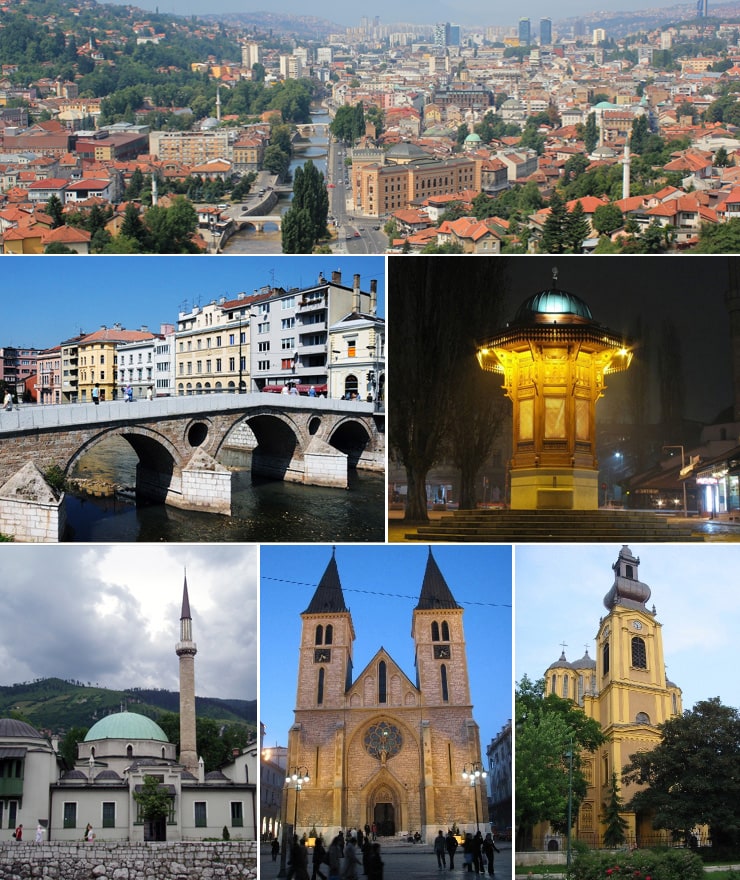
Sarajevo is the capital and largest city of Bosnia and Herzegovina, a city in the Miljacka River valley where Ottoman, Austro-Hungarian, Yugoslav, and postwar Bosnian layers sit close together. It functions as the capital of the Federation of Bosnia and Herzegovina and of Sarajevo Canton, and it has long been a major cultural and political centre in the Balkans.
| Fact | Detail |
|---|---|
| Country | Bosnia and Herzegovina |
| Status | Capital city; capital of the Federation of Bosnia and Herzegovina; centre of Sarajevo Canton |
| Setting | Sarajevo Valley, along the Miljacka River, ringed by the Dinaric Alps |
| Population | About 321,000 in the city proper; about 469,400 in the canton |
Where Sarajevo came from
Sarajevo grew at a crossing point between east and west, and that position shaped its architecture, street plan, and public life. The city expanded under Ottoman rule, when markets, mosques, baths, caravanserais, and narrow streets formed the historic core. In the late nineteenth century, Austro-Hungarian administration added boulevards, civic buildings, and apartment blocks that changed the city’s visual language without erasing the older one.
That overlap is still visible today. A short walk can pass from stone-paved bazaars and courtyards into grand façades, then into socialist-era housing and newer commercial buildings. Sarajevo’s material history is one reason it matters to artists, photographers, and designers: the city offers multiple urban styles in close proximity, each tied to a different political order and building tradition.
Why does Sarajevo matter in visual culture?
Sarajevo matters because it carries history visibly. The city’s built environment records empire, war, reconstruction, and everyday adaptation in brick, plaster, metal, and concrete. For photographers and filmmakers, that gives Sarajevo a strong sense of surface and contrast: worn masonry beside reflective glass, religious buildings beside administrative blocks, steep streets opening to dense façades.
It also matters as a place where memory is part of the streetscape. Signs of the 1990s siege remain in the form of repaired walls, commemorative plaques, and the famous red mortar marks known as Sarajevo roses. These traces are not abstract symbols; they are material interventions left in the city fabric, and they make Sarajevo a place where design, preservation, and trauma are difficult to separate.
What does Sarajevo look like on the ground?
The city is compact, enclosed by hills, and shaped by the river that runs through its centre. The old bazaar area of Baščaršija has timber shopfronts, cobbled lanes, copperware, and low-rise buildings clustered around mosques and small squares. A few blocks away, you find Habsburg-era streets with stone fronts, iron balconies, and formal civic buildings that give the centre a different rhythm.
Beyond the core, the city shifts again. Socialist apartment blocks, later infill, and rebuilt infrastructure spread through the valley, while the surrounding hills make Sarajevo feel both protected and compressed. That topography affects light, movement, and sightlines, which is part of why the city reads so strongly in photographs: it layers enclosure, depth, and abrupt change into one urban frame.
How has Sarajevo been represented and rebuilt?
Sarajevo has often been described through conflict, but that can flatten its actual civic life. The postwar city is not a ruin frozen in time. It is a working capital with universities, media, markets, religious institutions, and a steady program of repair, renovation, and new construction. Reconstruction after the siege involved not only infrastructure but also the restoration of bridges, façades, memorials, and public spaces.
That rebuilding has been uneven, and the city still shows visible differences between preserved, patched, and newly built surfaces. For a designer or photographer, those differences are part of the subject: repair leaves seams, replacements change scale, and new materials sit beside older ones. Sarajevo is therefore less a single style than a working archive of urban making.
Frequently Asked Questions
Is Sarajevo in Europe or the Balkans?
Sarajevo is in Southeastern Europe, within the Balkan Peninsula. It is the capital of Bosnia and Herzegovina and sits inland in a mountain basin rather than on the coast. That position has made it a crossroads city for trade, administration, and migration.
Why is Sarajevo important in history?
Sarajevo has been important for centuries as a regional centre under Ottoman and later Austro-Hungarian rule. It is also closely associated with the assassination of Archduke Franz Ferdinand in 1914, an event that helped trigger World War I. In the late twentieth century, the city became known for the siege of Sarajevo, one of the defining events of the Bosnian War.
What makes Sarajevo distinct for photographers and artists?
Sarajevo offers a dense mix of architectural periods, visible repair, and steep topography. The city produces strong contrasts between historic bazaars, imperial civic architecture, socialist housing, and postwar reconstruction. Those layers give images a clear sense of time, damage, and renewal in the same frame.
At a glance
- Address
- Sarajevo Canton, Bosnia and Herzegovina
- Coordinates
- 43.866665, 18.416666
Articles mentioning Sarajevo