| Born | Not stated in the available record |
|---|---|
| Known for | Design work spanning product, furniture, packaging, and architectural-scale projects |
| Practice | Studio-based, collaborative design with makers, craftspeople, and manufacturers |
| Style | Context-led, materially grounded, and practical |
| Clients | Established brands and early-stage start-ups |
Scott Jarvie is a designer whose practice moves between mass-produced products, one-off furniture, luxury packaging, and architectural-scale work. His output is defined less by a single visual signature than by a consistent method: he combines strong creative ideas with a practical understanding of materials, making processes, and production constraints. That makes his work adaptable across very different briefs without losing clarity or purpose.
What does Scott Jarvie actually do?
Jarvie works across several parts of the design field, which is unusual only because many studios specialise narrowly. One project might require a product destined for large-scale manufacture, while another calls for a bespoke furniture piece made by hand. He also takes on packaging and larger spatial or architectural commissions, so the studio’s range can extend from a small object on a shelf to an intervention that changes how a space is read and used.
The common thread is problem-solving through form, material, and construction. In practice, that means considering not only how something looks, but how it is made, handled, shipped, installed, and experienced. A design outcome may be refined and luxurious, but it still needs to stand up to real-world use.
Why does this approach matter?
Jarvie’s work reflects a model of design that values context over a fixed house style. That matters because products, furniture, and packaging all operate under different pressures. A mass-produced object has to be efficient and repeatable; a one-off piece can absorb more handcraft and experimentation; architectural-scale work brings site, structure, and collaboration into the foreground. His practice treats those differences as design conditions, not obstacles.
This is also why collaborators matter so much in his output. The studio works with skilled craftspeople and manufacturers to build project-specific teams. That allows the right technique to be matched to the brief, whether the answer is upholstery, joinery, textile work, fabrication, or packaging production. The result is design that feels resolved because the making method supports the idea from the start.
How does his work show up in practice?
In practical terms, a Scott Jarvie project tends to balance ambition with control. The form may be bold, but it is anchored by a clear grasp of structure and material behaviour. That can produce objects that feel polished without becoming sterile, or experimental without becoming fragile.
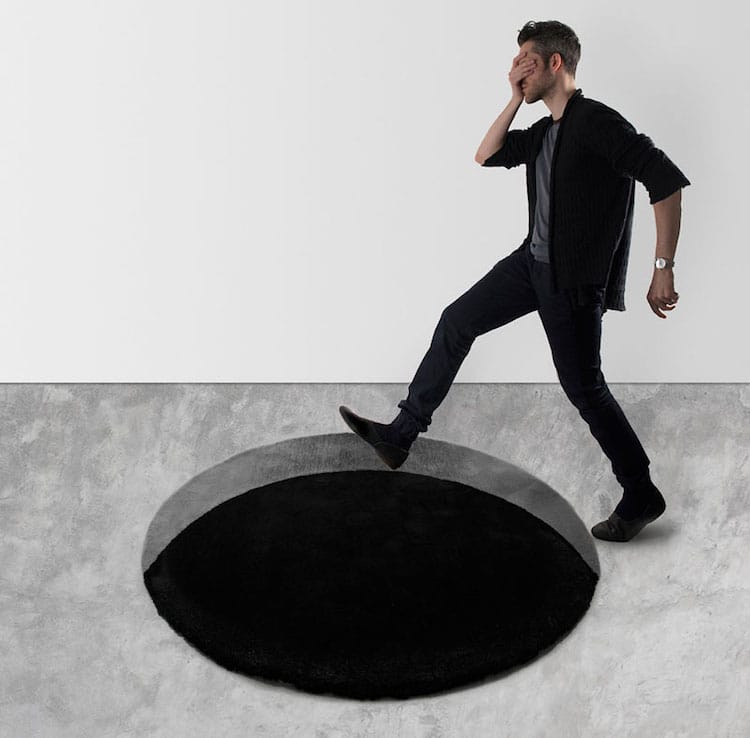
The article that mentioned his work involved an optical-illusion rug, which fits the broader logic of the practice: visual impact is never separate from construction. A rug that appears to create a depth effect depends on careful textile planning, colour placement, and fabrication. That kind of project shows how Jarvie’s design language can turn a simple category into something more conceptually charged while still remaining useful and made for the real world.
What kind of designer is he?
Jarvie is best understood as a generalist with a strong material intelligence rather than as a designer tied to one product type. That breadth gives the studio flexibility, but it is not a loose or accidental breadth. The available description points to a disciplined practice that uses creativity, context, and making expertise to shape each commission on its own terms.
For brands and clients, that means a designer who can move between commercial production and more craft-led work without treating either as secondary. For readers, it offers a useful example of contemporary design as a field where furniture, packaging, textiles, and spatial thinking often overlap.
Frequently Asked Questions
Is Scott Jarvie a product designer or a furniture designer?
He is both, and neither label fully captures the scope of his practice. His work spans products, furniture, packaging, and larger-scale design, so the better description is simply designer. The range matters because it shows a studio set up to work across scales rather than inside one category.
Does his studio specialise in handmade work?
Not exclusively. The practice includes one-off furniture and craft-led commissions, but it also works on best-selling mass-produced products and luxury packaging. That mix suggests a studio comfortable with both industrial production and bespoke making.
What makes his work distinctive?
The defining feature is the combination of creative ambition with practical design discipline. Materials, process, and context shape the outcome from the start, rather than being added later. That often produces work that looks striking but also feels convincingly made.
Articles mentioning Scott Jarvie