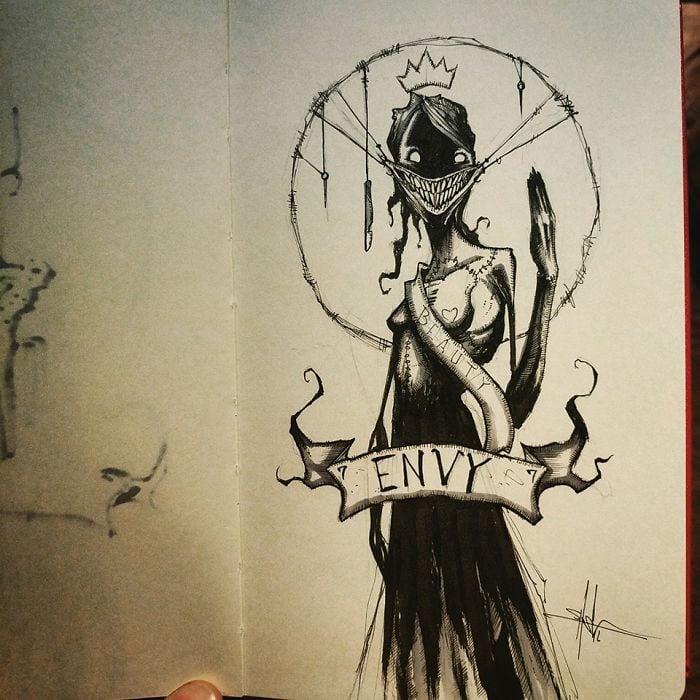
Shawn Coss is an American dark-art illustrator from Ohio known for blunt, high-contrast drawings that mix horror imagery, satire, and mental-health themes. He built a following through his work with Cyanide & Happiness, then widened his focus with Inktober Illness, a 2016 series that reframed psychiatric conditions as stark, memorable visual symbols. His work appears across comics, prints, apparel, and online posts, where the immediate, printable look of his images helps them spread quickly.
- He works primarily in dark art and illustration, using clean lines, heavy black fills, and disturbing but legible symbols.
- He became widely known through Cyanide & Happiness before shifting toward more personal independent work.
- Inktober Illness turned mental-health conditions into a public-facing visual series and changed the direction of his practice.
- He also co-owns and creates for Any Means Necessary, an Ohio-based lifestyle clothing brand.
What kind of artist is Shawn Coss?
Coss works in a corner of illustration often called dark art: imagery that borrows from horror, macabre comics, and graphic symbolism. His drawings usually rely on a limited palette, strong silhouettes, and simplified figures so that the message reads quickly. That clarity matters, because much of his work is designed for screens, posters, and apparel rather than gallery walls.
He is also associated with internet-native publishing and merchandising. The same image may appear as a social-media post, a print, or a shirt graphic, and that circulation is part of the work’s function. Coss’s style favors immediate recognition over subtle atmosphere; skulls, wounds, stitched flesh, and other stark motifs carry the meaning.
How did he become known?
Coss reached a broad audience through Cyanide & Happiness, the long-running webcomic brand known for deadpan humor and crude, sharply drawn cartoons. That exposure helped establish him as a versatile illustrator with a clear visual hand. From there, his independent work gave him room to push into more personal and serious subjects.
His online audience expanded further when individual images began circulating on their own, detached from any single publication. That is common for artists who make compact, high-contrast work: the image is easy to repost, and its meaning lands in seconds. For Coss, the internet became both portfolio and distribution channel.
Why did Inktober Illness matter?
Inktober Illness is the project that most clearly shifted Coss’s public identity. Created in 2016 as part of the annual Inktober prompt format, it presented mental-health conditions through highly stylized visual metaphors. Rather than treating diagnosis as abstract language, he gave it a body, a face, or a physical burden.
The series resonated because it made invisible experience feel visible without smoothing it over. Some viewers saw recognition; others saw a brutal shorthand for the weight of illness. That directness also created debate, which is part of why the series spread so widely. Whether read as catharsis, commentary, or shock imagery, it moved mental health into a space usually occupied by internet illustration and pop-horror graphics.
What does his work look like in practice?
In practice, Coss’s images are built from simple, forceful parts: black ink, white space, and a central figure that carries the joke or the wound. He often uses anatomy as a design tool, exaggerating teeth, ribs, eyes, and limbs to make emotion visible. The result feels clean at a distance and unsettling up close.
That method serves different projects in different ways. In webcomic work, the drawing supports a punch line; in his mental-health series, the image carries the argument on its own. On apparel for Any Means Necessary, the same graphic logic turns into a logo-like mark that can live on clothing. Across those formats, his art depends on compression: one image, one idea, no wasted motion.
Frequently Asked Questions
Is Shawn Coss only known for mental-health art?
No. He first reached a large audience through Cyanide & Happiness and has also worked as an independent dark-art illustrator and as part of Any Means Necessary clothing. The mental-health work became the most discussed part of his practice, but it sits inside a broader graphic style rooted in comics and horror imagery.
What makes his style different from other illustrators?
His drawings depend on blunt symbolism and strong contrast rather than detailed realism. He tends to build images that can be understood in a single glance, which makes them effective online and on clothing. The style is more about impact and legibility than fine texture or painterly depth.
Where does his work fit in contemporary visual culture?
Coss sits at the point where internet illustration, merch design, and personal commentary overlap. His images are made to travel quickly, and their meaning often changes as they move from comic context to standalone post to printed object. That flexibility is a major reason his work has stayed visible.
Articles mentioning Shawn Coss