
Sipho Mabona is a Swiss origami artist known for transforming single sheets of paper into sculptural animals, objects, and large-scale installation pieces. He works in the discipline of origami but pushes it beyond decorative folding into engineering, performance, and public spectacle. His paper elephant and other oversized works helped make him one of the best-known contemporary figures in the field.
Sipho Mabona on FreeYork
 Rick Tegelaar Transforms Chicken Wire into Luminous Sculptures with Custom Machines
 Sipho Mabona Transforms Bottle Gourds with Recycled Cartons and Mirrors in Tribute to His Father
 Origami Artist Made Life-Sized Elephant With One Sheet Of Paper
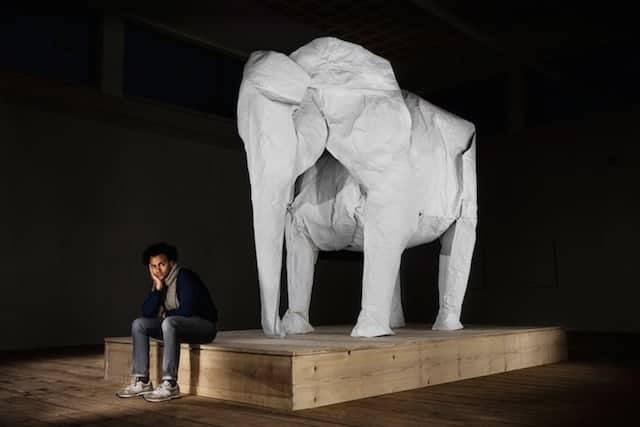 Origami Artist Sipho Mabona creates life-sized Elephant from one Piece of Paper
About Sipho Mabona
- He began folding paper airplanes as a child and later moved into more ambitious paper forms.
- His work ranges from precise small models to life-sized paper sculptures.
- He uses the discipline of origami as a sculptural medium, not just a craft.
- His projects often depend on careful planning, scoring, folding, and structural testing.
- He has become a visible advocate for origami as contemporary art and design.
What makes Sipho Mabona’s work different?
Mabona’s work stands out because it treats paper as a structural material. A finished piece is not only about image or decoration; it has to hold form, balance weight, and often withstand installation in a gallery or public setting. That means every fold matters. Creases act like joints, ribs, and load-bearing lines, turning a flat sheet into a figure with volume and presence.
He is best known for highly controlled animal forms, especially the life-sized elephant made from a single sheet of paper. Works like that require an understanding of scale, proportion, and paper behavior. The material can tear, buckle, or collapse if the folds are placed badly, so the design process matters as much as the final handwork.
How did he come to origami?
Mabona started folding paper airplanes at the age of five. What began as play became a technical obsession: by his teens, he had exhausted the usual range of airplane designs and started looking for other subjects and methods. That early fascination gave him a practical feel for paper as a material that can be shaped, tested, and refined through repetition.
His path into professional origami also reflects a broader shift in the medium. Origami has long been associated with mathematical precision and traditional folding systems, but contemporary artists like Mabona use it for installation, branding, and commissioned work. He helped show that origami could operate in the same space as sculpture, design, and visual communication.
What does his process look like?
Although each project differs, Mabona’s process typically starts with a concept sketch or a study of the form he wants to build. From there he develops a folding sequence that can produce the necessary volumes from one sheet. For larger works, the paper itself becomes part of the engineering problem: the grain, thickness, and surface finish all affect how the final piece behaves.
The work usually demands slow hand folding, careful creasing, and repeated adjustments. Even a small error can shift the whole structure. When the result is large, as in his elephant sculpture, the process becomes physically demanding as well as technical. The visual effect is often one of quiet force: a familiar creature or object rendered in paper, but with enough precision that the material’s fragility remains visible.
Why does Sipho Mabona matter?
Mabona matters because he expanded what many people expect origami to be. He showed that the form can produce not just intricate ornaments but serious contemporary sculpture. That has helped place paper folding within broader conversations about craft, design innovation, and the limits of a simple material used well.
His work also matters for the way it makes process visible. The folded surface records every decision that went into it, so the final object carries evidence of planning, patience, and revision. For a reader interested in making, that is part of the appeal: the object is elegant, but it never hides the work required to make it hold together.
Questions
Is Sipho Mabona only an origami artist?
Origami is the core of his practice, but his work reaches into sculpture, installation, and commissioned visual projects. He has used paper folding as a method for making objects that behave like contemporary artworks rather than hobbyist models. That wider context is part of why his name appears in design and visual culture coverage.
Why is the life-sized paper elephant so well known?
The elephant became famous because it showed how far origami could be pushed in scale and ambition. A single sheet of paper turned into a life-sized animal creates a strong contradiction: the subject feels massive, while the material remains thin and fragile. That tension made the piece memorable to both art audiences and design readers.
What materials does he work with?
Paper is the main material, and the specific sheet matters a great deal. Different weights, sizes, and surfaces change how sharply a fold can hold and how much the finished form can support itself. In that sense, his work is not only about folding but about choosing the right paper for the intended structure.