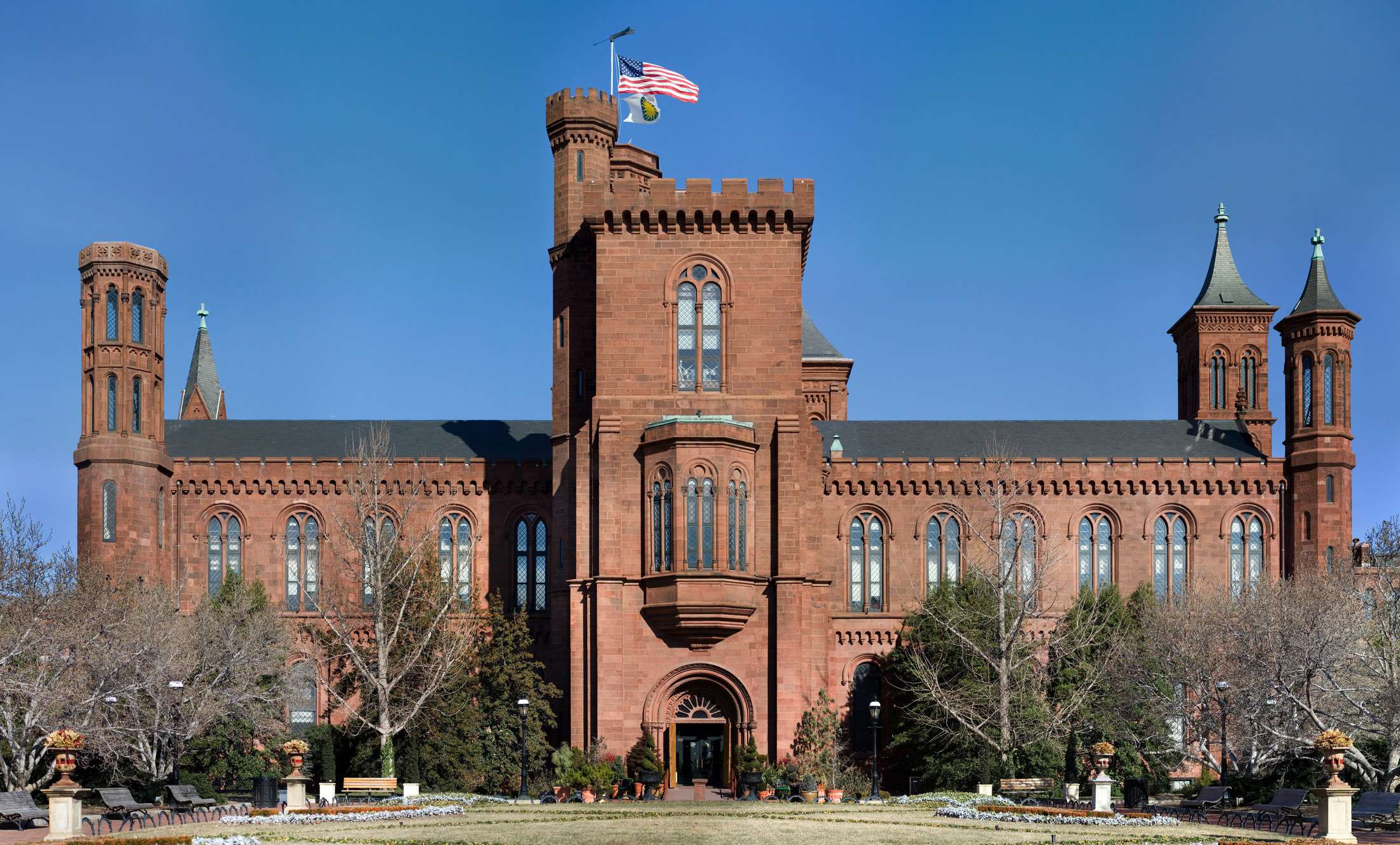
The Smithsonian Institution is a United States museum and research complex founded in 1846 to carry out “the increase and diffusion of knowledge.” Based mainly in Washington, D.C., it combines nineteen museums, nine research centers, and the National Zoo under one public umbrella, along with a vast collection of specimens, objects, documents, and artworks. It is the largest museum-and-research complex in the world and one of the best-known custodians of American and global material culture.
| Essential fact | Details |
|---|---|
| Founded | 1846 |
| Purpose | Increase and diffuse knowledge through research, collecting, and public display |
| Headquarters | Washington, D.C. |
| Scope | 19 museums, 9 research centers, and the National Zoo |
| Collection size | About 137 million objects, specimens, and records |
How did the Smithsonian begin?
The institution grew from the bequest of James Smithson, an English scientist who left his estate to the United States to found an establishment for knowledge. Congress accepted the gift and created the Smithsonian Institution as a federal trust, an unusual arrangement that gave it public purpose without making it a simple government department. From the start, it mixed exhibition, scholarship, and scientific collecting.
That structure still shapes it. The Smithsonian is not one museum but a network of museums and research units with different missions, from natural history and space science to American art, design, photography, and craft. Its breadth explains why the name can refer to both a single institution and a loose system of collections, staff, archives, and buildings.
What does the Smithsonian actually do?
The Smithsonian collects, preserves, studies, and exhibits. Its curators and researchers catalogue millions of specimens and objects, while conservators stabilize fragile paper, textiles, metals, wood, film, and other materials. Scientists in its research centers work on biology, anthropology, astrophysics, history, and environmental change; museum staff translate that work into galleries, labels, catalogues, and digital collections.
For a publication concerned with making, the Smithsonian matters because it holds evidence of how things were built and used. Its holdings include tools, prototypes, prints, cameras, garments, furniture, machine parts, and architectural fragments, along with the archives that explain them. The institution also makes its own objects of knowledge through photography, conservation, indexing, and exhibition design.
Why does it matter to designers, artists, and makers?
The Smithsonian is a reference point for material history. A textile conservator can study weave structure, dye fading, and repair techniques; a designer can examine how a chair joint or typeface solved a practical problem; a photographer can look at how images were printed, mounted, and archived. Its collections help connect visual form to production methods and use.
It also shapes what counts as preservation. The Smithsonian does not merely store objects; it decides how to classify, restore, describe, and display them. Those choices affect how audiences understand industrial design, Indigenous craft, scientific instrumentation, and everyday objects that would otherwise disappear from public view.
What does the Smithsonian look like in practice?
In practice, the Smithsonian is a layered system of public galleries, closed collections, conservation labs, libraries, and research facilities. Some of its buildings are national landmarks, while others are purpose-built for storage and study. Visitors usually encounter the institution through major museums such as the National Museum of Natural History or the National Museum of American History, but much of its work happens behind the scenes.
Its image is shaped by abundance: rows of cabinets, specimen drawers, climate-controlled stores, and carefully lit display cases. That abundance can feel encyclopedic, but it depends on meticulous routine work—packing, labeling, imaging, sampling, repairing, and documenting. The institution’s visual identity comes as much from that invisible labor as from the public rooms.
Frequently Asked Questions
Is the Smithsonian one museum?
No. It is an institution made up of many museums, research centers, libraries, and the National Zoo. The name is often used as shorthand for the whole network, even when a specific museum is the actual venue.
Why is the Smithsonian called “the nation’s attic”?
The phrase refers to the scale and variety of its holdings, which range from scientific specimens to paintings, uniforms, tools, and aircraft. It suggests accumulation, but it can also imply carelessness; in reality, the Smithsonian is a highly organized system of storage, study, and preservation.
Can the Smithsonian be used as a research source?
Yes. Many of its museums and research centers publish catalogues, databases, conservation notes, and scholarly studies, and its collections are used by historians, scientists, designers, and artists. Access varies by object and department, but research is part of the institution’s core mission, not an added service.
At a glance
- Founded
- August 10, 1846
- Address
- Washington, United States
Articles mentioning Smithsonian Institution