
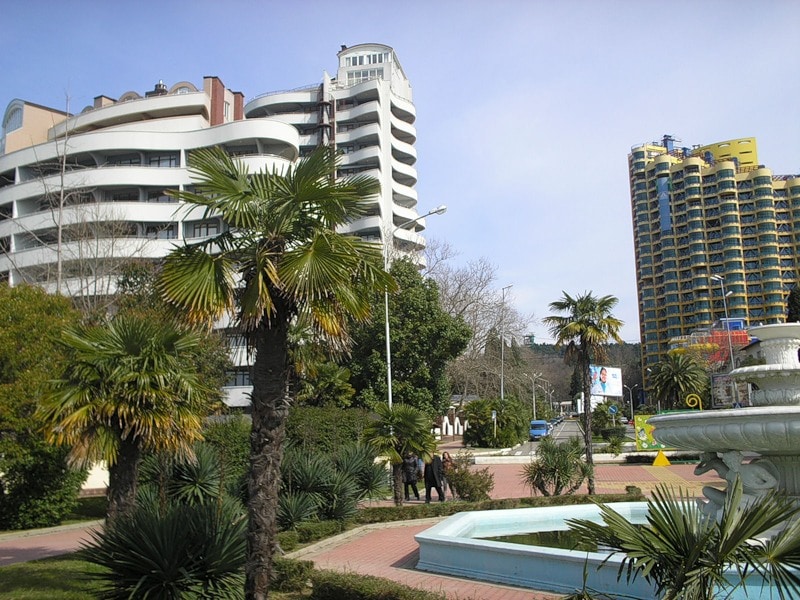
Sochi is a resort city on Russia’s Black Sea coast in Krasnodar Krai, stretched between the sea and the Caucasus Mountains near the border with Georgia and Abkhazia. It is Russia’s largest resort city and a major holiday destination, known for a long coastal strip, subtropical vegetation, and a built environment shaped by tourism, sports, and seasonal leisure.
- Coastal city on the Black Sea in southwestern Russia
- Part of Krasnodar Krai, near the Caucasus Mountains
- Known as Russia’s largest resort city
- Extended urban form spread along the shoreline rather than around a single compact center
- Associated with beaches, hotels, promenades, and large-scale event infrastructure
Where is Sochi?
Sochi sits on the eastern edge of the Black Sea, where the land narrows between water and mountain foothills. Its territory runs for roughly 145 kilometers along the coast, so the city reads more like a chain of districts than a single dense urban core. This geography gives Sochi a split character: seaside boulevards, sanatoriums, and beaches on one side; steep green slopes and upland neighborhoods on the other.
That setting matters to its identity. The climate is milder than most of Russia’s, which helped make the area a year-round holiday destination in the Soviet period and later a domestic tourism hub. Coastal light, humid air, reflective paving, and wet streets after rain all contribute to the city’s visual appeal in photography, where neon signs and traffic glints often register strongly against the dark sea-side palette.
Why has Sochi mattered in Russian culture?
Sochi became important as a place of rest, recovery, and display. In the Soviet era it developed as a network of resorts, pensions, and medical-sanatorium facilities that served workers and state institutions. That history left a visible urban fabric: long promenades, monumental public buildings, broad avenues, and hotel blocks designed to manage large seasonal crowds.
Later, Sochi gained international attention through major winter sports development and the 2014 Winter Olympics. That event added stadiums, transport systems, and upgraded public spaces, turning the city into a stage for national projection as well as recreation. In visual culture, Sochi often stands for a curated Russia of light, leisure, and spectacle rather than industrial grit.
What does Sochi look like on the ground?
The city’s appearance changes from district to district, but several elements recur: palm-lined roads, concrete seawalls, pebble beaches, hotel facades, and dense planting that softens the built environment. Older parts include Soviet-era resort architecture with large balconies, colonnades, and repetitive window grids, while newer developments favor glass, steel, and higher-rise forms tied to tourism and events.
Street photography from Sochi often picks up strong contrasts. Sunlit façades can sit beside damp pavements, motorbikes, market stalls, or reflective puddles after rain. At night, entertainment strips and traffic create colored reflections that suit neon-heavy urban imagery. The city’s mix of seaside calm and seasonal bustle makes it especially legible in pictures that focus on atmosphere, surface, and light.
How is Sochi used in images and design narratives?
Sochi appears in visual work as a shorthand for Russian leisure, coastal glamour, and a slightly surreal blend of nature and infrastructure. Photographers often use its beaches, resort hotels, and mountain backdrops to create images that feel bright but unstable, polished but informal. The city’s long shoreline also encourages wide framing, where human figures appear small against sea, sky, and repetitive architecture.
Design-wise, Sochi matters because it shows how a place can be built for performance as much as for habitation. Signage, paving, transport nodes, stadium structures, and waterfront furniture all contribute to its public image. The city’s visual language is not only scenic; it is made from systems for moving visitors, managing weather, and staging an idea of comfort.
Frequently Asked Questions
Is Sochi a city or a region?
Sochi is a city, but it functions as a large urban district spread along the coast. The name can also refer informally to the wider resort area around the city, especially when speaking about the Black Sea shoreline and nearby mountain zones. In administrative terms, though, it is a city in Krasnodar Krai.
Why do photographers like Sochi?
Sochi offers strong visual contrasts: sea and mountains, wet streets and bright sun, Soviet resort architecture and newer glass construction. Those conditions produce reflective surfaces, saturated color, and layered backgrounds that work well in street and travel photography. The city’s atmosphere shifts quickly between calm and busy, which gives images more tension.
What is Sochi best known for today?
Sochi is best known as Russia’s largest resort city and as the host of the 2014 Winter Olympics. It remains associated with domestic tourism, seaside leisure, and large public events. Its identity combines vacation culture with infrastructure built to support national prestige and seasonal crowds.
At a glance
- Address
- Krasnodar Krai, Russia
- Coordinates
- 43.585278, 39.720276
Articles mentioning Sochi

