Spider-Man is a fictional Marvel Comics superhero, a teenage crimefighter who first appeared in Amazing Fantasy #15 in 1962. Created by Stan Lee and Steve Ditko, he was designed as a young, awkward, money-strapped hero whose powers arrive alongside ordinary problems such as school, work, and family obligation. That mix made him one of the most recognizable figures in American comics and a durable reference point in film, advertising, toys, sculpture, and fashion.
- Spider-Man belongs to the Marvel Comics universe and was introduced in 1962.
- His core identity is Peter Parker, a teenager raised by Aunt May and Uncle Ben.
- The character combines superhero spectacle with everyday anxieties: debt, grief, responsibility, and adolescence.
- His visual signature is a red-and-blue suit with a web pattern, large white eye lenses, and a crouched, kinetic pose.
- His popularity made him a frequent subject for licensed products, reinterpretations, and debate over adaptation and branding.
Where Spider-Man came from
Stan Lee and Steve Ditko created Spider-Man for Marvel at a moment when comics were moving beyond simple adult wish-fulfillment. Lee wanted a hero with problems that mirrored younger readers, and Ditko gave him a lean, angular body, an expressive mask, and poses that suggested speed and spring-loaded motion. The origin story is brief and brutal: Peter Parker is bitten by a radioactive spider, gains extraordinary agility and wall-crawling ability, then fails to stop a thief who later kills Uncle Ben. The lesson becomes the character’s moral engine: with great power comes great responsibility.
That origin mattered because it tied action to consequence. Spider-Man was not a blank emblem or a distant godlike figure. He was a working-class New York teenager trying to keep his mask on while paying rent, getting to class, and protecting the people close to him. This made the character feel modern in a way that still shapes how he is written and drawn.
What makes Spider-Man different from other superheroes?
Spider-Man’s appeal comes from tension. He performs acrobatics in costume, but the story keeps pulling him back to ordinary life. He misses dates, loses jobs, arrives late, and carries guilt over failed choices. That structure gives artists and writers a lot to work with: the same web-swinging silhouette can support comedy, grief, romance, and city-scale spectacle.
Visually, he is one of the most legible figures in comics. The mask removes individual facial features, so posture and gesture do more of the work. Artists use foreshortening, diagonal movement, and web lines to make him feel airborne even when he is clinging to a wall. The suit is also a strong design object: the web motif, bright red and blue palette, and black contour lines read cleanly in print, animation, film, and product design.
Why does Spider-Man matter in visual culture?
Spider-Man became more than a comic character because he translates well across media and merchandise. The figure can be reduced to a logo, a pose, or a mask and still remain instantly identifiable. That makes him useful to publishers, studios, toy makers, advertisers, and artists working in paint, sculpture, photography, and digital composition. He also carries a built-in emotional story, so a new image rarely needs much explanation.
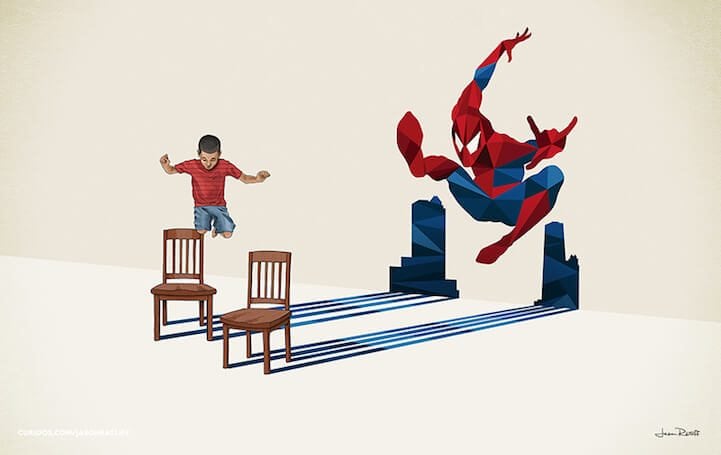
That flexibility has also made Spider-Man a frequent site of reinterpretation. Artists strip him back to shadow, age him into an elderly figure, rebuild him with mechanical detail, or place him in new urban scenes where the costume functions like public iconography. In commercial settings, the character can become a brand asset; in fine art or illustration, he can serve as a symbol of childhood, risk, performance, or surveillance. The same silhouette can feel playful, nostalgic, or critical depending on context.
What does Spider-Man look like in practice?
In comics, Spider-Man is most often shown in motion: crouched on a ledge, stretched between buildings, hanging upside down, or slinging webs in arcs that frame the page. The suit usually appears as red and blue fabric with a web pattern across the red areas and stylized white eye lenses. Different artists adjust the body type, lens shape, and web density, but the essential design remains stable enough to survive constant reinvention.
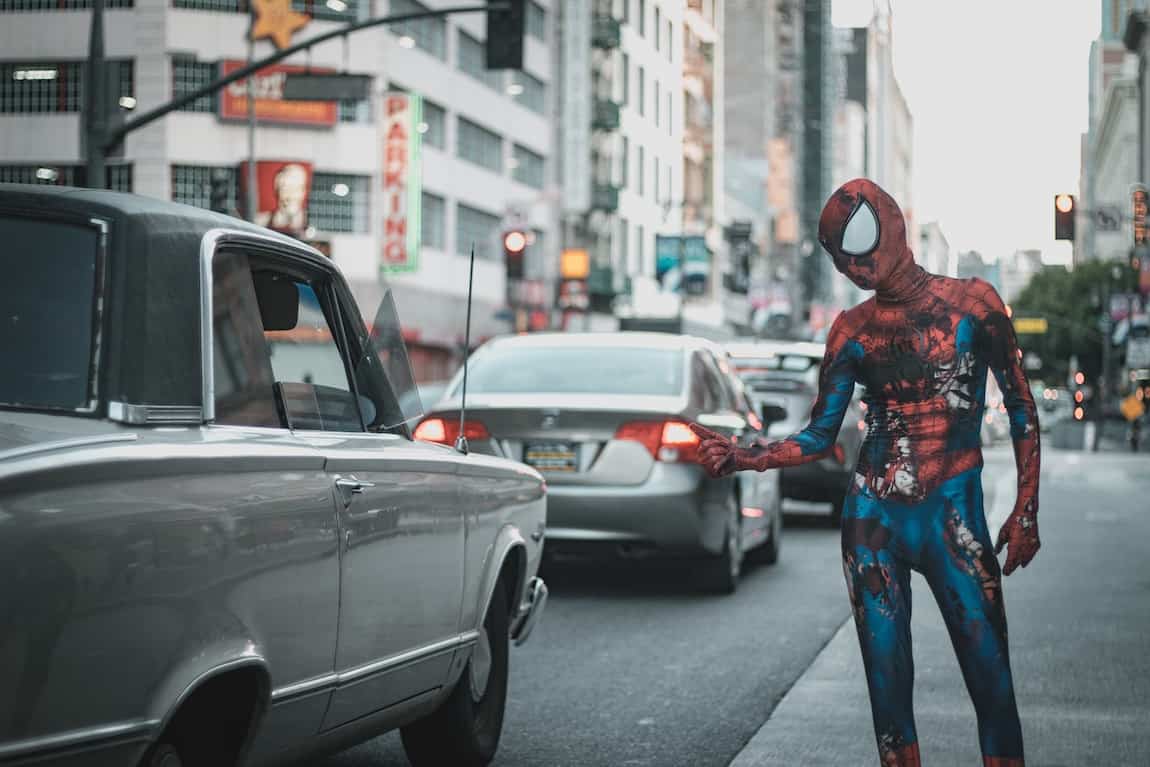
In film and objects, the character often becomes a technical challenge. Costume makers have to balance stretch fabric, ventilation, and seam visibility; digital artists have to preserve the body’s agility while making it believable under light; product designers have to compress the character into a watch dial, poster layout, or dashboard graphic without losing recognition. Spider-Man’s image works because it has both a narrative identity and a strong graphic structure.
Frequently Asked Questions
Is Spider-Man Peter Parker?
Usually, yes. Peter Parker is the original and best-known identity behind Spider-Man, though later stories and alternate universes have introduced other people who take on the Spider-Man name. The core idea is that the mask can be inherited, but the character’s emotional center stays tied to responsibility and sacrifice.
Why is Spider-Man so easy to recognize?
The costume is built from simple, high-contrast shapes: a full-face mask, large eye lenses, red and blue fields, and a web motif. Those elements read quickly at small size, from a distance, or in motion. The body language helps too, because Spider-Man is often drawn in bent, elastic poses that suggest movement even when the image is static.
Why do artists keep reinterpreting Spider-Man?
Spider-Man is both a character and a visual template. That makes him useful for testing style, medium, and meaning, from polished digital illustration to rough street art or sculptural work. Because the silhouette is so familiar, small changes in age, material, or pose can produce a strong new effect without losing recognition.
Articles mentioning Spider-Man