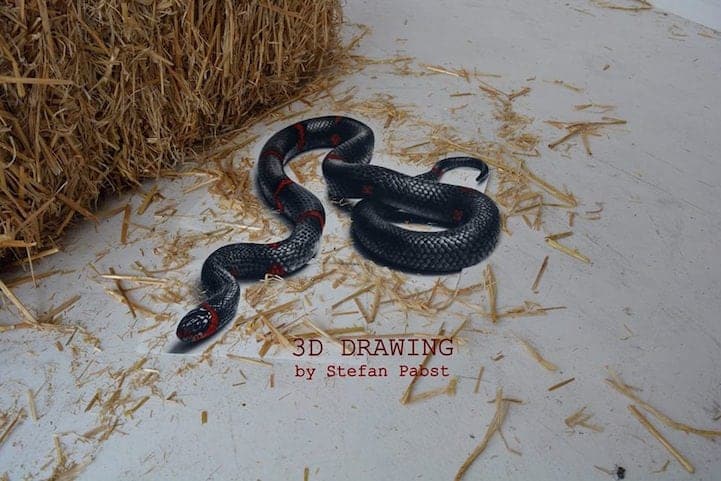
Stefan Pabst is a Russian-born German artist known for illusionistic drawings and paintings that appear to rise off the page. He works mainly with oil in a dry-brush technique on specially prepared paper, building form through tightly controlled highlights, shadows, and edge shifts rather than through heavy paint.
- He is best known for anamorphic and trompe-l’œil-style images that read as three-dimensional from a specific viewpoint.
- His work relies on oil dry-brush application, which uses very little medium and produces crisp, textured transitions.
- He began drawing as a child and turned professional after producing a portrait for a friend.
- He now works full time from his studio and takes commissions from public figures, companies, and private clients.
- He has also taught his methods to other artists.
How his work creates the illusion of depth
Pabst’s images depend on controlled deception. He places shadows where a real object would cast them, sharpens one edge while softening another, and uses perspective distortion so the image resolves into a convincing volume from one angle. The result can look like a snake coiling above the paper, a hand reaching outward, or a portrait with a face that seems to protrude into space.
This effect belongs to a long tradition of illusionistic drawing, but Pabst’s version is closely tied to online image culture. His pieces are often photographed from the exact viewpoint that completes the illusion, which means the finished work has two lives: the physical object and the image of the object. In person, the drawing still depends on skillful surface handling, but the camera angle makes the illusion unmistakable.
What is the oil dry-brush technique?
Oil dry-brush is a painting method that uses a brush loaded with very little oil paint. Instead of wet, blended passages, it creates broken, grainy strokes that can sit delicately on the paper’s surface. That dryness gives Pabst fine control over texture, which matters when the goal is to imitate skin, scales, metal, glass, or the soft shadow under a lifted form.
He works on special paper, which helps the medium grip and allows layered detail without drowning the image in sheen. The process is slow and exacting. Small changes in tone can shift a form from flat to convincing, so the method depends less on broad gesture than on patient calibration of value, contour, and reflected light.
How did Stefan Pabst become known?
Pabst began drawing at the age of five, and his early classmates noticed his talent quickly enough to ask for portraits. That early demand matters because portraiture trained him to observe likeness, proportion, and small facial cues. Those skills later translated into the hyperreal faces and animals that brought wider attention.
He became a full-time artist after making a portrait for a friend, then built a practice around commissions. His clients reportedly include companies, singers, actors, football players, and politicians. That mix of work suggests a career shaped as much by portrait demand and presentation as by gallery exhibition, with finished images designed to travel well through reproduction and social media.
Why does his work matter?
Pabst’s work matters because it shows how traditional drawing skill can still feel surprising when combined with precise illusion and a strong grasp of digital-era presentation. At a glance, a snake or face may seem to emerge from the paper as if it were a sculpted object. That shock comes from craft, not gimmick: disciplined shading, surface knowledge, and a deep understanding of how viewers read images.
His practice also sits at the intersection of illustration, portraiture, and spectacle. It asks drawing to do more than describe; it has to perform. For that reason, his work is useful to anyone interested in how contemporary artists adapt old techniques to new audiences, especially when the finished piece is expected to function both as an object and as a shareable visual event.
Frequently Asked Questions
Is Stefan Pabst a hyperrealist?
He is often grouped with hyperrealist and trompe-l’œil artists because his images aim for convincing realism and optical trickery. The difference is that his work is usually built around a deliberate viewpoint, so the illusion is strongest when seen from the intended angle. That makes perspective part of the subject, not just the method.
What materials does he use?
Pabst works primarily with oil paint in a dry-brush technique and uses special paper as the support. The reduced paint load gives him the narrow tonal control needed for fine textures and crisp illusions. The material choices are central to the effect, because heavy, wet paint would blur the surfaces he relies on.
Does he only make drawings of animals?
No. Animals are among the most eye-catching subjects because scales, fur, and claws show off the illusion well, but he also makes portraits and other three-dimensional effects. Commissioned portrait work has been part of his career from an early stage, and that remains a significant part of his practice.
Articles mentioning Stefan Pabst