
Stencil graffiti is a form of street marking in which an image or text is cut into a reusable template and then sprayed or rolled onto a surface. The stencil acts as a mask: paint passes through the cut-out areas while the rest of the surface stays protected. Because the same template can be used again and again, stencil graffiti is fast to apply and easy to repeat.
Stories from Stencil graffiti
3 stories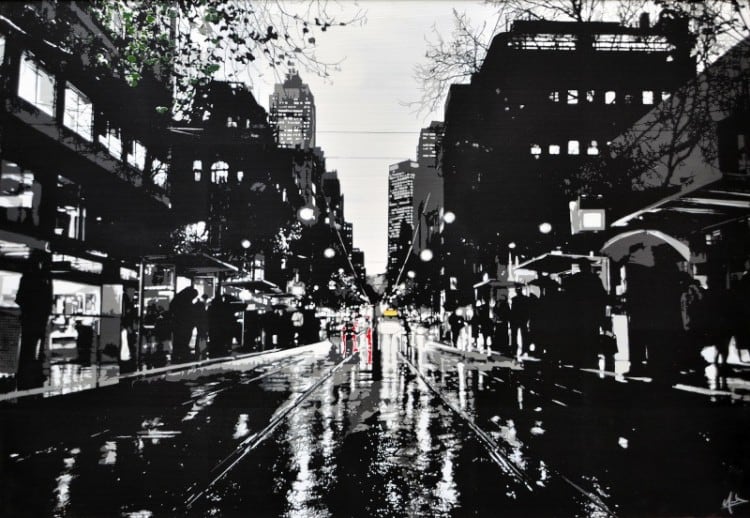

About Stencil graffiti
- It uses a cut template made from paper, card, acetate, or thin plastic.
- Artists often use spray paint, but rollers, brushes, and markers also appear.
- It produces sharp edges, repeated motifs, and layered images.
- It developed as part of broader graffiti and street-art practice, especially where speed and repetition mattered.
- It can carry political slogans, portraits, logos, symbols, or simple icon-like shapes.
Read the full overviewHow stencil graffiti works, Where did stencil graffiti come from?, Why does stencil graffiti matter?, What does it look like in practice?
How stencil graffiti works
The basic method is simple: an artist cuts a design out of a sheet, holds or tapes it against a wall, and applies paint over the openings. Once the stencil lifts away, the image remains on the surface. Complex works may use several stencils, each one carrying a different colour or layer, so that a single portrait or scene can be built from separate passes.
The material matters. Cardboard is cheap and easy to cut, but it absorbs paint and wears out quickly. Thinner acetate or plastic sheets last longer and hold finer detail. For street use, artists often prefer a compact stencil that can be deployed quickly, since the work may need to happen in seconds rather than minutes.
Where did stencil graffiti come from?
Stencilling predates modern graffiti by centuries, but its use as a street art method grew in the late 20th century. Political activists used stencils for slogans and symbols because they could reproduce a message quickly across many sites. Graffiti writers and street artists adopted the same logic: a stencil could carry a signature image, a logo-like figure, or a recurring character from one wall to the next.
That repeatability became a major part of its appeal. A hand-painted mural can vary from wall to wall, but a stencil preserves a fixed design and makes an image recognisable at a glance. This consistency helped stencil graffiti travel across cities and across artists, from underground tagging culture to widely circulated street art.
Why does stencil graffiti matter?
Stencil graffiti changed the pace and look of street image-making. It made detailed imagery possible without long exposure on site, and it allowed artists to balance speed with precision. Faces, hands, animals, symbols, and text all benefit from the crisp edge of a stencil, which can make the image feel official, graphic, or poster-like.
It also blurred the line between graffiti, printmaking, and graphic design. The stencil behaves like a printing plate, but it is used directly in public space rather than on paper. That connection is one reason stencil work is often associated with political messaging, satire, and strong visual identity. The same template can become a personal signature, a campaign tool, or an anonymous intervention.
What does it look like in practice?
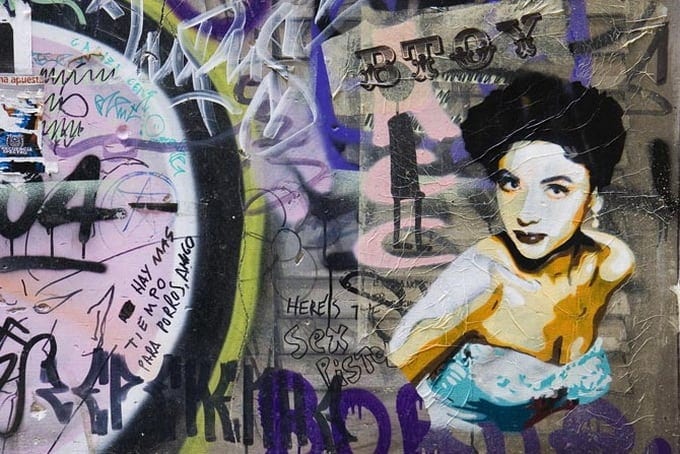
Stencil graffiti usually has hard edges, flat areas of colour, and a strong silhouette. Single-layer stencils often use one colour against a wall or pavement, while multi-layer pieces may combine black outlines, red accents, and shaded fills. The result can look clean and graphic, but overspray, drips, and rough wall texture still leave a handmade trace.
In practice, the method sits between control and accident. The cut determines the image, but the surface determines the finish: brick, concrete, metal shutters, and plywood all take paint differently. Many artists exploit that tension, using the stencil for clarity while letting weather, cracks, and urban grime become part of the work.
Frequently Asked Questions
Is stencil graffiti the same as stencil art?
Stencil art is the broader term, and it can include work on paper, canvas, packaging, or gallery walls. Stencil graffiti refers specifically to stencil-based images made in public space without permission or with street placement as part of the work. The two overlap heavily, especially when a street artist uses the same template in both contexts.
Why do artists choose stencils instead of painting freehand?
Stencils save time and reduce risk, which matters when a piece must be installed quickly. They also make it easier to repeat an image across multiple sites and to keep a character or symbol visually consistent. The method is especially useful for sharp typography, portraiture, and simple high-contrast shapes.
What materials are commonly used to make a stencil?
Artists often cut stencils from paper, card, acetate, or thin plastic sheets. Cardboard works for rough, short-term use, while acetate and plastic allow more reuse and finer detail. The choice depends on how many times the image needs to be printed and how much detail the design requires.
</n