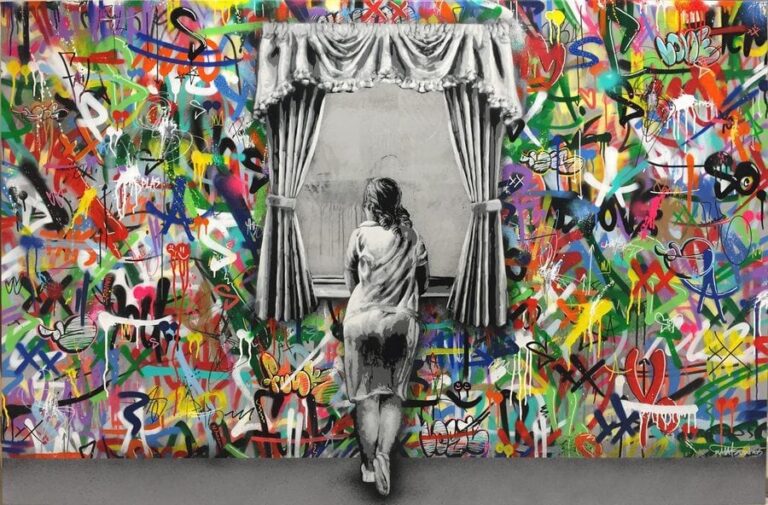
A stencil is a sheet or screen with cut-out shapes that lets pigment, ink, paint, or dye pass only where the openings are. It is one of the oldest and most practical image-making tools: a design is cut into paper, card, metal, plastic, or fabric, then pressed against a surface and printed repeatedly with a brush, sponge, spray, roller, or dabber.
- It makes a design repeatable without redrawing it each time.
- It produces sharp edges and consistent letterforms, symbols, or patterns.
- It works on many surfaces, from walls and signs to textiles, packaging, and skin.
- It can be cut by hand, with knives and punches, or by machine and laser.
- It has been used in sign-making, military marking, craft, street art, and decorative design.
How a stencil works
A stencil depends on negative space. The maker removes the parts meant to stay blank, leaving a bridge or mask that blocks most of the material. When paint is applied across the surface, it lands only through the open areas, transferring the design in one pass. That makes stencils useful when a form must be copied quickly, accurately, or many times.
The material matters. Paper and card are cheap and easy to cut but wear out quickly. Mylar, acetate, and thin plastic last longer and can be cleaned and reused. Metal stencils handle heavy industrial use. In art and craft, the cut edges, paint build-up, and slight overspray often become part of the look rather than a flaw.
Where did stencils come from?
Stenciling is old. It appears in many traditions of decoration and marking, from hand-cut templates used for lettering and signs to cut-paper patterns used in textiles and folk art. In Japan, katagami stencils were used for printing patterns on cloth, often cut from layered paper and strengthened with persimmon tannin. In Europe and North America, stencils became common in house painting, shop signs, shipping marks, and military equipment because they were fast and legible.
The method spread wherever repeated marks were needed. It suited factories, warehouses, and public spaces, but it also stayed close to domestic craft. A stencil can be as humble as a cut card used for numbering crates, or as elaborate as a finely cut pattern for wallpaper, fabric, or wall decoration.
Why do designers and artists use stencils?
Stencils matter because they combine control with speed. They let a maker repeat a word, emblem, border, or image with far less labor than drawing each version by hand. They also flatten handwriting into a designed form, which is why they are common in signage, packaging prototypes, screenless printmaking, and accessible craft techniques for people who want crisp results without advanced brush control.
In contemporary visual culture, stencils carry a particular graphic force. Graffiti artists use them to place a message quickly. Poster makers use them for bold, layered composition. Tattoo artists and illustrators use stencil transfers to move a design onto skin or paper before inking. The look is often direct and high-contrast: hard edges, repeated forms, and slight irregularities where the medium has bled around the mask.
What does stencil work look like in practice?
Working with a stencil starts with a design that can survive being cut apart. Closed forms such as the center of an A or O need bridges so the inner piece does not fall away. The stencil is then fixed to the surface with tape, spray adhesive, or simple pressure. Paint, ink, or pigment is applied lightly so it does not seep under the edges. If the stencil is removed carefully, the image appears as a clean transfer with defined edges and a slight trace of the tool.
Different fields use the method differently. Sign painters may use letter stencils for consistent typography. Textile makers may print repeating motifs on cloth. Street artists often layer several stencils to build color and detail. In each case, the essential idea stays the same: a cut mask controls where the material lands.
Frequently Asked Questions
Is a stencil the same as a template?
They overlap, but they are not identical. A template usually guides cutting, tracing, or shaping, while a stencil is meant to block and reveal material through openings. In practice, some objects do both jobs, but the defining feature of a stencil is that it is used for direct transfer.
What materials are best for stencils?
That depends on how often the stencil will be used and on the surface receiving the image. Card and paper suit short runs, while mylar, acetate, and thin plastic last longer and can be cleaned. Metal stencils are chosen for durability in industrial or repeated marking.
Why do stencil letters often have little gaps?
Those gaps are called bridges, and they hold the interior parts of letters in place. Without them, the center of an O, A, or P would fall out when the stencil is cut. The gaps are not a mistake; they are what makes the letter physically usable as a stencil.
Articles mentioning Stencil