
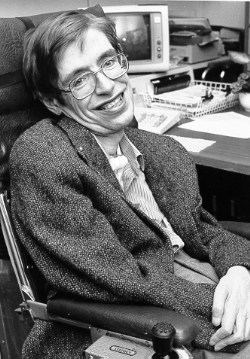
Stephen Hawking was a British theoretical physicist and cosmologist whose work reshaped modern ideas about black holes, the origin of the universe, and the limits of gravity. He became known both for technical contributions to general relativity and for a public career as a science writer who explained complex ideas to broad audiences.
| Born | 8 January 1942, Oxford, England |
|---|---|
| Died | 14 March 2018, Cambridge, England |
| Field | Theoretical physics, cosmology |
| Known for | Work on singularity theorems, black hole radiation, and popular science writing |
| Institutions | University of Cambridge; Cambridge’s Department of Applied Mathematics and Theoretical Physics |
What Hawking changed in physics
Hawking’s scientific reputation rests on two linked achievements. First, with Roger Penrose, he helped show that Einstein’s general relativity implies singularities under broad conditions, meaning the theory predicts places where spacetime curvature becomes extreme and the equations break down. Second, he showed that black holes are not completely black: quantum effects near the event horizon should make them emit thermal radiation, now called Hawking radiation.
That second result mattered beyond black-hole theory. It connected three domains that had resisted easy combination: gravity, quantum mechanics, and thermodynamics. Hawking radiation implied that black holes can lose mass over time and may eventually evaporate, which changed how physicists thought about information, entropy, and the fate of collapsed stars.
How did he become a public figure?
Hawking was not only a researcher but also one of the most recognizable scientists of the late 20th century. He wrote A Brief History of Time, a popular book that translated cosmology for general readers and sold in huge numbers. The book turned terms such as singularity, event horizon, and Big Bang into part of common cultural vocabulary.
His public image was shaped by his use of assistive technologies after motor neurone disease left him severely physically disabled and dependent on speech synthesis. The synthetic voice became inseparable from his public persona, but it also marked a practical reality of his working life: his communication system enabled lectures, interviews, and writing, even as the disease limited movement and speech.
Why does Hawking matter in visual culture?
Hawking matters to visual culture because his image became a shorthand for scientific intelligence, futuristic thinking, and bodily difference. Magazine covers, documentary footage, advertising, and film portrayals often used his wheelchair, speech synthesizer, and chalkboard diagrams as visual symbols of both vulnerability and intellectual authority. Those images carried a strong narrative: a body constrained by disease, paired with a mind framed as expansive and cosmic.
His diagrams and lectures also helped normalize a particular visual language of cosmology. Black-hole illustrations, spacetime curves, and pen-and-paper equations became familiar not only in academic settings but in exhibitions, television graphics, and editorial design. Hawking’s influence therefore extended from physics into how publishers, broadcasters, and designers pictured the universe.
What did Hawking actually work on?
Hawking’s early work examined the mathematics of the universe’s large-scale structure. Singularities were central to that research: points where densities and curvatures become infinite in the model, often associated with the Big Bang or the inside of black holes. His papers with Penrose gave these ideas rigorous footing inside general relativity, which had previously been treated more as a theory of gravity than as a map of cosmic beginnings and endings.
Later, he studied quantum field theory in curved spacetime, a difficult area where tiny quantum fluctuations are examined in the presence of strong gravity. That work led to Hawking radiation and to a set of questions that remain active today, especially the black hole information problem. Even where his proposals have been debated or refined, they set the agenda for later research.
Frequently Asked Questions
Was Hawking a physicist or a mathematician?
Hawking was a theoretical physicist and cosmologist, not a mathematician in the narrow professional sense. His work used advanced mathematics, especially in general relativity, but his goals were physical: understanding black holes, spacetime, and the evolution of the universe. He worked in the space where mathematical structures become models of nature.
What is Hawking radiation?
Hawking radiation is the predicted emission of particles from black holes due to quantum effects near the event horizon. It means a black hole can slowly lose energy and mass instead of absorbing everything forever. The idea remains one of the most famous links between quantum theory and gravity.
Why is Stephen Hawking so famous outside science?
He became famous because he combined major scientific ideas with an unusually clear public voice. A Brief History of Time made cosmology part of mainstream culture, and his appearance in media gave him a recognizable public identity. The combination of technical authority, accessibility, and a highly visible disability made him a global figure.