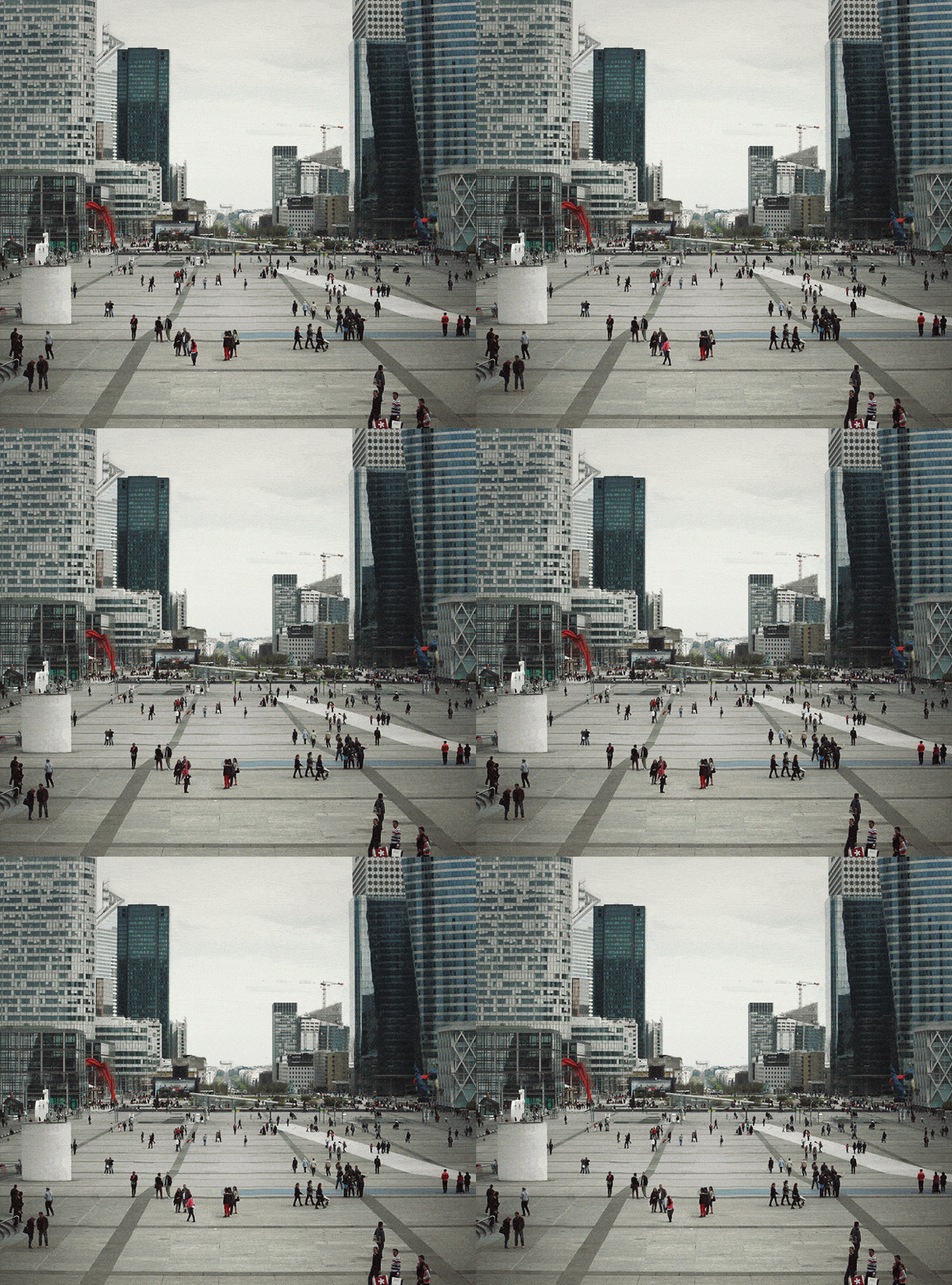
Strasbourg is a city in eastern France on the Rhine frontier, the capital of the Grand Est region and the Bas-Rhin département, and one of the main political and cultural centres of Alsace. It is also the official seat of the European Parliament. Its position between France and Germany has shaped its language, architecture, and visual identity for centuries.
- Border city with a strong French and German cultural history
- Capital of Alsace and Bas-Rhin, now within the Grand Est region
- Official seat of the European Parliament
- Known for a dense old centre, canal network, and Gothic cathedral
Why does Strasbourg matter?
Strasbourg matters because it sits at a crossroads that has been political, linguistic, and commercial for a long time. Control of the city passed between French and German powers, and that layered history still shows in its street plan, building types, and civic institutions. The city became an important European administrative site after World War II, when its border location made it a symbolic meeting point for postwar cooperation.
For visual culture, Strasbourg offers a mix that is hard to mistake: timber-framed houses in the old quarter, monumental civic buildings from different eras, and a river city layout that gives the centre a compact, walkable feel. The city’s name itself reflects its Germanic past; many places in Alsace keep that double character, where French governance and Germanic heritage sit side by side.
What does Strasbourg look like in practice?
The old centre, especially the Grande Île, is built around narrow streets, bridges, canals, and the cathedral district. The Cathedral of Notre Dame de Strasbourg dominates the skyline with pink sandstone and a famously elaborate Gothic façade. Around it are half-timbered houses, cobbled lanes, and commercial streets that keep the historic core active rather than preserved as a static monument.
Beyond the medieval centre, Strasbourg also has a very modern institutional face. The European Parliament building, the European Court of Human Rights, and related offices give the city a sharp contrast between historic masonry and late twentieth-century glass and steel. That contrast is part of what makes Strasbourg legible as a place: it does not read as a single era, but as a city continually rewritten.
How did Strasbourg become such an important city?
Strasbourg grew from an imperial and trading settlement on a strategic river crossing. Its location on the Rhine made it valuable for movement of goods, armies, and ideas. Over time it became a Protestant printing centre, a university city, and then a contested border town, especially during the Franco-Prussian War and the two world wars.
After 1945, the city’s role shifted from border stronghold to European capital. Institutions such as the Council of Europe and the European Parliament gave Strasbourg a new international function, turning a historically disputed city into a site meant to stand for continental cooperation. That political rebranding did not erase its older identity; instead, it added another layer to a city already shaped by exchange.
What should be remembered about Strasbourg’s identity?
Strasbourg is not simply “French with German influence.” It is a place where language, architecture, law, and administration have been negotiated across centuries. Alsatian identity, Rhine geography, and European governance all remain visible. The result is a city whose image depends on tension as much as harmony.
In articles about artists and makers, Strasbourg often appears as a shorthand for atmosphere: old-world streets, borderland ambiguity, or a civic setting with a strong sense of history. Those associations are grounded in the city’s built environment and long political memory. The city’s meaning comes from that mix of heritage and institutional present.
Frequently Asked Questions
Is Strasbourg part of France or Germany?
Strasbourg is part of France. It lies very close to the German border, and its history includes long periods of German-speaking culture and shifting national control. That is why the city often feels culturally mixed rather than purely French.
Why is the European Parliament in Strasbourg?
The European Parliament meets in Strasbourg because the city was chosen as a symbol of postwar European reconciliation. Its border location made it a useful place for institutions meant to represent cooperation across former rivals. The city’s political role is part practical and part symbolic.
What is Strasbourg best known for visually?
Strasbourg is best known for its Gothic cathedral, half-timbered old town, canals, and the contrast between historic streets and modern civic buildings. The city has a distinctive Rhine-border look, with a strong sense of layered history in the architecture. That visual mix is one reason it appears so often in work about place and atmosphere.
At a glance
- Address
- Unterelsaß, France
- Coordinates
- 48.5844, 7.7486
Articles mentioning Strasbourg