
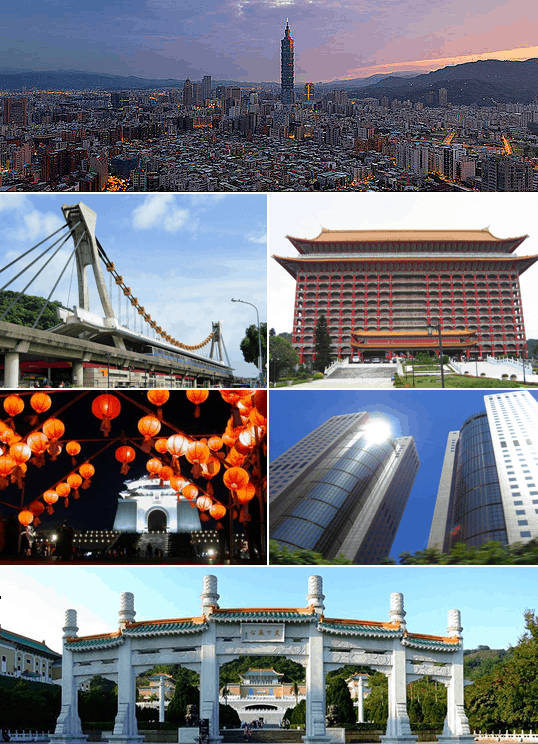
Taipei is the capital city of Taiwan, built in the river valleys of the island’s north and shaped by dense urban growth, government institutions, and a strong design and manufacturing culture. It sits on the Tamsui River basin, where the Keelung and Xindian rivers meet, and functions as Taiwan’s political centre, largest metropolitan market, and main stage for contemporary architecture, media, and technology.
- Capital of Taiwan and the seat of national government.
- Located in northern Taiwan, in a basin formed by the Keelung and Xindian rivers.
- Known for a high-density skyline, transit-oriented development, and frequent large-scale public projects.
- Important to design, product launches, exhibitions, and brand collaborations across East Asia.
- Combines older street markets and neighbourhood fabric with experimental architecture and digital spectacle.
Where is Taipei?
Taipei lies at the northern end of Taiwan, inland from the Pacific coast and west of the port city of Keelung. The city spreads across low valleys and flat alluvial land rather than dramatic hills, which has encouraged compact building, heavy infrastructure, and a clear dependence on drainage, bridges, and transit lines. The rivers give the city its structure: they also constrain where towers, roads, and public works can go.
This geography matters to how Taipei looks and works. Dense districts stack housing, offices, and retail close together, while major boulevards, rail stations, and river crossings organise movement through the city. The result is a place where everyday street life and large civic projects share the same frame.
Why does Taipei matter in design and architecture?
Taipei has become a useful testing ground for architects and urban planners because land is limited, density is high, and redevelopment pressure is constant. Projects in the city often deal with reuse, renewal, and the negotiation between private development and public space. That has made Taipei relevant to firms working on mixed-use towers, transit infrastructure, and city-scale masterplans.
Recent projects associated with Taipei often show two recurring themes: ambition and restraint. A tower may need to stand out in the financial district, but it still has to answer to wind, seismic risk, and a crowded street network. A bridge or waterfront project may be engineered as a landmark, yet it must also serve commuters and fit the basin’s environmental conditions. In practice, that means Taipei produces architecture that is visible, technical, and closely tied to urban management.
What does Taipei look like in practice?
Visually, Taipei is a city of layers. Street markets, scooters, temple fronts, apartment blocks, and glass towers can all appear in the same district. The skyline changes quickly from one neighbourhood to another: older low-rise fabric gives way to commercial corridors, then to high-rise business zones and public developments. This mix gives the city a jagged, unfinished appearance that reflects constant rebuilding rather than a single fixed image.
The city is also strongly associated with public display and media events. Large projections, drone shows, exhibition launches, and brand activations often use Taipei as a backdrop because the city already reads as technologically current. At the same time, local craft, food culture, and daily street commerce remain central to its identity, preventing the city from becoming only a polished corporate image.
How should Taipei be understood historically?
Taipei’s modern form grew through successive political and economic changes, especially during the late 19th and 20th centuries, when administration, transport, and industry concentrated there. The city expanded from a regional centre into the capital of Taiwan, and that status brought ministries, universities, financial firms, and major infrastructure. Its recent history is inseparable from urban intensification and globalisation.
That history is visible in the built environment. New tower projects often sit beside older blocks, while bridges, rail links, and riverside works show how the city has had to adapt to both growth and geography. Taipei is therefore less a single style than a record of repeated adjustment: a capital city built by making room for more people, more traffic, and more institutions.
Frequently Asked Questions
Is Taipei the same as Taiwan?
No. Taipei is one city within Taiwan, though it is the capital and the most politically prominent urban centre on the island. It holds the national government and many major cultural and business institutions, which makes it closely associated with Taiwan in international reporting.
Why do architects keep working in Taipei?
Taipei combines high land values, dense urban conditions, and complex planning demands, which makes it attractive to ambitious architectural firms. Projects there often need to solve practical problems while also making a public statement. That balance creates work that is both technically demanding and visually significant.
What makes Taipei different from other Asian capitals?
Taipei is smaller and more compact than many major Asian capitals, but it feels intensely urban because of its density and layered street life. Its skyline, rivers, and basin geography give it a distinct structure, while its mix of local commerce and international design culture gives it a sharp contemporary edge. The city feels built for constant movement and adaptation rather than grand ceremonial scale.
At a glance
- Address
- Taiwan
- Coordinates
- 25.033333, 121.63333
Articles mentioning Taipei


