
Takashi Murakami is a Japanese contemporary artist known for moving between painting, sculpture, animation, fashion, and merchandise while treating those categories as part of the same visual field. He is one of the best-known figures to collapse the divide between fine art and commercial production, and he coined superflat to describe both a graphic style and a broader cultural condition in postwar Japan.
Stories from Takashi Murakami
5 stories



About Takashi Murakami
- Murakami works across gallery art and mass-produced goods without treating one as secondary to the other.
- His work is marked by bright color, flat surfaces, crisp outlines, and motifs drawn from manga, anime, and Japanese decorative traditions.
- Superflat names both his aesthetic and his critique of the flattened status of images in consumer culture.
- He has collaborated with fashion labels, luxury brands, musicians, and museums, making him a central figure in contemporary art’s relationship with commerce.
- His influence reaches beyond painting into exhibition design, product design, and the visual language of global pop art.
Read the full overviewWhat is Takashi Murakami known for?, What does superflat mean?, How does he work in practice?, Why does Murakami matter?
What is Takashi Murakami known for?
Murakami is known for large, glossy paintings and sculptures that mix cute characters, cartoon flowers, skulls, mushrooms, and repeated emblem-like motifs. His surfaces often look mechanically clean, but the work is usually built through careful studio production and technical control. He uses the visual energy of manga and anime, yet he places those references beside art-historical styles, Buddhist imagery, and Japanese decorative traditions.
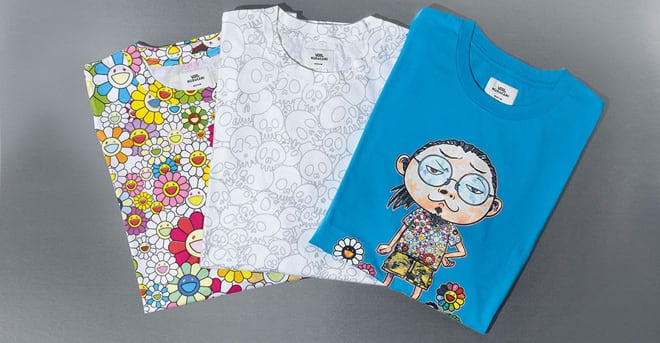
That combination made him a major figure in late-20th- and early-21st-century art. Murakami’s work is not only recognisable; it is highly portable. A smiling flower can appear in a museum painting, on a handbag, on a sneaker, or in an animation, and still read as part of the same authorship.
What does superflat mean?
Superflat is Murakami’s best-known concept. It describes the shallow, compressed look of his pictures, where space is deliberately flattened and outlines stay sharp. It also refers to a broader reading of Japanese visual culture, from traditional woodblock prints to postwar manga and consumer graphics, all of which tend to privilege surface, pattern, and strong contour over illusionistic depth.
Murakami uses the term to link style and society. In his account, postwar Japan produced a culture in which distinctions between elite and popular, high and low, serious and playful, became unstable. Superflat gives that condition a visual form: bright, polished, easily reproducible, and aware of its own relation to mass media and consumer goods.
How does he work in practice?
Murakami often runs work through a studio system rather than producing everything by hand himself. Assistants execute parts of paintings, editions, sculptures, and commercial projects under his direction, much like a workshop or design studio. That approach matters because it mirrors the way his art thinks about production: authorship is present, but it does not depend on solitary craft alone.
He also treats collaboration as a core method. Fashion brands, sneaker companies, record labels, and luxury houses have used his imagery because it travels well across materials and formats. In practice, that means a Murakami project may begin as a drawing or digital composition and end as silk screen printing, vinyl toys, embroidered clothing, or an animated sequence.
Why does Murakami matter?
Murakami became important because he showed how contemporary art could absorb the visual language of advertising, anime, and branded goods without simply becoming those things. His work helped define a global market for art that is immediately legible, highly reproducible, and tied to design culture. For many viewers, he made the art object feel closer to packaging, toys, and fashion graphics, while still keeping it inside the museum and gallery system.
He also forced a sharper conversation about value. A Murakami painting can sit next to a mass-produced accessory, and both can carry the same iconography. That creates a useful tension for visual culture: it asks what changes when an image moves from canvas to commodity, and whether that shift weakens the work or expands its reach.
Where did his style come from?
Murakami’s visual language draws on several sources at once. He has cited Japanese painting traditions, postwar pop imagery, subcultural illustration, and the clean lines of commercial graphics. The result is not a single style so much as a controlled collision between sources that are usually separated by art history.
His rise also belongs to the wider context of Japan’s postwar cultural economy, where consumer culture, media saturation, and exportable design became globally influential. Murakami understood that environment not as a background but as material. His art makes that material visible by turning it into surfaces, characters, and systems of repetition.
Frequently Asked Questions
Is Takashi Murakami a fine artist or a commercial designer?
He is primarily a contemporary artist, but his practice deliberately crosses into commercial design, fashion, and product development. That crossing is not incidental; it is part of the work’s meaning. Murakami uses the same imagery across both contexts to challenge the hierarchy between them.
Why are flowers and smiling faces so common in his work?
Those motifs function like signatures, but they also act as testing grounds for repetition, scale, and emotional tone. A cheerful flower can read as innocent, synthetic, or unsettling depending on context. Murakami uses that ambiguity to keep the image from settling into a single meaning.
What makes his work different from ordinary pop art?
Murakami shares pop art’s interest in mass culture, but he pushes further into the systems that produce and distribute images. His studio methods, brand collaborations, and controlled merchandise line make production itself part of the artwork. The result is less a commentary on consumer culture from the outside than an artwork that operates inside it.