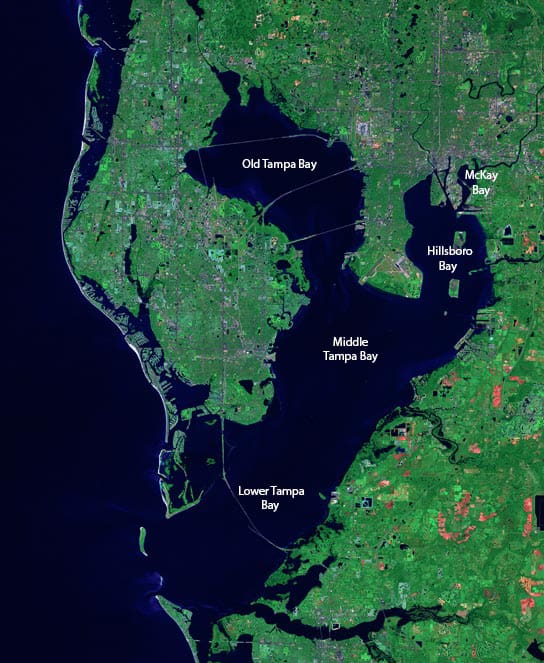
Tampa Bay is a large natural harbor and estuary on Florida’s west-central Gulf Coast. It is not a city or municipality; it is a body of water made up of several connected parts, including Hillsborough Bay, Old Tampa Bay, Middle Tampa Bay, and Lower Tampa Bay. The name often gets used loosely for the surrounding metropolitan area, especially because major sports teams and civic institutions use it as a regional label.
- A coastal estuary on the Gulf of Mexico, shaped by tides, river runoff, and shallow sheltered waters.
- It includes several named sub-bays rather than being one single basin.
- The city of Tampa sits on its shore, but the bay itself is not a town.
- The term “Tampa Bay” is commonly used for the wider urban region around the harbor.
- Its geography has made it important for shipping, settlement, recreation, and regional identity.
What makes Tampa Bay distinctive?
Tampa Bay is an estuary, which means salt water from the Gulf mixes with fresh water flowing in from surrounding rivers and wetlands. That mix creates shallow, productive waters rather than the deep, enclosed feel of a true bay or inland lake. Its broad surface, protected inlets, and marshy edges have long shaped how people move, build, and work around it.
The bay’s form matters as much as its name. Hillsborough Bay, Old Tampa Bay, Middle Tampa Bay, and Lower Tampa Bay create a network of sheltered water that supports ports, marinas, bridges, and waterfront development. At the same time, the shallows and tidal flats limit where large vessels can go, so dredging, channel marking, and harbor engineering have always played a role in its use.
Where did the name come from?
The word “Tampa” predates the modern city and is usually traced to Indigenous origin, though the exact etymology remains debated. Spanish explorers and mapmakers later applied the name to the region, and it stayed attached to the waterway and the settlement that grew beside it. Over time, the harbor became the geographic anchor for the broader area.
The confusion between the bay and the city is common because the urban center took the same root name. In practice, “Tampa Bay” now functions in two ways: as a precise geographic term for the estuary, and as a regional shorthand for the cluster of communities around it. That second usage appears in transportation planning, tourism, sports branding, and local news.
Why does Tampa Bay matter to architecture and urban form?
As a sheltered harbor, Tampa Bay helped determine where docks, warehouses, bridges, rail links, and later highways could go. Cities on its edge grew around access to water rather than away from it, and the coastline became a place where infrastructure and landscape had to meet. Building here has always meant dealing with soft ground, high water tables, storm surge, and a changing shoreline.
That makes the bay more than a scenic backdrop. It is a working edge that has influenced shipbuilding, port design, resort development, and the layout of waterfront public space. In architectural projects around the bay, materials must resist salt air and humidity; foundations must cope with saturated soils; and large spans often answer the need to cross water without blocking navigation.
How does it look and function in practice?
On the ground, Tampa Bay is experienced less as a single open expanse than as a sequence of views, causeways, marinas, mangroves, beaches, and industrial waterfronts. The water changes color and texture with weather and tide: calm and reflective in sheltered areas, broken by wind chop and boat wakes in wider sections. Shorelines range from natural marshes to seawalls, docks, and dense urban edges.
Its practical life is mixed and layered. Cargo vessels, fishing fleets, pleasure craft, and commuter traffic use the same water system. Nearby, architects and builders respond to the bay with elevated structures, broad terraces, corrosion-resistant finishes, and openings that frame the water while protecting interiors from heat and storms. The result is a coast where geography is never separate from construction.
Frequently Asked Questions
Is Tampa Bay a city?
No. Tampa Bay is the name of the water body, not a municipality. The city of Tampa sits on the bay’s shore, and the surrounding metro area often uses the bay’s name for convenience and regional identity.
Why do sports teams use the name Tampa Bay?
Teams use “Tampa Bay” to represent the wider market rather than only the city of Tampa. The label signals that fans come from multiple nearby counties and communities around the estuary. That branding has made the bay’s name far more visible than its strict geographic meaning.
What kind of water body is Tampa Bay?
It is an estuary, where fresh water and salt water mix. This gives it a different ecology and shoreline behavior from a lake or a simple inlet. Its shallow, protected waters helped make the area suitable for settlement, shipping, and waterfront construction.
At a glance
- Address
- United States
- Coordinates
- 27.7625, -82.545833
Articles mentioning Tampa Bay