
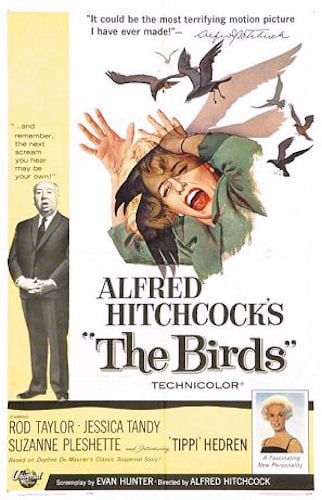
The Birds is a 1963 suspense film directed by Alfred Hitchcock about a coastal town suddenly besieged by violent bird attacks. Loosely adapted from Daphne du Maurier’s 1952 short story of the same name, it turns an ordinary setting into a study of panic, control, and the collapse of everyday order.
- Directed by Alfred Hitchcock and released in 1963.
- Based loosely on Daphne du Maurier’s short story, but with a different setting and new characters.
- Famous for its sound design and special effects, which make the birds feel unnervingly present without explaining them.
- Introduced Tippi Hedren in her first film role.
- Set in and around Bodega Bay, California, where domestic spaces and open landscapes become sites of threat.
What is The Birds about?
The film begins as a flirtatious social drama and slowly becomes a disaster story. Melanie Daniels, played by Tippi Hedren, follows lawyer Mitch Brenner to Bodega Bay, where small incidents with birds escalate into coordinated attacks on people, buildings, and vehicles. Hitchcock never gives a scientific explanation, which is part of the film’s power: the threat remains visible, physical, and irrational at once.
That absence of explanation shifts attention to procedure and response. Doors are barred, windows boarded, and the ordinary rhythm of shopping, school, and family life is replaced by makeshift defence. The film works by showing how quickly a polished seaside community can become a place of siege.
How was it made?
The Birds is notable for the way it mixes live action, matte work, mechanical birds, trained birds, and optical effects. The attack scenes depend on editing and timing as much as on any single shot. Hitchcock used the tools of studio filmmaking to make an impossible event feel immediate: cuts, rear projection, and carefully staged motion carry the illusion.
The sound is just as important. Composer Bernard Herrmann contributed a score built from electronic and percussive textures rather than conventional melody, and the film famously uses bird sounds in unsettling ways. The result is not a naturalistic soundtrack but a constructed one, in which screeches, wings, silence, and sudden noise create tension before any bird appears on screen.
Why does it matter?
The film remains influential because it treats fear as something made through image, sound, and anticipation. Instead of relying on gore, it lets repetition and escalation do the work. Birds gathering on wires or watching from roofs become part of the film’s design, turning the landscape itself into a threat.
It also matters in the history of screen performance and production. Tippi Hedren’s debut became one of Hitchcock’s best-known casting choices, and the film’s staging of women, domestic labour, and social performance has kept critics returning to it. Designers and filmmakers still study it for its control of pacing, its use of negative space, and its ability to make ordinary materials—glass, wood, wire, feathers, sound—feel hostile.
What does it look like on screen?
Visually, the film is restrained and precise. The palette often feels cool and coastal: pale sky, grey water, weathered timber, and the green and beige tones of suburban interiors and clothing. Hitchcock uses wide exteriors to place small human figures against open space, then tight interiors to trap them when the attacks begin.
Birds are shown in ways that make them seem both actual and artificial. Some shots depend on clusters of birds perched in unnervingly symmetrical rows; others emphasise motion blur, shadows, and impact rather than clear avian anatomy. That mix gives the film its strange texture: the birds are never reduced to monsters, but they are never allowed to stay ordinary animals either.
Frequently Asked Questions
Is The Birds based on a true story?
No. The film is based loosely on Daphne du Maurier’s short story, which also imagines an unexplained bird assault, but neither version comes from a documented real event. Hitchcock and his collaborators used the premise as a way to build suspense from something familiar and visually simple. The lack of explanation is central to the story’s effect.
Why is the film still discussed so often?
It is still discussed because it combines genre filmmaking with formal control. The attacks are memorable, but so is the way the film builds pressure through composition, sound, and pauses. It also became a reference point for later horror and thriller films that use environment and atmosphere rather than monsters with clear motives.
What made the special effects important?
The effects matter because they had to make birds look dangerous without turning them into cartoons. The production combined different techniques to produce believable motion, then edited them into scenes that escalate step by step. That craftsmanship is part of why the film still feels tense even when the effects show their age.