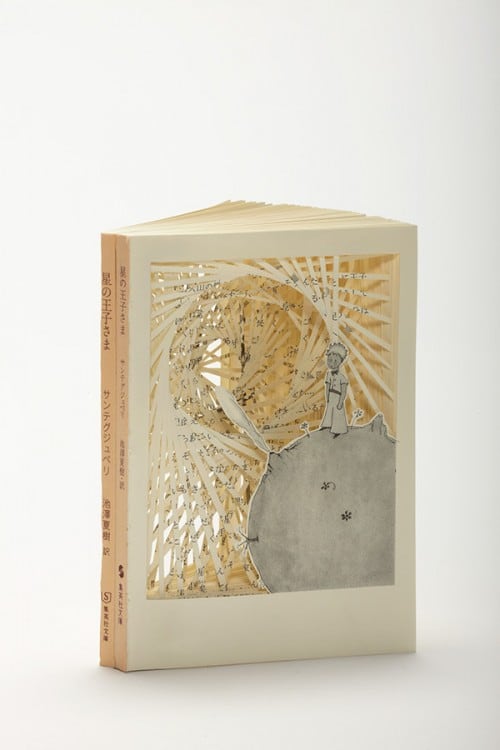
Tomoko Takeda is a Japanese book artist and paper engineer known for transforming printed pages into sculptural, interactive works. Her practice sits between book arts, illustration, and fine craft: she cuts, folds, layers, and assembles paper so that a book becomes an object to handle as much as to read.
| Field | Book art, paper engineering, artist’s books |
|---|---|
| Known for | Paper constructions that reinterpret texts as three-dimensional forms |
| Materials | Printed paper, card, adhesives, hand-cut elements, folded structures |
| Primary medium | Artist’s books and paper sculpture |
| Origin | Japan |
| Why it matters | Shows how narrative, image, and structure can merge in a book object |
What Tomoko Takeda makes
Takeda’s work treats the page as a physical site rather than a flat support. Instead of relying only on illustration or typography, she uses paper itself as the material of expression: a page may split open, protrude, layer into relief, or unfold into a scene. The result is often closer to a hybrid of sculpture and publication than a conventional book.
This approach matters because it pushes the book beyond readability alone. In Takeda’s hands, sequence, surprise, and touch become part of the meaning. A story is not just told through words; it is built through the act of opening, turning, and discovering shapes hidden inside the structure.
How does paper engineering shape her work?
Paper engineering gives Takeda a set of formal tools: scoring, folding, cutting, lamination, tabs, and nested layers. These techniques can create pop-up forms, suspended elements, or intricate internal volumes that shift as the book is handled. Precision is essential, because a small error in cutting or folding can change how the whole structure moves.
That engineering logic is also part of the reading experience. A viewer encounters timing, reveal, and choreography. Pages do not simply turn; they perform, and the book becomes an event in miniature. This is one reason her work is often discussed alongside artist’s books and contemporary book art rather than standard illustration.
Why book art matters in her practice
Book art uses the codex, or book form, as an artistic medium in its own right. In that field, the physical object carries as much meaning as the text or image inside it. Takeda’s work belongs to this tradition because it uses the book’s structure to carry emotion, narrative, and visual rhythm.
Her practice also shows how contemporary makers can work against the idea that books are only containers for content. By stressing handwork and material specificity, she keeps the book tied to craft and objecthood. That makes her work especially relevant at a time when much reading happens on screens and the tactile life of paper can feel newly distinct.
What it looks like in practice
A Takeda work may open into a scene with layered paper forms that rise from the page, or it may use repeated cut shapes to create depth and pattern across a sequence of spreads. Colors are often restrained enough to let structure carry the composition. In many cases, the visible labor of cutting and assembling is part of the appeal, since the eye can follow the construction as well as the image.
Her books reward close viewing. A first glance may read as a compact object, but opening it reveals spatial complexity, mechanical ingenuity, and careful pacing. That combination of intimacy and engineering is central to her reputation as a book artist.
Frequently Asked Questions
Is Tomoko Takeda mainly a printer, illustrator, or sculptor?
She is best understood as a book artist and paper engineer. Her work can include illustration-like imagery, but the core of her practice is structural: she designs paper forms that change through handling. That places her closer to sculpture and artist’s books than to traditional illustration.
What materials does she use?
Her work relies primarily on paper and card, sometimes combined with glue and other simple binding materials. The key material question is not decoration but structure, since the way the paper is cut, folded, and joined determines the final form. The technique is handmade and exacting rather than industrial.
Why is her work associated with famous novels?
Takeda’s book art can be used to reinterpret literary texts by translating plot, mood, or character into paper form. A novel becomes a visual and tactile object, with scenes and ideas expressed through spatial design rather than illustration alone. That makes her work useful for projects that want literature to be experienced physically as well as read.
Articles mentioning Tomoko Takeda