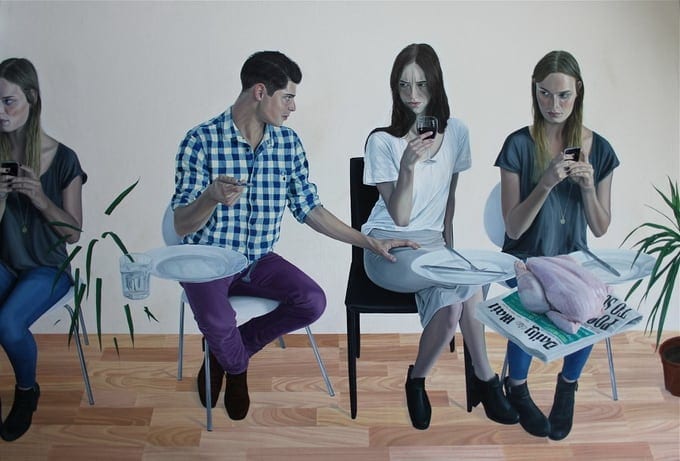
Tristan Pigott is a contemporary artist known for depicting narcissistic, self-absorbed figures in ways that probe vanity, performance, and the uneasy drama of the self. His work uses character-led imagery to turn psychological traits into visual form, making ego itself feel like a subject that can be staged, exaggerated, and scrutinised.
- Works across character-based art that centres personality, posture, and self-display.
- Often depicts narcissism as both comic and unsettling rather than simply villainous.
- Uses visible expression, gesture, and compositional emphasis to show how ego occupies space.
- His practice belongs to a wider strand of figurative art interested in psychology and social behaviour.
What kind of artist is Tristan Pigott?
Pigott is best understood as a figurative and character-driven artist. Rather than treating the human figure as neutral form, he uses bodies, faces, and props to suggest a specific state of mind. The recurring effect is narrative: each image appears to show a person caught in an act of self-presentation.
That focus places him close to traditions of satirical portraiture and psychological illustration, where an image reveals character as much as appearance. His subjects are not just people; they are embodiments of vanity, craving, and social performance.
How does he depict narcissism?
Pigott’s treatment of narcissism is visual rather than diagnostic. He shows the habits that signal self-absorption: posed gestures, absorbed expressions, and a sense that the figure is performing for an unseen audience. The work makes ego visible through posture and composition, not through text or explanation.
That approach matters because narcissism can easily become abstract when discussed as a personality trait. Pigott gives it shape, turning it into something that can be read in the body and the scene around it. The result is often humorous, but the humour carries tension; the figures can seem brittle, defensive, or trapped inside their own importance.
What does his work look like in practice?
Although Pigott’s exact materials and processes vary by work, the practical emphasis is on image-making that foregrounds character. The figures are usually arranged so that their self-regard becomes the centre of attention, whether through exaggerated expression, theatrical stance, or a deliberate imbalance between subject and surroundings. The composition does as much psychological work as the facial features.
In practice, this means the artist relies on visual cues that most viewers recognise immediately: a lifted chin, a fixed gaze, an overconfident pose, or a scene that seems to revolve around one person’s need for attention. Those details make the work legible fast, but they also reward closer looking because they reveal the social mechanics behind the character being shown.
Why does Tristan Pigott matter?
Pigott matters because he treats ego as a contemporary subject worth painting, drawing, or otherwise visualising in its own right. That makes his work useful in a culture shaped by self-branding, image management, and constant performance. He does not simply condemn vanity; he shows how seductive and comic it can be.
His work also sits within a broader interest in art as a tool for reading behaviour. By focusing on narcissistic characters, he connects personality to form in a way that is immediate and accessible. The viewer does not need specialist knowledge to understand the premise, but the work still leaves room for discomfort and ambiguity.
Frequently Asked Questions
Is Tristan Pigott mainly a painter?
He is primarily discussed as an artist working with figurative character studies, though individual works may use different media. The important point is not the label of one format, but the way his practice centres people as carriers of psychological meaning. His images depend on style, expression, and staging to communicate character.
What subjects appear most often in his work?
The central subject is the narcissistic or ego-driven figure. These are characters defined by self-importance, performance, or a need to be seen. Rather than offering general scenes, Pigott tends to focus on one person’s psychological presence and the social signals they emit.
Why is narcissism a useful theme in art?
Narcissism gives artists a way to examine vanity, insecurity, and social performance in a single image. It is easy to recognise and hard to pin down, which makes it effective for visual art. In Pigott’s work, that theme becomes a way to study how people construct themselves for others.
Articles mentioning Tristan Pigott