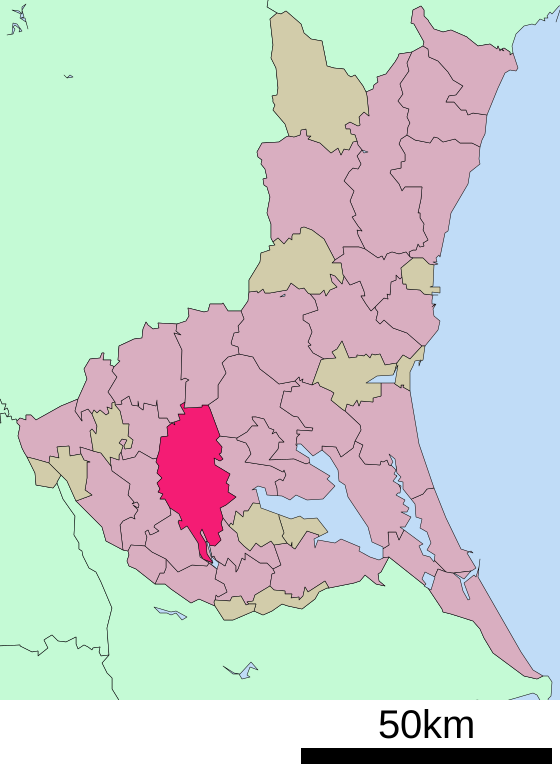
Tsukuba, Ibaraki is a city in Ibaraki Prefecture, Japan, best known as the site of Tsukuba Science City, a planned research district developed in the 1960s. It sits at the edge of the Kantō plain near Mount Tsukuba, and it combines university campuses, government laboratories, housing estates, and older agricultural land. That mix gives the city a character shaped as much by planning and infrastructure as by local landscape and shrine culture.
| Fact | Detail |
|---|---|
| Country | Japan |
| Prefecture | Ibaraki |
| City status | Municipal city |
| Known for | Tsukuba Science City, Mount Tsukuba |
| Planning period | Major development from the 1960s onward |
| Landscape | Lowland city with a nearby volcanic mountain and shrine sites |
Why Tsukuba was planned as a science city
Tsukuba’s modern identity began with a national plan to relieve pressure on Tokyo and concentrate research institutions in one place. From the 1960s, Japan moved universities, public laboratories, and technical agencies into the new science city. The idea was not just administrative efficiency. It was also urban design: wide roads, separated zones, open land, and campuses arranged at a scale that differed sharply from older Japanese city centers.
That planning still defines the city’s look and use. Tsukuba feels spacious, with large institutions, apartment blocks, business parks, and transport corridors spread across a broad area. For artists, designers, and writers, it offers a city built less from merchant streets and more from postwar policy, research infrastructure, and controlled growth.
What does Tsukuba look like on the ground?
Tsukuba is not a single image but a set of contrasts. The Science City area contains clean-lined buildings, open plazas, and campus-like compounds, while the surrounding districts include housing, retail strips, and patches of farmland. The city’s scale matters: long distances, major roads, and modern station districts make movement feel planned rather than inherited.
Mount Tsukuba anchors the area visually and culturally. The mountain rises separately from the flat plain and has long been associated with pilgrimage, seasonal change, and shrine architecture. Its presence keeps the city from reading as purely modernist. Even where laboratories and transport systems dominate, the mountain and nearby religious sites remain part of how the place is experienced.
How does Tsukuba shape creative work?
Tsukuba matters to visual culture because it stages a particular Japanese urban condition: the deliberate city. It shows how planning, science, and public policy can produce a built environment with a clear ideological frame. That makes it useful for artists and photographers interested in infrastructure, standardized forms, suburban edges, and the aesthetics of research culture.
The city also appears in work connected to mobility, isolation, and the friction between designed space and lived space. Its laboratory buildings, housing estates, and wide roads can feel both futuristic and impersonal, which gives them strong visual and conceptual appeal. In an art context, Tsukuba often stands for the postwar effort to engineer knowledge as well as to house it.
What is Mount Tsukuba’s role in the city?
Mount Tsukuba gives the city a premodern reference point. The mountain has long been a destination for worship and recreation, and its shrine complexes, ropeway, and hiking routes bring together religious practice and leisure. The contrast between the mountain’s older sacred landscape and the planned research city below is central to Tsukuba’s identity.
That contrast matters in visual terms too. The mountain supplies a strong silhouette and a sense of place that the low-rise science city cannot provide on its own. In photographs and illustrations, it often functions as the natural counterweight to the city’s rationalized grid of institutions and roads.
Frequently Asked Questions
Is Tsukuba a historic city or a new city?
It is both, but in different senses. The city contains older settlements and the longstanding cultural presence of Mount Tsukuba, yet its modern identity comes from postwar planning. The science city was a deliberate 20th-century project rather than an organic urban core.
Why is Tsukuba important in Japanese design and architecture?
Tsukuba is a clear example of state-led urban design. Its laboratories, campuses, road layouts, and residential zones show how modern Japan organized knowledge and housing at a large scale. For architecture and design, it is valuable as a built record of planning ideology.
What makes Tsukuba different from Tokyo?
Tokyo grew by accretion over centuries and became dense, layered, and commercially intense. Tsukuba was shaped more recently around research, open land, and separated functions. It feels less like an accumulated metropolis and more like a designed environment for institutions.
At a glance
- Coordinates
- 36.0761, 140.1113
Articles mentioning Tsukuba, Ibaraki