
Valletta is Malta’s capital city, a fortified Baroque settlement built by the Order of St John after the Great Siege of 1565. Compact, steep, and heavily planned, it grew as a military and administrative centre and still carries the stone fabric, churches, palazzi, and harbour defences of that origin.
Stories from Valletta
2 stories
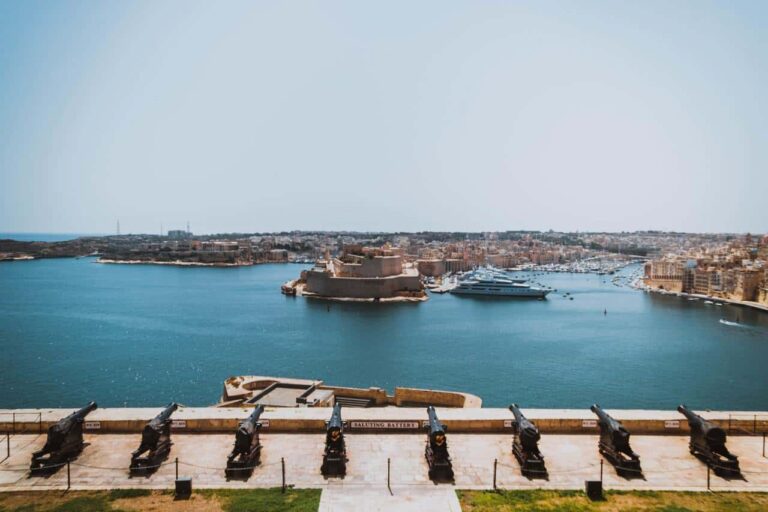
About Valletta
- Founded in the late 16th century on a peninsula between two natural harbours.
- Designed as a fortified capital for the Knights Hospitaller.
- Known for limestone streets, Baroque facades, and dense urban planning.
- Listed as a UNESCO World Heritage city for its historic integrity.
- Still functions as Malta’s political, cultural, and commercial core.
Read the full overviewWhy was Valletta built?, What does Valletta look like in practice?, Why does Valletta matter in Maltese culture?, How is Valletta used and experienced today?
Why was Valletta built?
Valletta was founded in 1566, one year after the Ottoman siege that nearly overwhelmed Malta. The Knights Hospitaller, who ruled the island, wanted a city that could defend the peninsula and project authority across the central Mediterranean. The site gave them commanding views over both Grand Harbour and Marsamxett Harbour, which made it ideal for fortifications, ship movement, and customs control.
The city was named after Jean Parisot de Valette, the Grand Master who led the defence of Malta. Its streets were laid out on a rigid grid, unusual for the period, with wide enough routes for movement of troops, artillery, and supplies. That planning still shapes the city today: Valletta feels compressed but legible, with straight streets dropping sharply toward the sea and bastions closing the edges.
What does Valletta look like in practice?
Valletta is built largely from Maltese limestone, a warm pale stone that weathers to honey and grey. The material gives the city a uniform tone, even when the architecture ranges from military walls to ornate churches and domestic balconies. Many buildings date from the 16th to 18th centuries, but the city also carries later layers of repair, wartime damage, and modern adaptation.
Its visual character comes from contrast: heavy fortifications outside, refined ornament within. Baroque churches, carved stone portals, timber balconies, enclosed courtyards, and narrow staircases sit beside bastions, gun emplacements, and parade spaces. The urban scale is intimate, but the built environment was designed to manage power, religion, trade, and defence at once.
Why does Valletta matter in Maltese culture?
Valletta matters because it condenses Maltese history into a walkable core. It has served as a seat of government, a ceremonial capital, and a working harbour city, so it holds more than one identity at once. The city remains central to Maltese public life through its institutions, festivals, churches, theatres, and street activity.
It also matters as a record of how stone, planning, and empire shaped urban form in the Mediterranean. The city shows how a ruling order could impose a designed capital onto a small island and how that capital could later become part of a national identity. Valletta’s preservation is not just architectural; it is cultural, because so much of Malta’s memory and civic life is still concentrated there.
How is Valletta used and experienced today?
Today Valletta functions as a working capital rather than a frozen monument. Government buildings, shops, cafés, museums, and offices operate inside the historic streets, while cruise visitors, commuters, and residents all move through the same constrained grid. The city’s steep topography and limited traffic access shape daily life, making walking the main way to move between districts.
For a visual culture reader, Valletta is striking because it rewards attention to surfaces and sequence. Light falls hard on limestone walls, façades are close enough to read from the pavement, and small changes in level create long views toward the harbours. The city’s strongest quality is not grandeur at a distance but density at human scale: a place where masonry, shadow, and movement remain tightly bound.
Frequently Asked Questions
Is Valletta a planned city?
Yes. Valletta was intentionally designed after the Great Siege as a fortified capital, not allowed to grow piecemeal from a village core. Its grid plan, defensive perimeter, and public buildings reflect that deliberate origin. That makes it unusual among Mediterranean capitals of the period.
What materials define Valletta’s architecture?
Maltese limestone defines the city’s appearance and construction. The stone was easy to quarry locally and suited both structural walls and carved ornament, though it weathers and requires regular upkeep. Timber balconies, ironwork, plaster, and painted doors add smaller-scale contrast to the stone mass.
Why is Valletta important beyond tourism?
Valletta is the administrative and symbolic centre of Malta, not only a visitor destination. It concentrates government, religious heritage, cultural institutions, and historical memory in one place. That combination gives it ongoing civic importance, even as tourism remains a major part of its economy.