Venezuela is a country on the northern coast of South America, known for its long Caribbean shoreline, Andean highlands, Orinoco plains, and Amazonian south. Its varied geography has shaped a dense mix of urban culture, extractive industry, and artistic production, with Caracas as the political and cultural center. The country is also marked by severe economic and political instability in recent decades, which has affected everyday life and the work of artists, photographers, and designers.
| Official name | Bolivarian Republic of Venezuela |
|---|---|
| Region | Northern South America |
| Capital | Caracas |
| Population | About 29 million |
| Area | About 916,445 square kilometres |
| Languages | Spanish, with many Indigenous languages also spoken |
| Notable landscapes | Andes, Llanos, Orinoco Delta, Amazon Basin, Caribbean coast |
Why Venezuela matters in visual culture
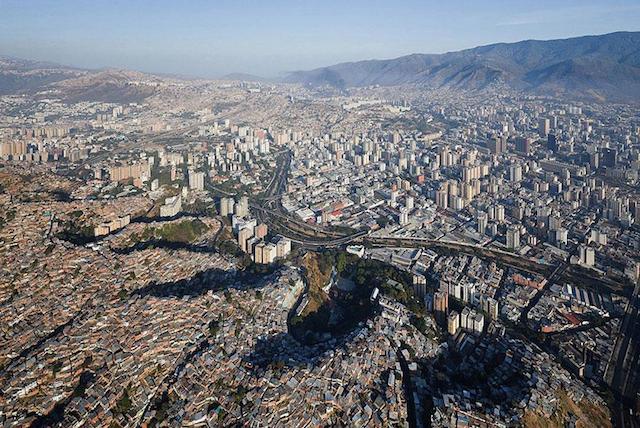
Venezuela matters because its modern culture has been shaped by sharp contrasts: oil wealth and collapse, dense city life and vast remote landscapes, state power and informal survival. Those contrasts appear directly in photography, architecture, film, and contemporary art. Images of Caracas often show improvised housing climbing steep hillsides, shuttered modernist buildings, or the visual residue of crisis, while other work draws on the country’s bright coastal light, tropical vegetation, and hard-edged urban geometry.
The country has also produced artists with an international profile, including sculptors and kinetic artists associated with abstraction and movement. Venezuela’s position in Latin America connects it to broader histories of modernism, exile, migration, and political upheaval, all of which help explain why it appears in discussions of art and design far beyond its borders.
What does Venezuela look like on the ground?
Venezuela is not a single landscape but a sequence of them. The Andes in the west bring cooler elevations and steep terrain; the center opens into the Llanos, broad grassy plains shaped by cattle ranching and seasonal flooding; the south contains rainforest and river systems tied to the Amazon Basin; and the east reaches the Orinoco River Delta, a wet, labyrinthine landscape of mangroves and channels. The Caribbean coast adds ports, beaches, and a humid coastal climate.
In cities, especially Caracas, the built environment often reveals tension between ambitious mid-century planning and later informal expansion. Modern towers, unfinished structures, and hillside settlements can stand side by side. That visual collision has become a recurring subject for photographers because it shows how architecture, infrastructure, and social inequality occupy the same frame.
How has the country shaped art and design?
Venezuelan art is closely linked to the country’s postwar modernist period, when artists worked with abstraction, color, motion, and integration of art into public space. Jesús Rafael Soto and Carlos Cruz-Diez are among the best-known figures from this context, each exploring optical vibration and kinetic effects through painted surfaces, rods, grids, and large-scale installations. Their work depends on movement, viewer position, and industrial fabrication as much as on drawing or painting.
That legacy still matters in contemporary visual culture. Designers and photographers working in or about Venezuela often respond to the country’s material conditions: concrete, rebar, corrugated metal, painted facades, dust, heat, and the signs of repair or abandonment. The result is a visual field where formal invention meets scarcity, and where the everyday built environment becomes a record of larger political and economic forces.
What has shaped Venezuela in recent decades?
Venezuela’s recent history is defined by political polarization, economic contraction, shortages, migration, and recurrent infrastructure failure. These conditions have altered how people move, work, make images, and maintain buildings. They also shape the circulation of Venezuelan artists, many of whom have left the country while continuing to work with its memory, symbols, and social realities.
For visual culture, this history is not background noise. It affects the kinds of materials available, the state of galleries and museums, the condition of public space, and the appearance of domestic and civic architecture. Images from Venezuela often carry this pressure visibly: patched surfaces, crowded interiors, emptied office towers, or improvised housing become part of the story rather than incidental detail.
Frequently Asked Questions
Is Venezuela part of the Caribbean or South America?
Venezuela is part of South America, but its northern edge sits on the Caribbean Sea. That geography gives it both continental and Caribbean identities in culture, trade, and climate. Coastal cities and island territories often feel very different from inland plains or southern rainforest regions.
Why do so many articles about Venezuela mention art and architecture?
Venezuela has produced major modern and contemporary artists, and its cities offer strong visual contrasts. Caracas, in particular, combines modernist ambition, informal settlement, and visible signs of economic strain. Those conditions make the country especially legible in photography, architecture criticism, and reportage.
What is Venezuela best known for in visual terms?
It is often associated with kinetic and optical art, especially the work of Jesús Rafael Soto and Carlos Cruz-Diez. Beyond fine art, it is also known for dramatic landscapes, dense urban fabric, and buildings that reflect both modernist planning and later decay. These are recurring subjects because they show how politics and geography appear in everyday form.
At a glance
- Coordinates
- 10.5, -66.96667
Articles mentioning Venezuela