
Victor Nunes is a Brazilian illustrator and visual artist known for turning ordinary household objects into small comic scenes by drawing around them. His work combines simple line drawing, collage-like placement, and sharp observational wit to make fruit, scissors, cups, pins, and other found items read as characters, landscapes, or props.
Victor Nunes on FreeYork

How his drawings work
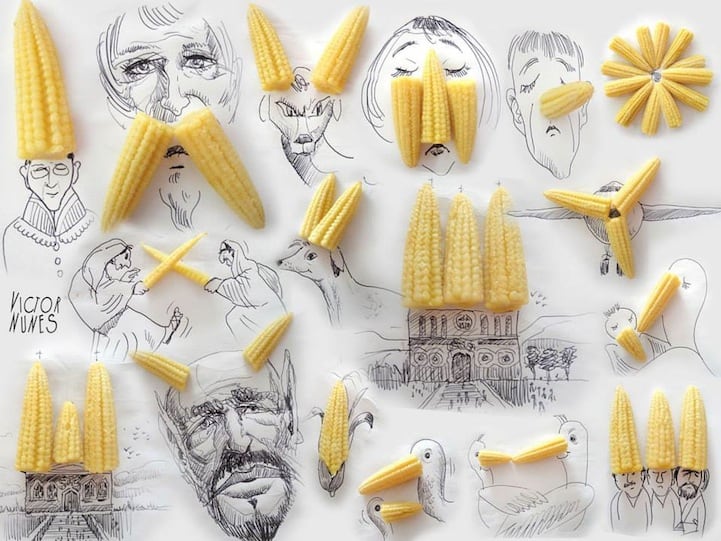
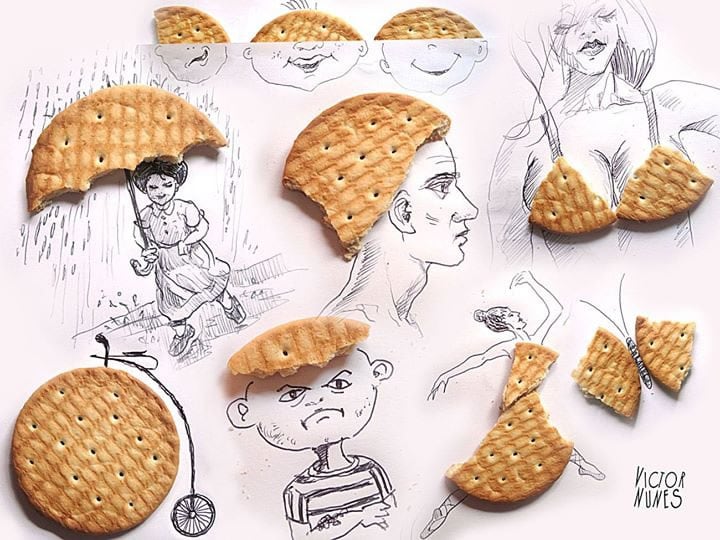
Nunes builds images from direct encounters with the things already sitting on a desk, table, or kitchen counter. A grape becomes a head, a pair of scissors becomes a body, a spoon becomes a slide, or a tangle of hair becomes smoke, waves, or a bird’s nest. The drawing does not hide the object; it depends on the object staying visible and being read differently at once.
That method gives the work its force. The viewer first recognizes the item as a practical thing, then sees it reassigned into a tiny scene. The joke is visual, but the craft matters just as much: the drawing has to meet the object precisely, so the transition between real material and drawn line feels immediate rather than forced.
Why does this kind of illustration matter?
Nunes’s work belongs to a broader tradition of object-based drawing, but it stands out for its clarity and economy. He does not rely on elaborate rendering or digital effects. A few marks and a well-chosen object can produce a complete image, which makes the process legible to a wide audience and especially effective on social media, where the appeal comes from instant recognition.
The work also shows how illustration can begin with selection rather than invention from scratch. Instead of starting with a blank page, Nunes starts with the world already full of shapes, textures, and accidental suggestions. That approach keeps the work grounded in material reality: paper, ink, shadows, surfaces, and the specific form of a spoon or hairpin all carry meaning.
What does his process look like in practice?
His process is straightforward but highly controlled. He places one or more objects on a flat surface, studies their contours, and then draws just enough to complete the illusion. A drawn arm might extend from a fork handle; a face might use a plum for a nose; a bicycle might emerge from two buttons and a bent wire. The success of each piece depends on choosing objects whose shapes suggest a second identity without losing their first.
Because the material remains physical, each image functions as both drawing and small arrangement. The work sits between illustration, photography, and assemblage. It also rewards close looking: the viewer has to notice where the real object ends and the drawn intervention begins, which is part of the pleasure of the piece.
Where did his style come from?
Nunes emerged within a contemporary field of online image-making that values wit, brevity, and process visibility. His work draws on older habits of doodling and visual improvisation, but it updates them through the everyday culture of the smartphone camera and the shareable image. The finished piece is often encountered as a photograph, even though the core of the work is a hand-built drawing on a table.
His style also connects to a long history of artists who use found forms as prompts. The difference is that Nunes keeps the gesture small and domestic. Rather than transforming objects into monumental sculpture, he lets a tomato or a comb do most of the work, then uses line to tip the object into narrative.
Questions
Is Victor Nunes mainly an illustrator or a photographer?
He is mainly an illustrator, because the key act in the work is drawing. Photography usually records the finished arrangement so it can be shared or published. The photograph preserves a temporary composition, but it is not the primary medium of invention.
What makes his work different from ordinary doodling?
Ordinary doodling usually starts with marks on a blank page. Nunes starts with an actual object and lets its existing shape determine the image. That shift makes the work more tactile and more dependent on material observation than on freehand invention alone.
Why do editors and art writers keep featuring his images?
His images are easy to understand quickly, but they still reward close looking. They also photograph well, which suits online publishing and image-led articles. Most importantly, they show a simple method that turns common domestic items into visual ideas without losing the character of the objects themselves.