
Voss is a municipality in Vestland county, Norway, centred on the village of Vossevangen and historically part of the traditional district of Voss. It covers a broad inland area of western Norway, where farming, transport routes, and later tourism shaped the built environment and local economy.
- Type: municipality
- Country: Norway
- County: Vestland, formerly Hordaland
- Administrative centre: Vossevangen
- Established: 1 January 1838
Where is Voss, and what is it like?
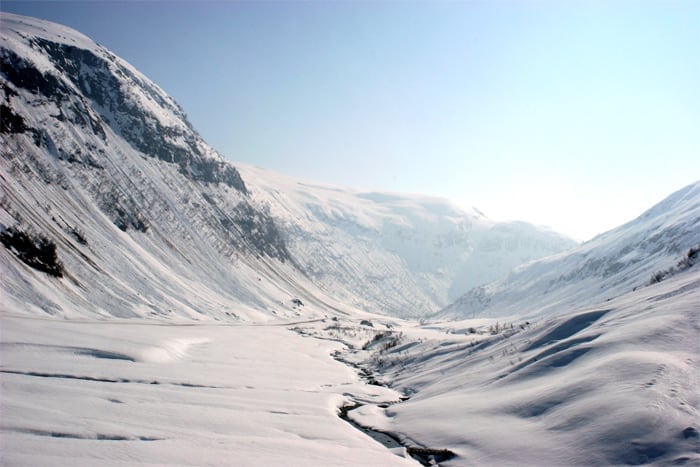
Voss sits in western Norway, inland from the coast, in a landscape of valleys, water, forest, and steep mountain edges. Its setting has made it a regional meeting point rather than a scattered collection of isolated farms. The municipality’s centre, Vossevangen, developed as the main service town for the surrounding district.
That geography matters to how the place looks and works. Settlement tends to cluster along flatter ground near the lake and transport corridors, while the higher land remains more sparsely used. The result is a landscape where a compact town core sits inside a much larger rural municipality.
How did the municipality take shape?
Voss became a municipality on 1 January 1838, when Norway introduced local self-government through the formannskapsdistrikt system. Like many older municipalities, its boundaries changed over time as administrative needs shifted and population patterns changed. Vossestrand was separated from Voss in 1868, and Evanger followed in 1885.
The modern municipality is partly the result of consolidation. In 1964, all of Vossestrand and the main part of Evanger were merged back into Voss. That kind of boundary change is common in Norwegian local administration, where larger units were often created to manage schools, roads, welfare, and other public services more efficiently.
Why does Voss matter?
Voss matters because it is both a historic district name and a functioning municipality with a strong local identity. In Norway, place names often carry several layers at once: the administrative unit, the wider cultural district, and the village that acts as a centre. Voss has all three, which gives it more weight than a simple line on a map.
Its importance also comes from continuity. The municipality has kept the same core role for nearly two centuries, even as borders shifted around it. That long administrative history has helped preserve a recognizable local framework for churches, farms, schools, roads, and municipal buildings.
What does Voss look like in practice?
In practice, Voss is a rural municipality with a town-like centre and a strong pattern of everyday movement between settlement and landscape. The built environment is modest rather than monumental: local housing, public buildings, farm structures, and infrastructure designed to work with weather, terrain, and distance. The visual character comes less from grand architecture than from how buildings sit in relation to the land.
For a reader interested in visual culture, Voss is useful as an example of how Norwegian municipalities are shaped by topography and administration at the same time. The place is defined by its landscape, but also by the repeated work of governing and reorganizing that landscape through local boundaries, services, and centres of population.
Frequently Asked Questions
Is Voss a town or a municipality?
Voss is a municipality, not a town. Its administrative centre is the village of Vossevangen, which serves as the local focus for services and public life. The name can therefore refer to both the wider municipality and the traditional district.
What changed in Voss in 1964?
In 1964, Voss expanded when Vossestrand and the main part of Evanger were merged back into the municipality. This restored much of the older territorial footprint that had been reduced by earlier separations. The change reflects a broader mid-20th-century pattern in Norway of consolidating smaller municipalities.
Why is the traditional district of Voss mentioned separately?
The traditional district is a cultural and historical area, while the municipality is an administrative unit. The two often overlap, but they are not identical. In Voss, that overlap helps explain why the name carries both local identity and government meaning.
At a glance
- Coordinates
- 60.7025, 6.423056