


Google has made a bold declaration: it claims, through mathematical proof, that AI image generators create original images instead of merely duplicating the artwork they study. This revelation strikes at the core of ongoing debates between artists and tech innovators. The paper, titled “On the interpolation effect of score smoothing in diffusion models,” was presented by Google research scientist Zhengdao Chen at the ICLR 2026 conference.
Understanding Google’s Argument
AI image generators use a process starting with random noise, transforming it into a coherent image. This process is guided by a mechanism Google calls the score function, likened to an “invisible hand” steering the noise toward recognizable forms. Ideal precision in this process would result in exact replicas of training data, thus equating to mere memorization.
However, due to a phenomenon known as score smoothing, the precision is naturally blurred, allowing for outputs that blend features from multiple training images. Google posits that it is in this blend, or interpolation, that new and plausible images arise.
Artists’ Perspectives
While Google’s explanation is mathematically clear and pushes back against the notion of AI as a mere collage tool, many creators argue the term “creativity” is misapplied. True artistry encompasses personal experiences, choices, and emotions—not simply mathematical interpolations.
Consider Van Gogh‘s famous works; his unique style was a result of personal struggles and experimental techniques, not the average of other paintings. Similarly, Monet’s repetitive studies of Rouen Cathedral were driven by an intense observation of changing light, rather than a mathematical midpoint.
To see contemporary creativity, dive into how artists Jessie and Katey transform spaces with their vibrant installations.

Where AI Falls Short
These diffusion models lack personal stakes in their creations. They are not motivated by an emotional challenge or interpretative quest. Additionally, the ethical controversy surrounding the use of artists’ work as training data without consent or compensation remains unresolved. While Google’s math may disprove the notion of simple image collage, it doesn’t fully account for the artistic nuances of creativity.
Though Google’s mathematical approach offers insight into AI image generation, the essence and recognition of creativity in any traditional artistic sense remain questions open to debate. As such, their claim, while technically solid, may yet need rephrasing to truly resonate with the creative community they aim to address.
Sources & Links
Source: creativebloq.com
Frequently asked questions
What is Google’s claim about AI image generators?
Google claims, through mathematical proof, that AI image generators create original images instead of merely duplicating the artwork they study.
How does score smoothing contribute to AI creativity?
Score smoothing blurs precision in the AI process, allowing for outputs that blend features from multiple training images, which Google argues leads to new and plausible images.
What is the artists’ main argument against AI creativity claims?
Many artists argue the term ‘creativity’ is misapplied to AI, as true artistry includes personal experiences, choices, and emotions—not simply mathematical interpolations.
More in
Technology
All Technology


More like this

Meet Lamp: The Robotic Desk Light that Mimics Life and Tracks Your Posture
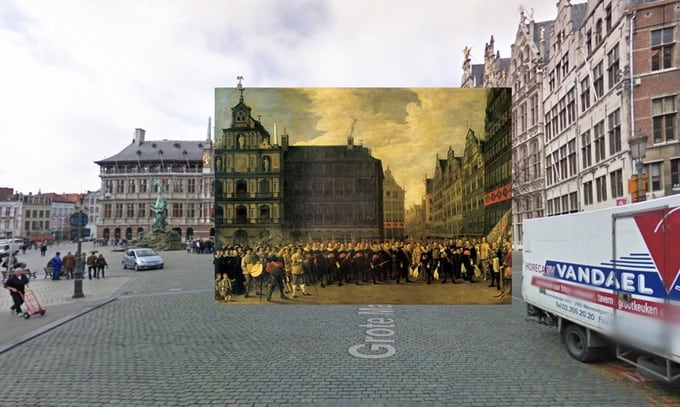
Classic Paintings of World Cities Meet Google Street View

Dell's Cutting-Edge Workstations Revolutionize Design with AI and Nvidia GPUs

Norway Weighs Ban on Smart Glasses Recording Public Without Consent Amid Privacy Concerns

AI Robot Transforms into a Mobile Vase to Highlight Human Attention Dynamics
